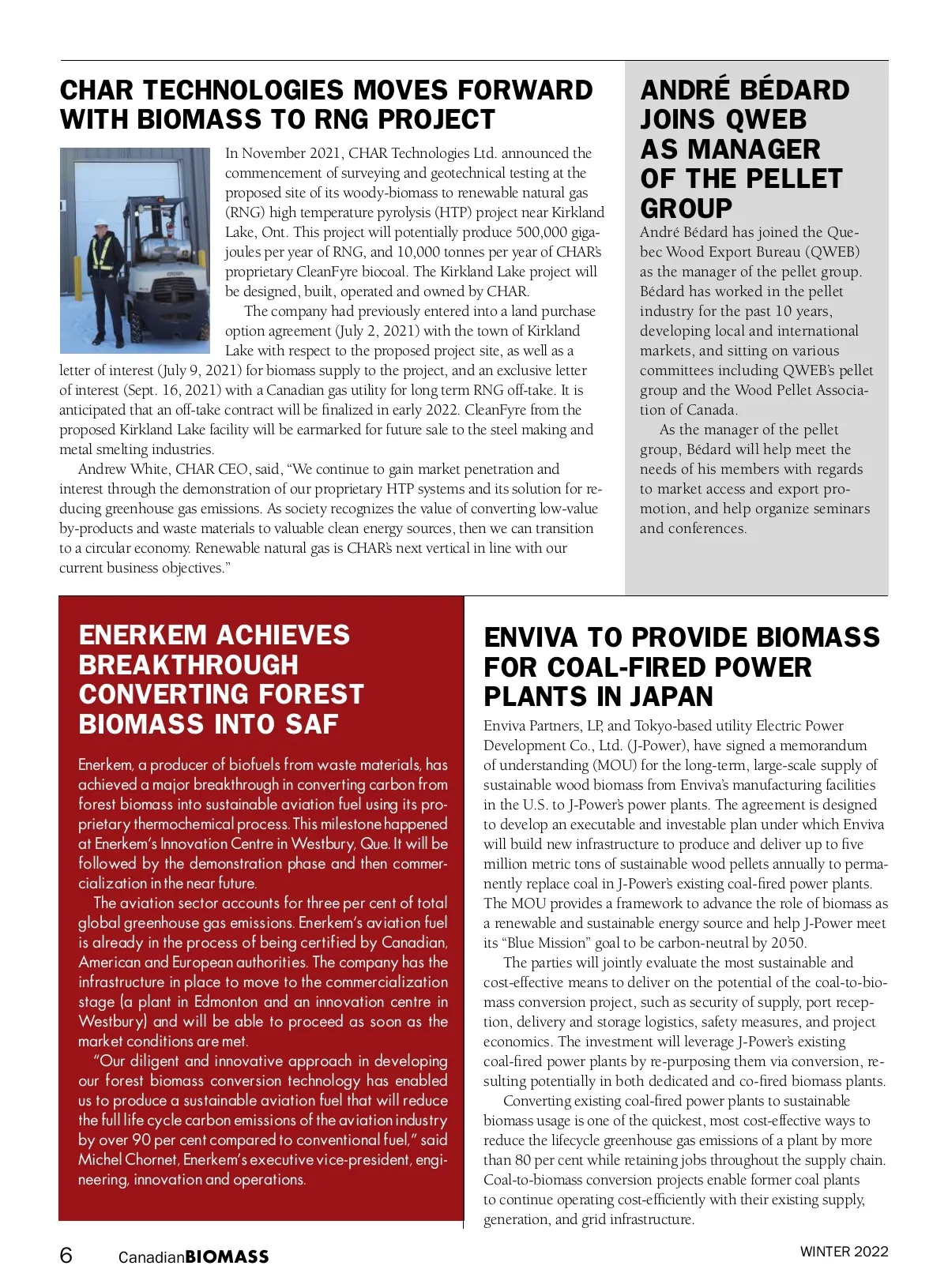
CHAR TECHNOLOGIES MOVES FORWARD WITH BIOMASS TO RNG PROJECT In November 2021, CHAR Technologies Ltd. announced the commencement of surveying and geotechnical testing at the proposed site of its woody-biomass to renewable natural gas (RNG) high temperature pyrolysis (HTP) project near Kirkland Lake, Ont. This project will potentially produce 500,000 giga-joules per year of RNG, and 10,000 tonnes per year of CHAR’s proprietary CleanFyre biocoal. The Kirkland Lake project will be designed, built, operated and owned by CHAR. The company had previously entered into a land purchase option agreement (July 2, 2021) with the town of Kirkland Lake with respect to the proposed project site, as well as a letter of interest (July 9, 2021) for biomass supply to the project, and an exclusive letter of interest (Sept. 16, 2021) with a Canadian gas utility for long term RNG off-take. It is anticipated that an off-take contract will be finalized in early 2022. CleanFyre from the proposed Kirkland Lake facility will be earmarked for future sale to the steel making and metal smelting industries. Andrew White, CHAR CEO, said, “We continue to gain market penetration and interest through the demonstration of our proprietary HTP systems and its solution for re-ducing greenhouse gas emissions. As society recognizes the value of converting low-value by-products and waste materials to valuable clean energy sources, then we can transition to a circular economy. Renewable natural gas is CHAR’s next vertical in line with our current business objectives.” ANDRÉ BÉDARD JOINS QWEB AS MANAGER OF THE PELLET GROUP André Bédard has joined the Que-bec Wood Export Bureau (QWEB) as the manager of the pellet group. Bédard has worked in the pellet industry for the past 10 years, developing local and international markets, and sitting on various committees including QWEB’s pellet group and the Wood Pellet Associa-tion of Canada. As the manager of the pellet group, Bédard will help meet the needs of his members with regards to market access and export pro-motion, and help organize seminars and conferences. ENERKEM ACHIEVES BREAKTHROUGH CONVERTING FOREST BIOMASS INTO SAF Enerkem, a producer of biofuels from waste materials, has achieved a major breakthrough in converting carbon from forest biomass into sustainable aviation fuel using its pro-prietary thermochemical process. This milestone happened at Enerkem’s Innovation Centre in Westbury, Que. It will be followed by the demonstration phase and then commer-cialization in the near future. The aviation sector accounts for three per cent of total global greenhouse gas emissions. Enerkem’s aviation fuel is already in the process of being certified by Canadian, American and European authorities. The company has the infrastructure in place to move to the commercialization stage (a plant in Edmonton and an innovation centre in Westbury) and will be able to proceed as soon as the market conditions are met. “Our diligent and innovative approach in developing our forest biomass conversion technology has enabled us to produce a sustainable aviation fuel that will reduce the full life cycle carbon emissions of the aviation industry by over 90 per cent compared to conventional fuel,” said Michel Chornet, Enerkem’s executive vice-president, engi-neering, innovation and operations. ENVIVA TO PROVIDE BIOMASS FOR COAL-FIRED POWER PLANTS IN JAPAN Enviva Partners, LP, and Tokyo-based utility Electric Power Development Co., Ltd. (J-Power), have signed a memorandum of understanding (MOU) for the long-term, large-scale supply of sustainable wood biomass from Enviva’s manufacturing facilities in the U.S. to J-Power’s power plants. The agreement is designed to develop an executable and investable plan under which Enviva will build new infrastructure to produce and deliver up to five million metric tons of sustainable wood pellets annually to perma-nently replace coal in J-Power’s existing coal-fired power plants. The MOU provides a framework to advance the role of biomass as a renewable and sustainable energy source and help J-Power meet its “Blue Mission” goal to be carbon-neutral by 2050. The parties will jointly evaluate the most sustainable and cost-effective means to deliver on the potential of the coal-to-bio-mass conversion project, such as security of supply, port recep-tion, delivery and storage logistics, safety measures, and project economics. The investment will leverage J-Power’s existing coal-fired power plants by re-purposing them via conversion, re-sulting potentially in both dedicated and co-fired biomass plants. Converting existing coal-fired power plants to sustainable biomass usage is one of the quickest, most cost-effective ways to reduce the lifecycle greenhouse gas emissions of a plant by more than 80 per cent while retaining jobs throughout the supply chain. Coal-to-biomass conversion projects enable former coal plants to continue operating cost-efficiently with their existing supply, generation, and grid infrastructure. WINTER 2022 6 Canadian BIOMASS
Canadian Biomass Winter 2022: Page 6