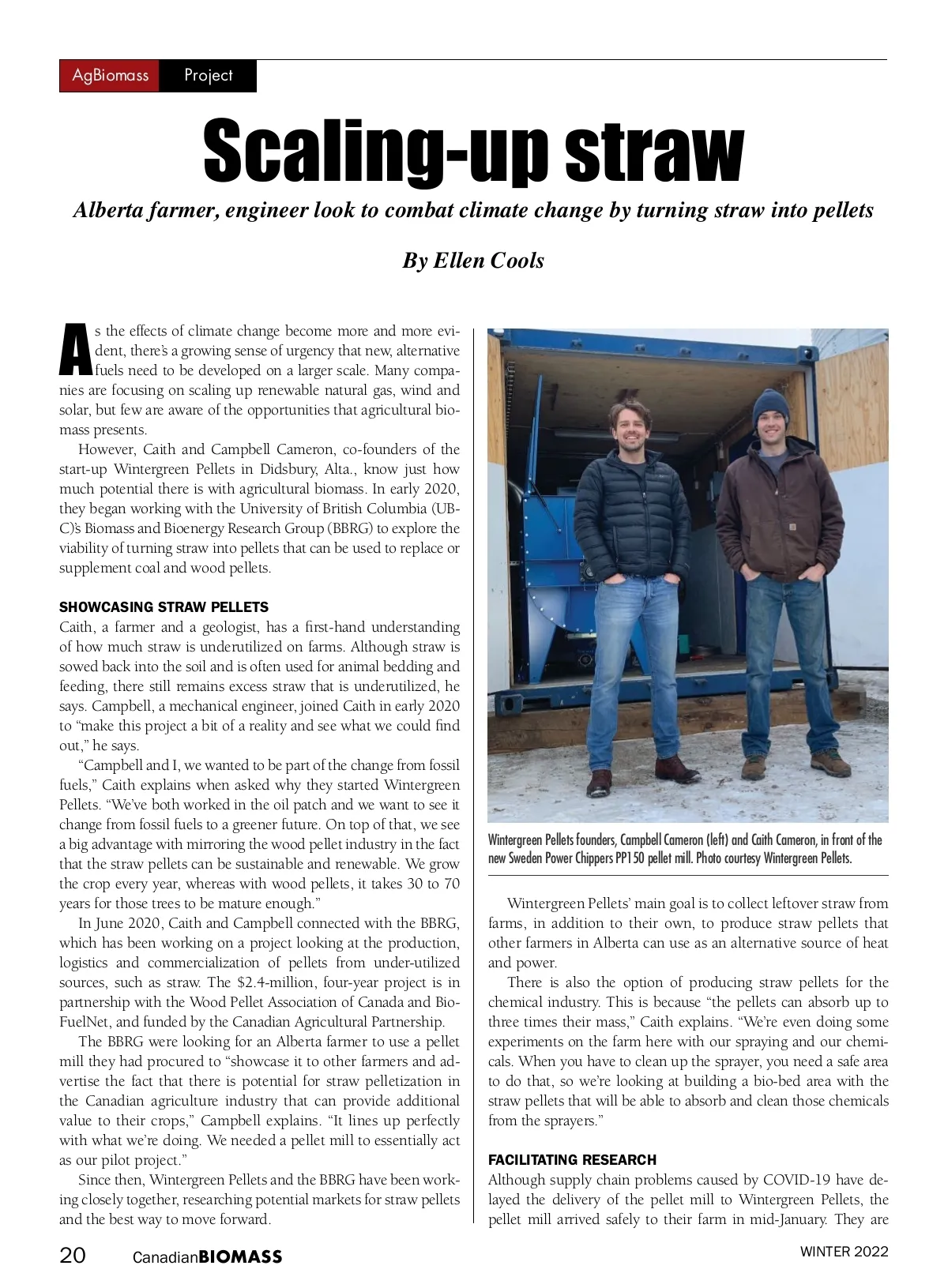
optimistic that they will be able to get it operational and begin the research and development phase of their operations soon. The pellet mill is a Sweden Power Chippers PP150, rated to do 175 kilograms of straw per hour, housed within a 20-foot ship-ping container. “It’s meant to be a plug-and-play type operation, fully enclosed within the sea can container,” Campbell explains. They plan to use the mill for a year, during which time they will determine if it’s viable business for them. “At that point, we’re going to decide whether we need to go out and buy our own or maybe purchase this one from UBC, and go from there,” Campbell says. Once the pellet mill is operational, they will begin testing batch-es of straw, around one to two tonnes at a time. These batches will be tested in different coal and biomass power plants in Alberta that are interested in potentially using straw pellets in the future, Campbell explains. Those power plants will provide feedback on how the straw pellets performed, which will help Wintergreen Pellets’ steer their future operations. They will also produce batches for the BBRG as requested, us-ing different types of straw, such as wheat, barley and pea straw. Those batches will be sent back to UBC so they can test the pellets for their own research purposes. “We’re there to facilitate and help them in that research,” Caith explains. “It would be a day-to-day, project-by-project basis, and whatever they want, we’ll pump it out.” “We’ve never made pellets before ourselves, so we’re excited to learn,” Caith adds. “I think there will be quite a learning curve. I don’t think it’s as easy as it looks, that you just put straw in and out comes a pellet. So, we’re definitely going to take this winter to try to tune it and hone in on the skills.” SCALING-UP POTENTIAL “This last year in the agriculture community, we saw a devas-tating drought throughout Saskatchewan and eastern Alberta that proved that there was no straw available,” Caith says. “So, we’re looking at being flexible in the fact that there could be years like that again.” One way they might overcome these challenges is by produc-ing wood pellets (in addition to straw pellets) using recycled wood from construction operations in Calgary, he says. “Another challenge is communicating to farmers that we un-derstand, as a farmer myself, how important straw is for the soil. We’re not trying to take everybody’s straw; we’re only looking at trying to utilize excess straw.” BUILDING UP BIOMASS Caith and Campbell agree that communicating and educating farmers about the potential benefits and uses of agricultural bio-mass will also be key for moving the industry forward. Although Canada has the potential to be a mass producer of both wood and biomass pellets, the majority of wood pellets pro-duced in Canada are exported to Asia and Europe, something Caith would like to see change in the future through more gov-ernment support. “I know they struggle up north finding heat sources. I think government subsidies would really open the door to finding alter-natives like straw pellets,” he says. “We need government supporting the pellet industry, whether it’s wood or straw,” Campbell adds. • 371, Boulevard des Chutes Bureau #102 Québec, QC, G1E 3G1 1-800-463-4862 551, Ferdinand Blvd. Unit 4 Dieppe, NB, E1A 7G1 1-800-931-9611 om w.c According to Campbell, the BBRG’s original goal with this project was to use the pellet mill as a showcase project to demonstrate to farmers that they can have their own pellet mills and produce pellets on their farms. “But, there’s a lot that goes into understanding the different additives, the different pressures and mechanical aspects that go into producing pellets that maybe would be too difficult for each individual farmer to do,” he says. “So, maybe the ideal logistical model would be to have one large pellet producing facility and you gather the straw from the other farmers in the area.” If the results of the research and development phase prove that producing straw pellets is a viable business model for Win-tergreen Pellets, then they will look at scaling up their operations in a larger facility in Didsbury, Caith says. This larger facility would be capable of producing 50,000 to 60,000 tonnes of straw pellets annually. “That would become a model that shows other farms there is a market for it, and either that spurs on other facilities to produce it themselves or we look at securing more straw feedstock from local farms throughout Alberta to be a main pellet producer for the straw market,” he says. However, both Caith and Campbell are aware of the poten-tial challenges that come with producing straw pellets, especially considering that growing straw is reliant on the weather, which is changing drastically thanks to climate change. dinalsa www.car our team to get IN Contact yours today, or to schedule a demo! STOCK The Next Generation in Shredding Perfect Balance of Power and Performance INVENTHOR 6 SM 720.2 Trommel Screen See it in action [email protected] Canadian BIOMASS 21 2022-02-02 10:45 AM CB_EquipmentCardinal-quarter_Winter22_CSA.indd 1
Canadian Biomass Winter 2022: Page 21