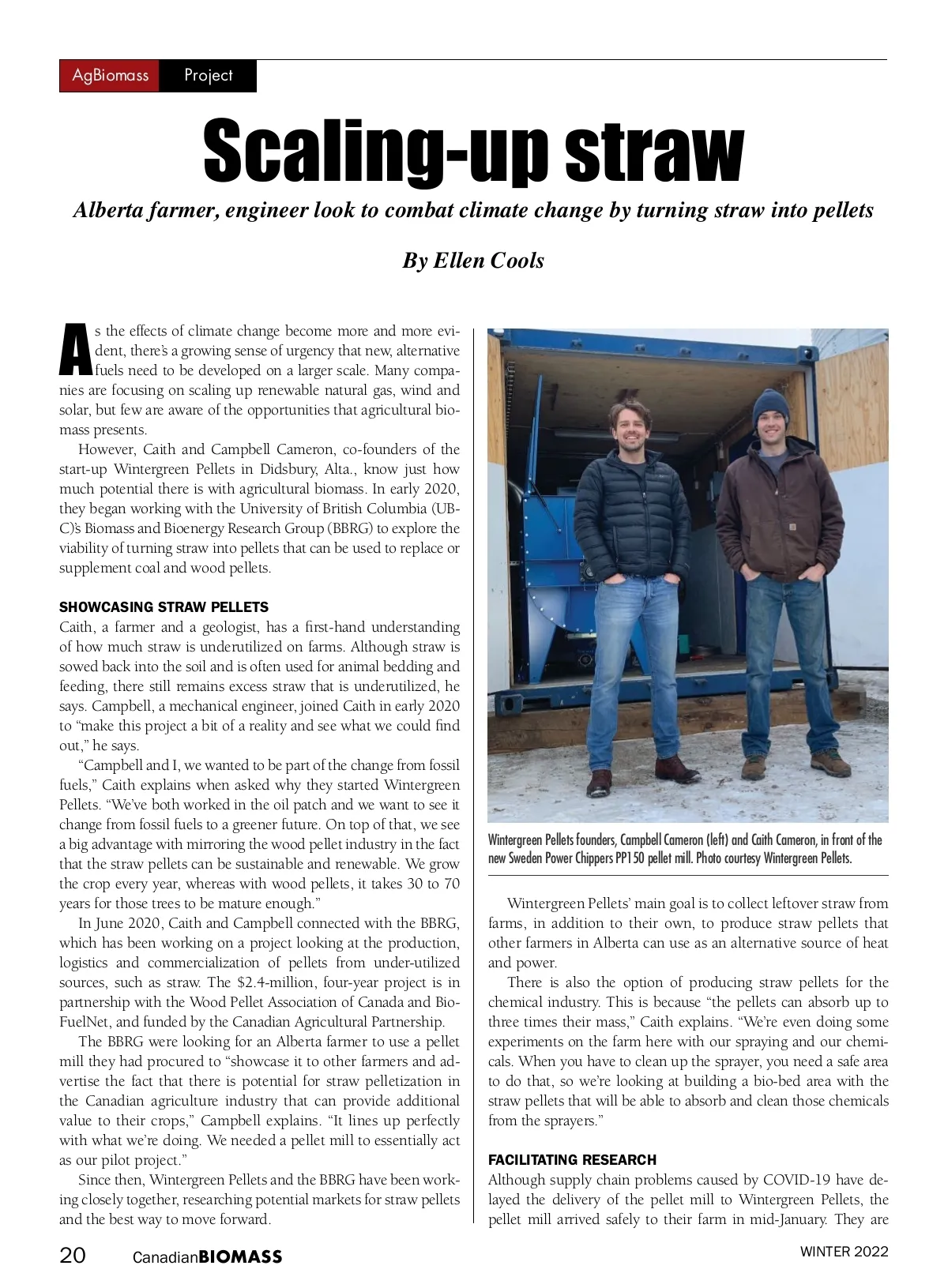
AgBiomass Project Alberta farmer, engineer look to combat climate change by turning straw into pellets By Ellen Cools Scaling-up straw A s the effects of climate change become more and more evi-dent, there’s a growing sense of urgency that new, alternative fuels need to be developed on a larger scale. Many compa-nies are focusing on scaling up renewable natural gas, wind and solar, but few are aware of the opportunities that agricultural bio-mass presents. However, Caith and Campbell Cameron, co-founders of the start-up Wintergreen Pellets in Didsbury, Alta., know just how much potential there is with agricultural biomass. In early 2020, they began working with the University of British Columbia (UB-C)’s Biomass and Bioenergy Research Group (BBRG) to explore the viability of turning straw into pellets that can be used to replace or supplement coal and wood pellets. SHOWCASING STRAW PELLETS Caith, a farmer and a geologist, has a first-hand understanding of how much straw is underutilized on farms. Although straw is sowed back into the soil and is often used for animal bedding and feeding, there still remains excess straw that is underutilized, he says. Campbell, a mechanical engineer, joined Caith in early 2020 to “make this project a bit of a reality and see what we could find out,” he says. “Campbell and I, we wanted to be part of the change from fossil fuels,” Caith explains when asked why they started Wintergreen Pellets. “We’ve both worked in the oil patch and we want to see it change from fossil fuels to a greener future. On top of that, we see a big advantage with mirroring the wood pellet industry in the fact that the straw pellets can be sustainable and renewable. We grow the crop every year, whereas with wood pellets, it takes 30 to 70 years for those trees to be mature enough.” In June 2020, Caith and Campbell connected with the BBRG, which has been working on a project looking at the production, logistics and commercialization of pellets from under-utilized sources, such as straw. The $2.4-million, four-year project is in partnership with the Wood Pellet Association of Canada and Bio-FuelNet, and funded by the Canadian Agricultural Partnership. The BBRG were looking for an Alberta farmer to use a pellet mill they had procured to “showcase it to other farmers and ad-vertise the fact that there is potential for straw pelletization in the Canadian agriculture industry that can provide additional value to their crops,” Campbell explains. “It lines up perfectly with what we’re doing. We needed a pellet mill to essentially act as our pilot project.” Since then, Wintergreen Pellets and the BBRG have been work-ing closely together, researching potential markets for straw pellets and the best way to move forward. Wintergreen Pellets founders, Campbell Cameron (left) and Caith Cameron, in front of the new Sweden Power Chippers PP150 pellet mill. Photo courtesy Wintergreen Pellets. Wintergreen Pellets’ main goal is to collect leftover straw from farms, in addition to their own, to produce straw pellets that other farmers in Alberta can use as an alternative source of heat and power. There is also the option of producing straw pellets for the chemical industry. This is because “the pellets can absorb up to three times their mass,” Caith explains. “We’re even doing some experiments on the farm here with our spraying and our chemi-cals. When you have to clean up the sprayer, you need a safe area to do that, so we’re looking at building a bio-bed area with the straw pellets that will be able to absorb and clean those chemicals from the sprayers.” FACILITATING RESEARCH Although supply chain problems caused by COVID-19 have de-layed the delivery of the pellet mill to Wintergreen Pellets, the pellet mill arrived safely to their farm in mid-January. They are WINTER 2022 20 Canadian BIOMASS
Canadian Biomass Winter 2022: Page 20