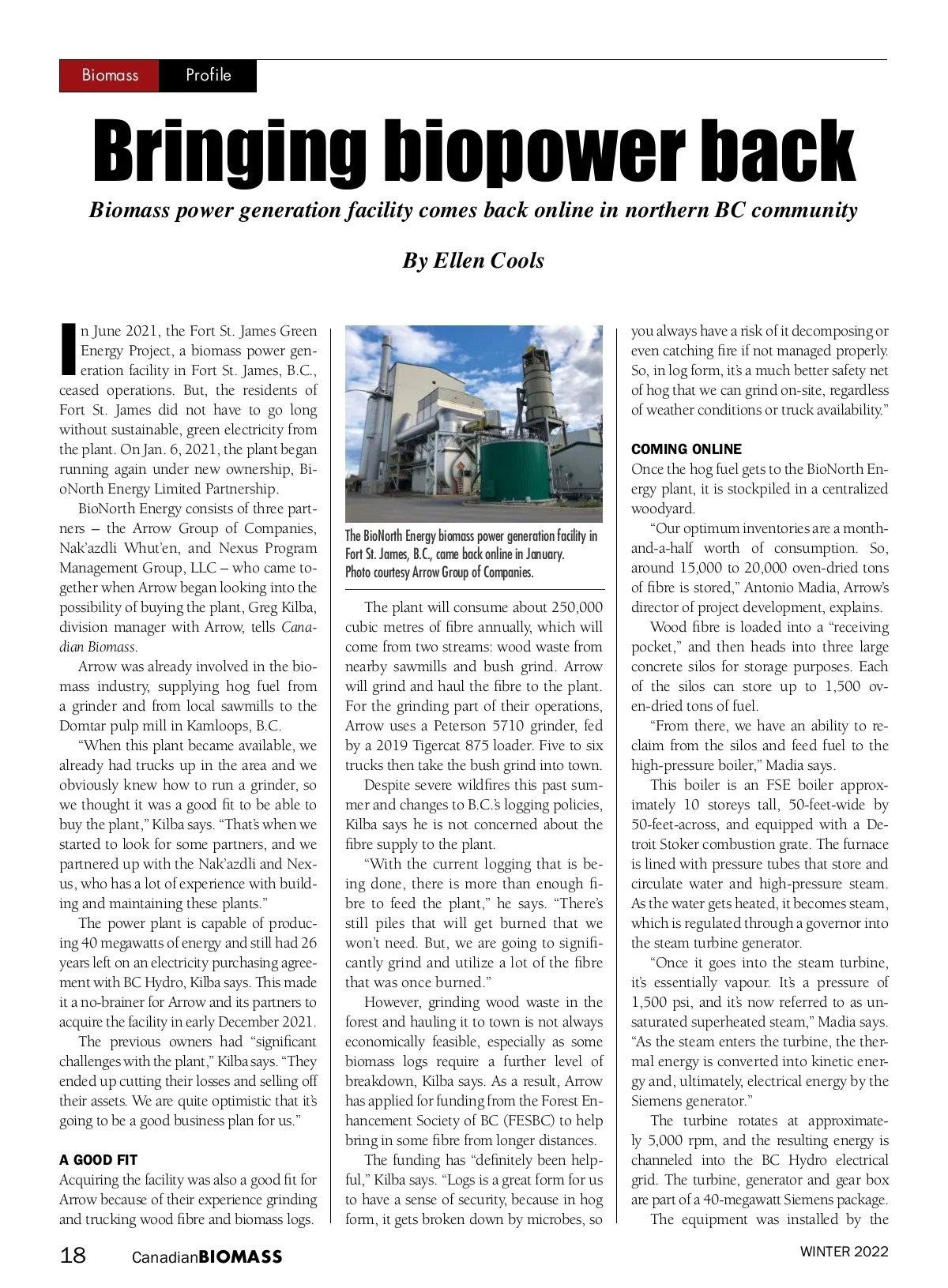
Biomass Profile Biomass power generation facility comes back online in northern BC community By Ellen Cools n June 2021, the Fort St. James Green Energy Project, a biomass power gen-eration facility in Fort St. James, B.C., ceased operations. But, the residents of Fort St. James did not have to go long without sustainable, green electricity from the plant. On Jan. 6, 2021, the plant began running again under new ownership, Bi-oNorth Energy Limited Partnership. BioNorth Energy consists of three part-ners – the Arrow Group of Companies, Nak’azdli Whut’en, and Nexus Program Management Group, LLC – who came to-gether when Arrow began looking into the possibility of buying the plant, Greg Kilba, division manager with Arrow, tells Cana-dian Biomass . Arrow was already involved in the bio-mass industry, supplying hog fuel from a grinder and from local sawmills to the Domtar pulp mill in Kamloops, B.C. “When this plant became available, we already had trucks up in the area and we obviously knew how to run a grinder, so we thought it was a good fit to be able to buy the plant,” Kilba says. “That’s when we started to look for some partners, and we partnered up with the Nak’azdli and Nex-us, who has a lot of experience with build-ing and maintaining these plants.” The power plant is capable of produc-ing 40 megawatts of energy and still had 26 years left on an electricity purchasing agree-ment with BC Hydro, Kilba says. This made it a no-brainer for Arrow and its partners to acquire the facility in early December 2021. The previous owners had “significant challenges with the plant,” Kilba says. “They ended up cutting their losses and selling off their assets. We are quite optimistic that it’s going to be a good business plan for us.” A GOOD FIT Bringing biopower back I you always have a risk of it decomposing or even catching fire if not managed properly. So, in log form, it’s a much better safety net of hog that we can grind on-site, regardless of weather conditions or truck availability.” COMING ONLINE The BioNorth Energy biomass power generation facility in Fort St. James, B.C., came back online in January. Photo courtesy Arrow Group of Companies. Acquiring the facility was also a good fit for Arrow because of their experience grinding and trucking wood fibre and biomass logs. The plant will consume about 250,000 cubic metres of fibre annually, which will come from two streams: wood waste from nearby sawmills and bush grind. Arrow will grind and haul the fibre to the plant. For the grinding part of their operations, Arrow uses a Peterson 5710 grinder, fed by a 2019 Tigercat 875 loader. Five to six trucks then take the bush grind into town. Despite severe wildfires this past sum-mer and changes to B.C.’s logging policies, Kilba says he is not concerned about the fibre supply to the plant. “With the current logging that is be-ing done, there is more than enough fi-bre to feed the plant,” he says. “There’s still piles that will get burned that we won’t need. But, we are going to signifi-cantly grind and utilize a lot of the fibre that was once burned.” However, grinding wood waste in the forest and hauling it to town is not always economically feasible, especially as some biomass logs require a further level of breakdown, Kilba says. As a result, Arrow has applied for funding from the Forest En-hancement Society of BC (FESBC) to help bring in some fibre from longer distances. The funding has “definitely been help-ful,” Kilba says. “Logs is a great form for us to have a sense of security, because in hog form, it gets broken down by microbes, so Once the hog fuel gets to the BioNorth En-ergy plant, it is stockpiled in a centralized woodyard. “Our optimum inventories are a month-and-a-half worth of consumption. So, around 15,000 to 20,000 oven-dried tons of fibre is stored,” Antonio Madia, Arrow’s director of project development, explains. Wood fibre is loaded into a “receiving pocket,” and then heads into three large concrete silos for storage purposes. Each of the silos can store up to 1,500 ov-en-dried tons of fuel. “From there, we have an ability to re-claim from the silos and feed fuel to the high-pressure boiler,” Madia says. This boiler is an FSE boiler approx-imately 10 storeys tall, 50-feet-wide by 50-feet-across, and equipped with a De-troit Stoker combustion grate. The furnace is lined with pressure tubes that store and circulate water and high-pressure steam. As the water gets heated, it becomes steam, which is regulated through a governor into the steam turbine generator. “Once it goes into the steam turbine, it’s essentially vapour. It’s a pressure of 1,500 psi, and it’s now referred to as un-saturated superheated steam,” Madia says. “As the steam enters the turbine, the ther-mal energy is converted into kinetic ener-gy and, ultimately, electrical energy by the Siemens generator.” The turbine rotates at approximate-ly 5,000 rpm, and the resulting energy is channeled into the BC Hydro electrical grid. The turbine, generator and gear box are part of a 40-megawatt Siemens package. The equipment was installed by the WINTER 2022 18 Canadian BIOMASS
Canadian Biomass Winter 2022: Page 18