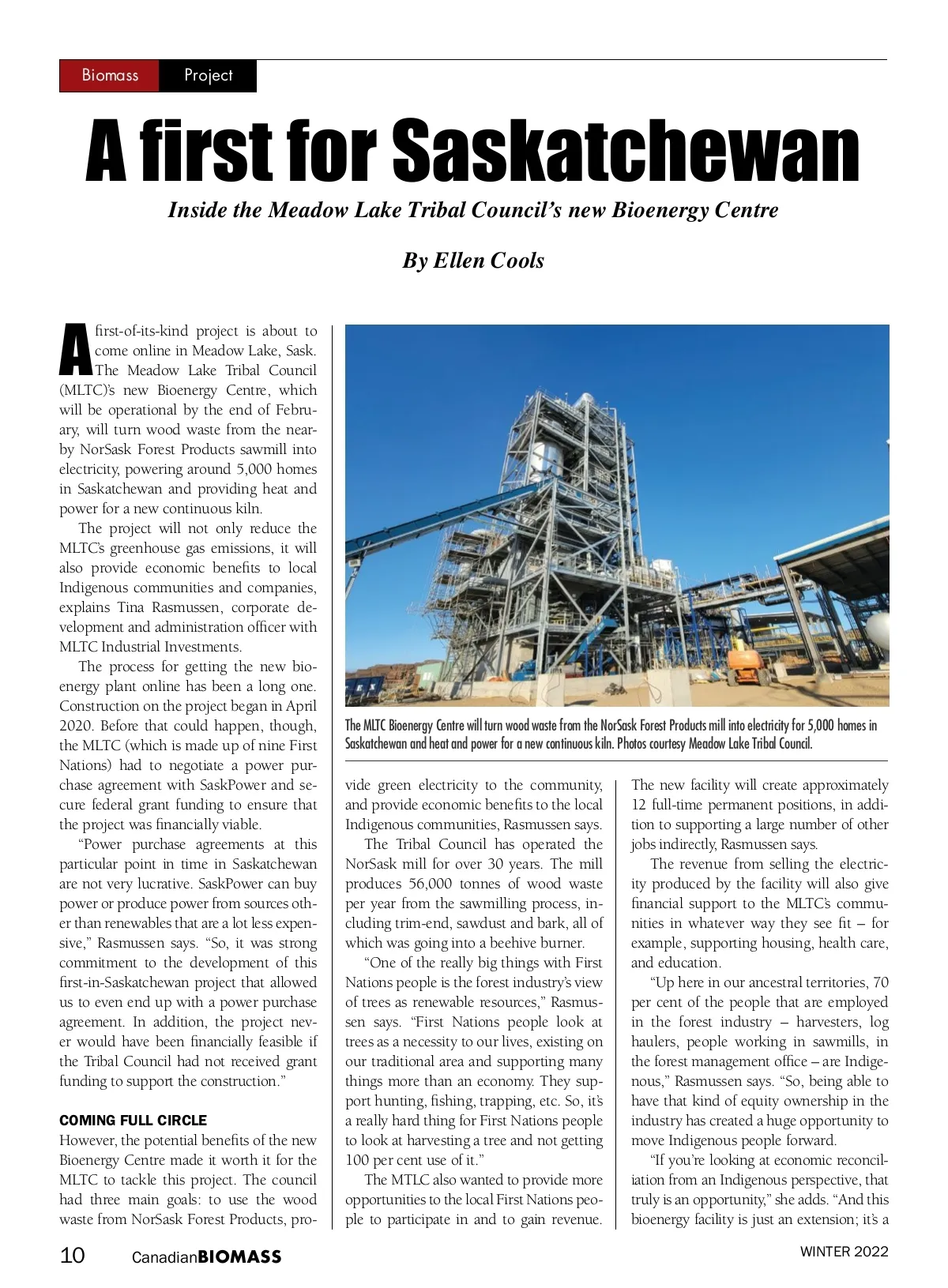
CHALLENGES CREATED BY COVID Excess power from the Bioenergy Centre goes back into the facility and some of it is used to heat glycol, which is piped to NorSask’s new Muhlbock six-zone Progressive Flo 1306 PRO continuous kiln. completion of the circle, in addition to taking a resource that we have already harvested and turning it into an opportunity.” Many Indigenous-owned companies were contracted for the construction of the Bioenergy Centre, which had just entered commissioning stages at the time of writing in January 2021. The MLTC chose to self-manage the project – a new undertaking for them – so they could ensure Indigenous-owned companies could take advantage of the construction contracts and job opportuni-ties, Rasmussen says. “We’re talking about $80-82 million. The Tribal Council had never done a project on that scale before. We started by hiring an In-digenous partnership project management company,” she explains. “They handled the construction RFP [request for proposal] process and oversaw the project, working directly with us as the owners. “Through our project manager, we were able to put RFPs togeth-er that companies owned by Indigenous communities, First Nations communities or Indigenous people were able to bid on and be suc-cessful in.” By the end of the construction and commissioning process, the MLTC expects at least $35 million in construction contracts will have been given to Indigenous companies. All told, the MLTC maintained between 33 and 40 per cent Indigenous employment on this project. The MLTC faced a few hurdles in the actual construction of the plant, as construction began soon after the COVID-19 pandemic first hit. “We’ve managed to weather COVID. And we continue to man-age through COVID because, of course, we all know things are getting pretty tense in all of our provinces,” Rasmussen says. Supply chain issues, a side effect of the pandemic, also posed difficulties for the MLTC. “We had issues related to the costs and delivery of steel, electronics and issues around shipping because of COVID-19’s impact on suppliers in their own locations and their own factories,” Rasmussen says. To deal with these issues, the MLTC had to be agile, moving the timeline for the construction and installation of different pieces of equipment. The silo, for example, was only installed at the end of January as a result of supply chain issues. This also led to a delay in installing all of the conveyors at the plant, as the silos first need-ed to be in place, Rasmussen says. The MLTC is currently commissioning the equipment, with the plant set to begin producing power by the end of February. CLOSING THE LOOP How exactly does the wood waste from NorSask become electric-ity? First, wood waste from NorSask goes through a grinder from Rawlings Manufacturing, which grinds the wood waste into pieces around three inches by three inches large. This wood waste is then transported by an open-air pipe belt conveyor to the Bioenergy Centre, where the material is dumped into a silo that is approxi-mately 60-feet-wide by 80-feet-tall. The silo can store up to three days’ worth of fuel, since Nor-Sask does not run on the weekends, but the Bioenergy Centre will run 24/7. From the silo, the material goes through an auger system and is carried by conveyor to the top of the thermal oil plant, which is a 120-foot-tall building with a reciprocating grate furnace from Classen Apparatebau Wiesloch (CAW) at the bottom. The fibre drops down on top of the furnace, where it is slowly burned. The fire slowly heats tubes in the plant that are filled with thermal oil, similar to radiator heating, Rasmussen says. CB_Rawlings_third_Winter22_MLD.indd 1 Canadian BIOMASS 2022-01-26 11:13 AM 11
Canadian Biomass Winter 2022: Page 11