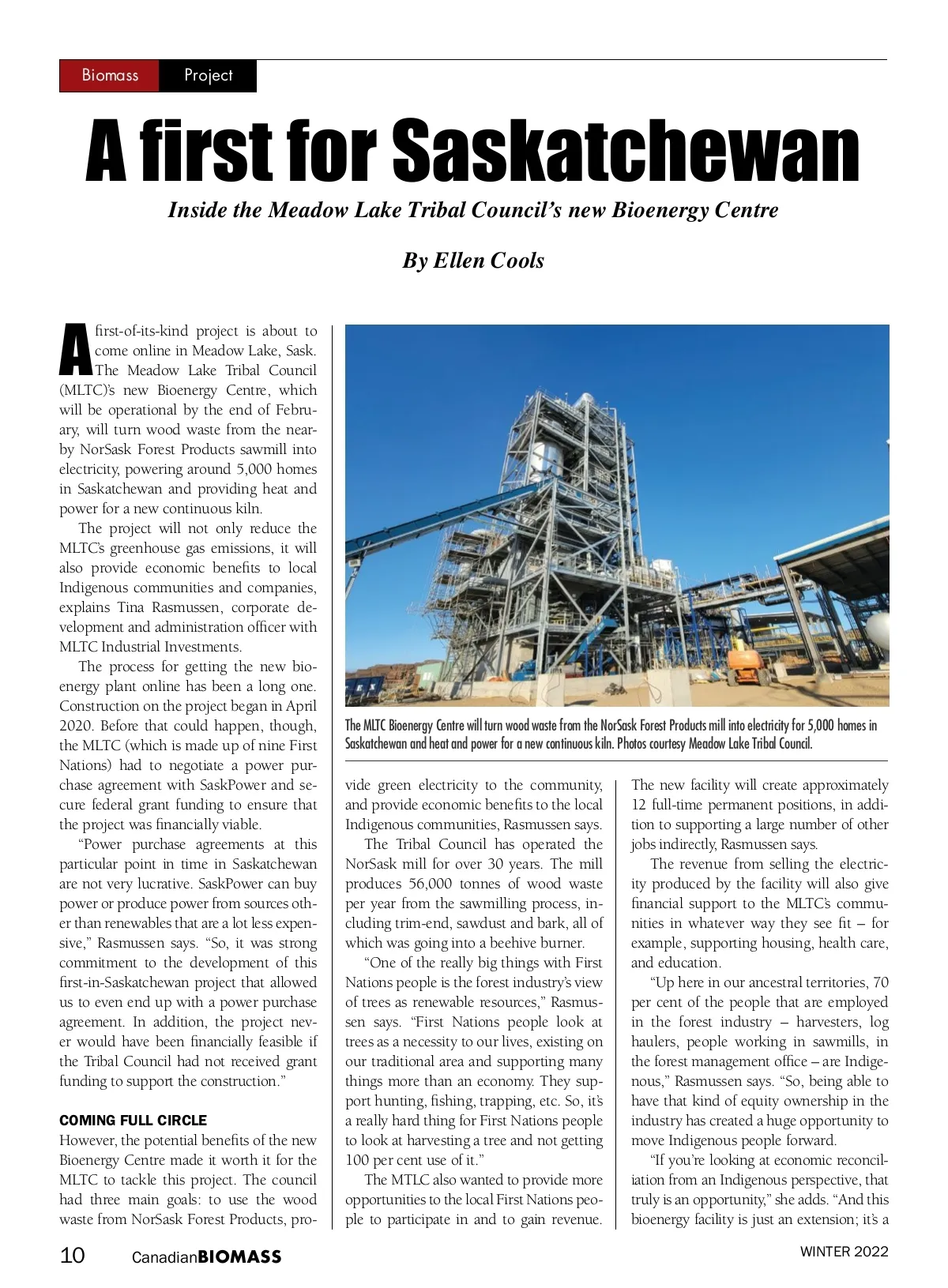
Biomass Project A first for Saskatchewan Inside the Meadow Lake Tribal Council’s new Bioenergy Centre By Ellen Cools A first-of-its-kind project is about to come online in Meadow Lake, Sask. The Meadow Lake Tribal Council (MLTC)’s new Bioenergy Centre, which will be operational by the end of Febru-ary, will turn wood waste from the near-by NorSask Forest Products sawmill into electricity, powering around 5,000 homes in Saskatchewan and providing heat and power for a new continuous kiln. The project will not only reduce the MLTC’s greenhouse gas emissions, it will also provide economic benefits to local Indigenous communities and companies, explains Tina Rasmussen, corporate de-velopment and administration officer with MLTC Industrial Investments. The process for getting the new bio-energy plant online has been a long one. Construction on the project began in April 2020. Before that could happen, though, the MLTC (which is made up of nine First Nations) had to negotiate a power pur-chase agreement with SaskPower and se-cure federal grant funding to ensure that the project was financially viable. “Power purchase agreements at this particular point in time in Saskatchewan are not very lucrative. SaskPower can buy power or produce power from sources oth-er than renewables that are a lot less expen-sive,” Rasmussen says. “So, it was strong commitment to the development of this first-in-Saskatchewan project that allowed us to even end up with a power purchase agreement. In addition, the project nev-er would have been financially feasible if the Tribal Council had not received grant funding to support the construction.” The MLTC Bioenergy Centre will turn wood waste from the NorSask Forest Products mill into electricity for 5,000 homes in Saskatchewan and heat and power for a new continuous kiln. Photos courtesy Meadow Lake Tribal Council. COMING FULL CIRCLE However, the potential benefits of the new Bioenergy Centre made it worth it for the MLTC to tackle this project. The council had three main goals: to use the wood waste from NorSask Forest Products, pro-vide green electricity to the community, and provide economic benefits to the local Indigenous communities, Rasmussen says. The Tribal Council has operated the NorSask mill for over 30 years. The mill produces 56,000 tonnes of wood waste per year from the sawmilling process, in-cluding trim-end, sawdust and bark, all of which was going into a beehive burner. “One of the really big things with First Nations people is the forest industry’s view of trees as renewable resources,” Rasmus-sen says. “First Nations people look at trees as a necessity to our lives, existing on our traditional area and supporting many things more than an economy. They sup-port hunting, fishing, trapping, etc. So, it’s a really hard thing for First Nations people to look at harvesting a tree and not getting 100 per cent use of it.” The MTLC also wanted to provide more opportunities to the local First Nations peo-ple to participate in and to gain revenue. The new facility will create approximately 12 full-time permanent positions, in addi-tion to supporting a large number of other jobs indirectly, Rasmussen says. The revenue from selling the electric-ity produced by the facility will also give financial support to the MLTC’s commu-nities in whatever way they see fit – for example, supporting housing, health care, and education. “Up here in our ancestral territories, 70 per cent of the people that are employed in the forest industry – harvesters, log haulers, people working in sawmills, in the forest management office – are Indige-nous,” Rasmussen says. “So, being able to have that kind of equity ownership in the industry has created a huge opportunity to move Indigenous people forward. “If you’re looking at economic reconcil-iation from an Indigenous perspective, that truly is an opportunity,” she adds. “And this bioenergy facility is just an extension; it’s a WINTER 2022 10 Canadian BIOMASS
Canadian Biomass Winter 2022: Page 10