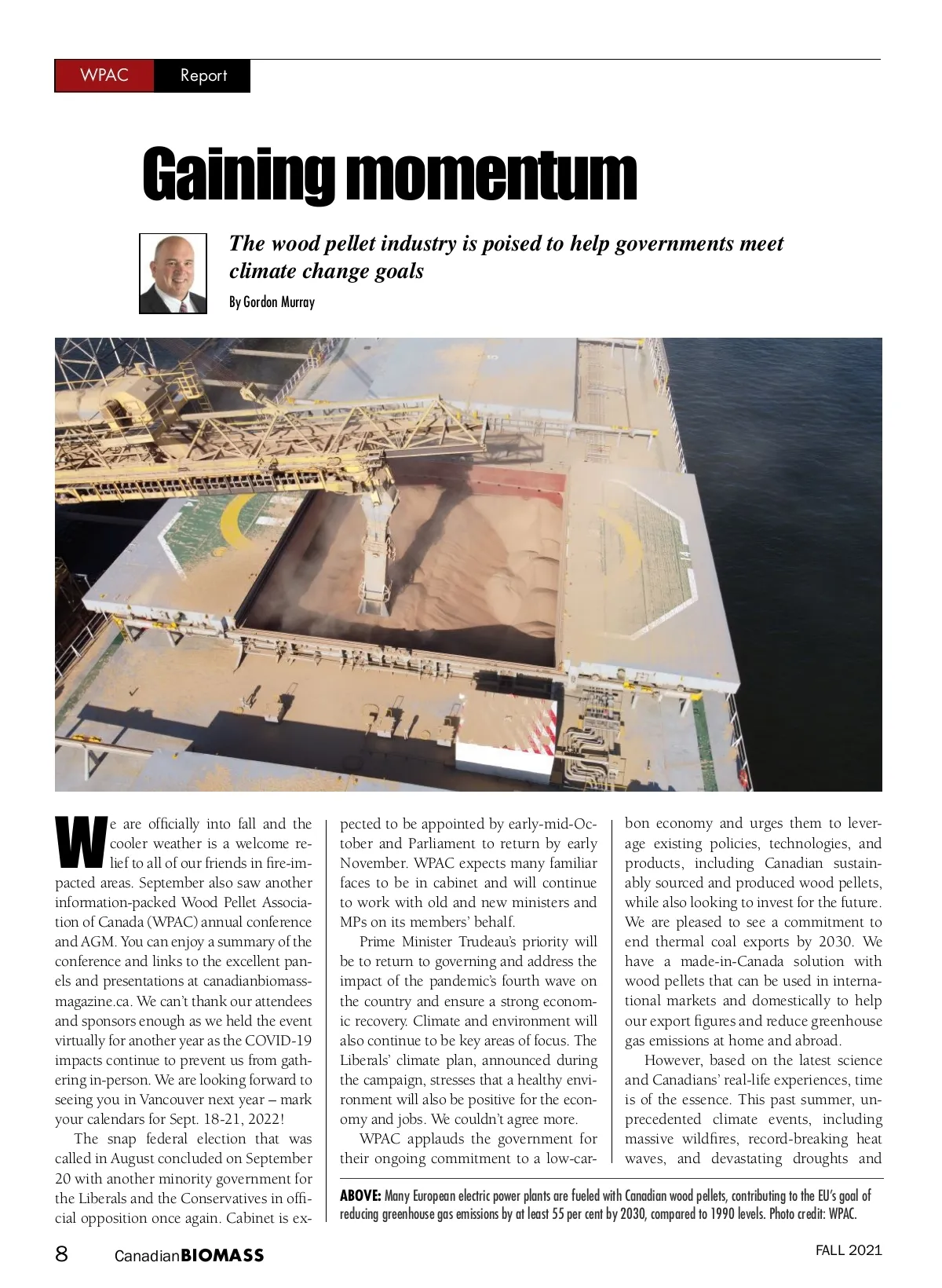
floods, brought climate change front and centre in all of our lives. The picture is no different globally, and in Europe, politicians are leading the charge. The European Commission (EC) released On the path to fit for 55 , a pack-age of proposals to make the EU’s poli-cies fit for reducing net greenhouse gas emissions by at least 55 per cent by 2030. Sustainable bioenergy continues to be seen as a key part of the EU energy mix, playing a role in making Europe climate neutral by 2050. The proposed revisions to the Renewable Energy Directive (RED III) include changes to biomass sustain-ability requirements, and the Canadian pellet industry is well-positioned to meet these criteria. We will work closely with our European industry partners and cus-tomers to ensure that the provisions of RED III are practical and viable. Closer to home, we are encouraged by the British Columbia government’s recently released Intentions Paper with its focus on three principles, supported by WPAC, that will govern future actions and policies: 1. Increased sector participation 2. Enhanced stewardship and sustain-ability 3. Strengthened social contract. Katrine Conroy, British Columbia’s Minister of Forests, Lands, Natural Re-source Operations and Rural Develop-ment, opened our conference this year and challenged all of us to look beyond just energy to find more opportunities for pellets that will contribute to the emerging bioeconomy and reap some of the carbon benefits within the province as well. Clearly there is political momentum from all angles as we get set to watch a convergence of thought leaders, polit-ical leaders, global scientists and NGOs this fall at COP26. The recently released IPCC Sixth Assessment Report linked global climate change with specific ex-treme weather events and warned that we should expect more of this in the years to come. “We need immediate, rapid and sus-tained reductions,” says John Fyfe, senior research scientist with Environment and Climate Change Canada and a lead author. We couldn’t agree more. Replacing fossil fuels with sustainably harvested and pro-duced wood pellets is a solution for today. At WPAC, we are moving forward on some ambitious initiatives and goals. At our recent AGM, we received full support of our 2021-22 priorities including build-ing on our market outreach and advocacy efforts, getting the Sustainable Biomass Program (SBP) Regional Risk Assessments completed for New Brunswick and Nova Scotia, and moving forward on assess-ments for Alberta and Saskatchewan. Do-mestically, we will continue to improve our sector’s pellet safety performance across Canada and grow the domestic market with a focus on the Maritimes. We will also establish a research advisory group in co-operation with the University of British Columbia to tap into the full potential of pellets in the bioeconomy. Achieving these goals and tackling cli-mate change will require all of us listen-ing, sharing ideas, investing in research, committing to safety 24/7 and pulling in the same direction. We have a solid track record on this front, but there’s more work to do. • TSI BUILDS MACHINERY FOR THE BIOMASS INDUSTRY This includes Rotary Drum Dryers coupled with Heat Energy systems; TSI also builds Wet Electrostatic Precipitators when required to meet Client’s emission goals. TSI also offers technology for Torrefaction. TSI machinery is custom designed and ranges from 50,000 tons/year to 450,000 tons/year. (425) 239-7490 www.tsi-inc.net Canadian BIOMASS CB_TSI_HP_Sept21_CWM.indd 1 2021-09-08 10:36 AM 9
Canadian Biomass Fall 2021: Page 9