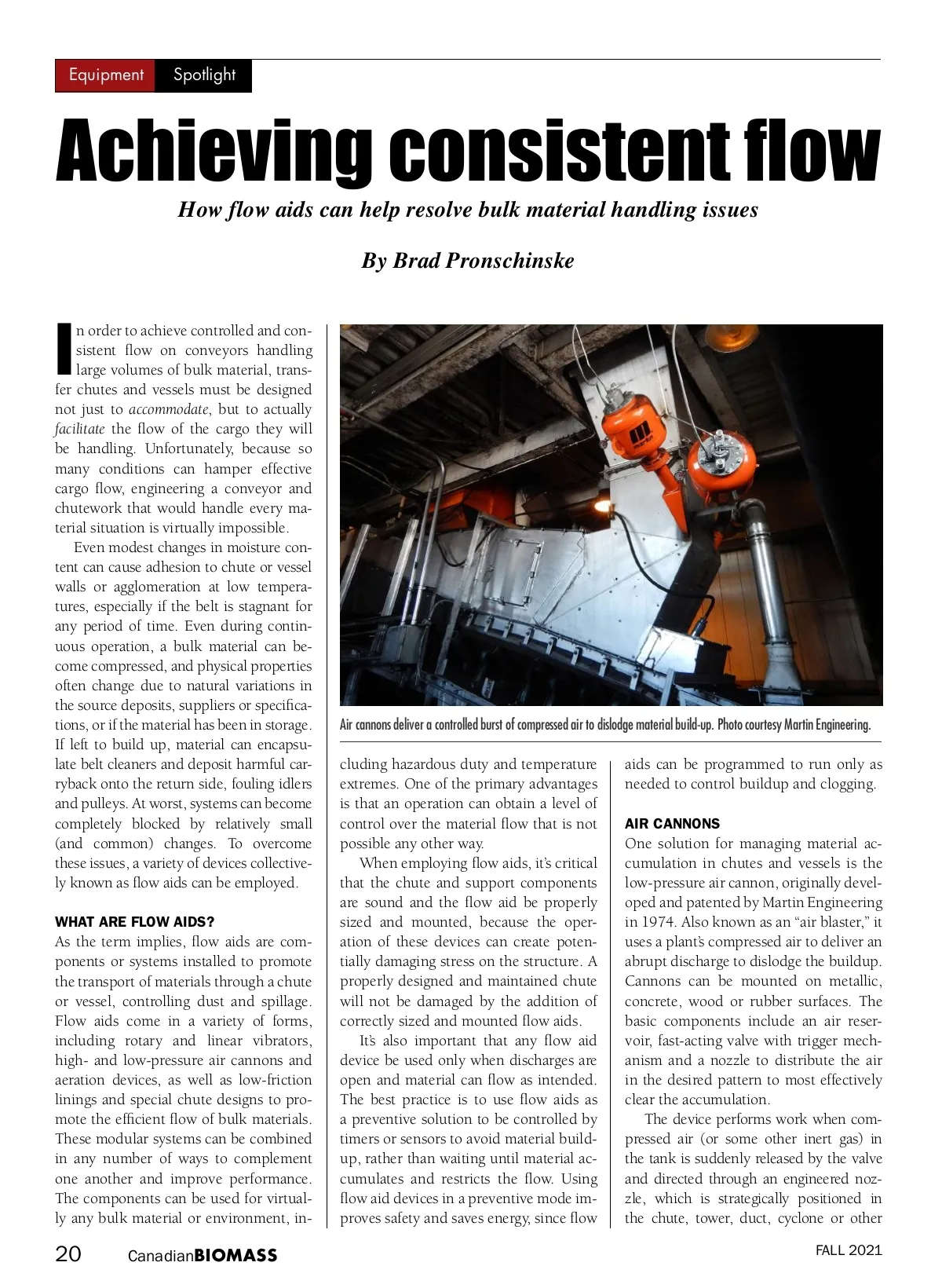
Equipment Spotlight Achieving consistent flow How flow aids can help resolve bulk material handling issues By Brad Pronschinske n order to achieve controlled and con-sistent flow on conveyors handling large volumes of bulk material, trans-fer chutes and vessels must be designed not just to accommodate , but to actually facilitate the flow of the cargo they will be handling. Unfortunately, because so many conditions can hamper effective cargo flow, engineering a conveyor and chutework that would handle every ma-terial situation is virtually impossible. Even modest changes in moisture con-tent can cause adhesion to chute or vessel walls or agglomeration at low tempera-tures, especially if the belt is stagnant for any period of time. Even during contin-uous operation, a bulk material can be-come compressed, and physical properties often change due to natural variations in the source deposits, suppliers or specifica-tions, or if the material has been in storage. If left to build up, material can encapsu-late belt cleaners and deposit harmful car-ryback onto the return side, fouling idlers and pulleys. At worst, systems can become completely blocked by relatively small (and common) changes. To overcome these issues, a variety of devices collective-ly known as flow aids can be employed. WHAT ARE FLOW AIDS? I Air cannons deliver a controlled burst of compressed air to dislodge material build-up. Photo courtesy Martin Engineering. As the term implies, flow aids are com-ponents or systems installed to promote the transport of materials through a chute or vessel, controlling dust and spillage. Flow aids come in a variety of forms, including rotary and linear vibrators, high-and low-pressure air cannons and aeration devices, as well as low-friction linings and special chute designs to pro-mote the efficient flow of bulk materials. These modular systems can be combined in any number of ways to complement one another and improve performance. The components can be used for virtual-ly any bulk material or environment, in-cluding hazardous duty and temperature extremes. One of the primary advantages is that an operation can obtain a level of control over the material flow that is not possible any other way. When employing flow aids, it’s critical that the chute and support components are sound and the flow aid be properly sized and mounted, because the oper-ation of these devices can create poten-tially damaging stress on the structure. A properly designed and maintained chute will not be damaged by the addition of correctly sized and mounted flow aids. It’s also important that any flow aid device be used only when discharges are open and material can flow as intended. The best practice is to use flow aids as a preventive solution to be controlled by timers or sensors to avoid material build-up, rather than waiting until material ac-cumulates and restricts the flow. Using flow aid devices in a preventive mode im-proves safety and saves energy, since flow aids can be programmed to run only as needed to control buildup and clogging. AIR CANNONS One solution for managing material ac-cumulation in chutes and vessels is the low-pressure air cannon, originally devel-oped and patented by Martin Engineering in 1974. Also known as an “air blaster,” it uses a plant’s compressed air to deliver an abrupt discharge to dislodge the buildup. Cannons can be mounted on metallic, concrete, wood or rubber surfaces. The basic components include an air reser-voir, fast-acting valve with trigger mech-anism and a nozzle to distribute the air in the desired pattern to most effectively clear the accumulation. The device performs work when com-pressed air (or some other inert gas) in the tank is suddenly released by the valve and directed through an engineered noz-zle, which is strategically positioned in the chute, tower, duct, cyclone or other FALL 2021 20 Canadian BIOMASS
Canadian Biomass Fall 2021: Page 20