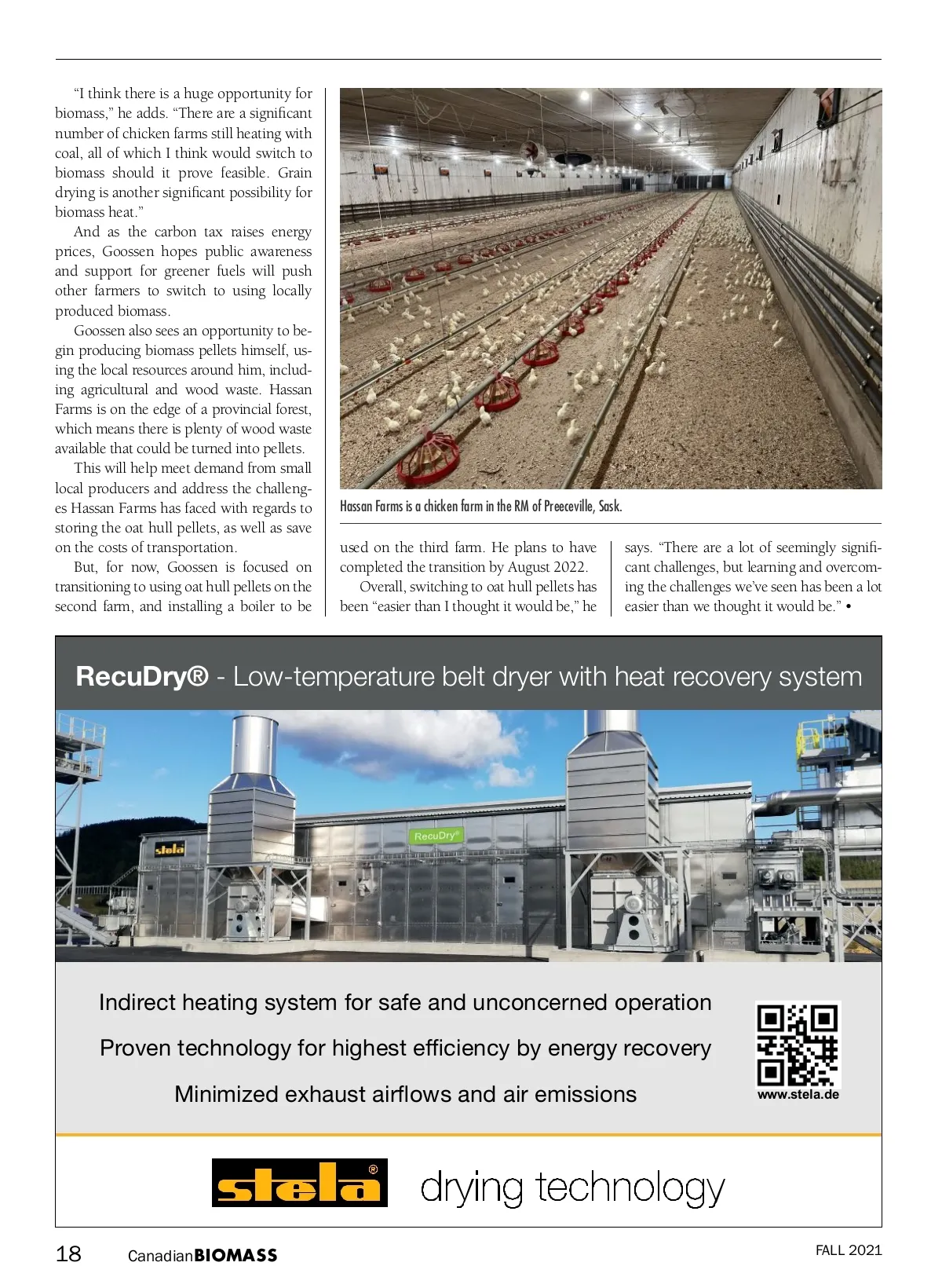
“I think there is a huge opportunity for biomass,” he adds. “There are a significant number of chicken farms still heating with coal, all of which I think would switch to biomass should it prove feasible. Grain drying is another significant possibility for biomass heat.” And as the carbon tax raises energy prices, Goossen hopes public awareness and support for greener fuels will push other farmers to switch to using locally produced biomass. Goossen also sees an opportunity to be-gin producing biomass pellets himself, us-ing the local resources around him, includ-ing agricultural and wood waste. Hassan Farms is on the edge of a provincial forest, which means there is plenty of wood waste available that could be turned into pellets. This will help meet demand from small local producers and address the challeng-es Hassan Farms has faced with regards to storing the oat hull pellets, as well as save on the costs of transportation. But, for now, Goossen is focused on transitioning to using oat hull pellets on the second farm, and installing a boiler to be Hassan Farms is a chicken farm in the RM of Preeceville, Sask. used on the third farm. He plans to have completed the transition by August 2022. Overall, switching to oat hull pellets has been “easier than I thought it would be,” he says. “There are a lot of seemingly signifi-cant challenges, but learning and overcom-ing the challenges we’ve seen has been a lot easier than we thought it would be.” • RecuDry® -Low-temperature belt dryer with heat recovery system Indirect heating system for safe and unconcerned operation Proven technology for highest efficiency by energy recovery Minimized exhaust airflows and air emissions www.stela.de 18 Canadian BIOMASS CB_Stela_Summer21_CSA.indd 1 FALL 2021 2021-07-12 10:17 AM
Canadian Biomass Fall 2021: Page 18