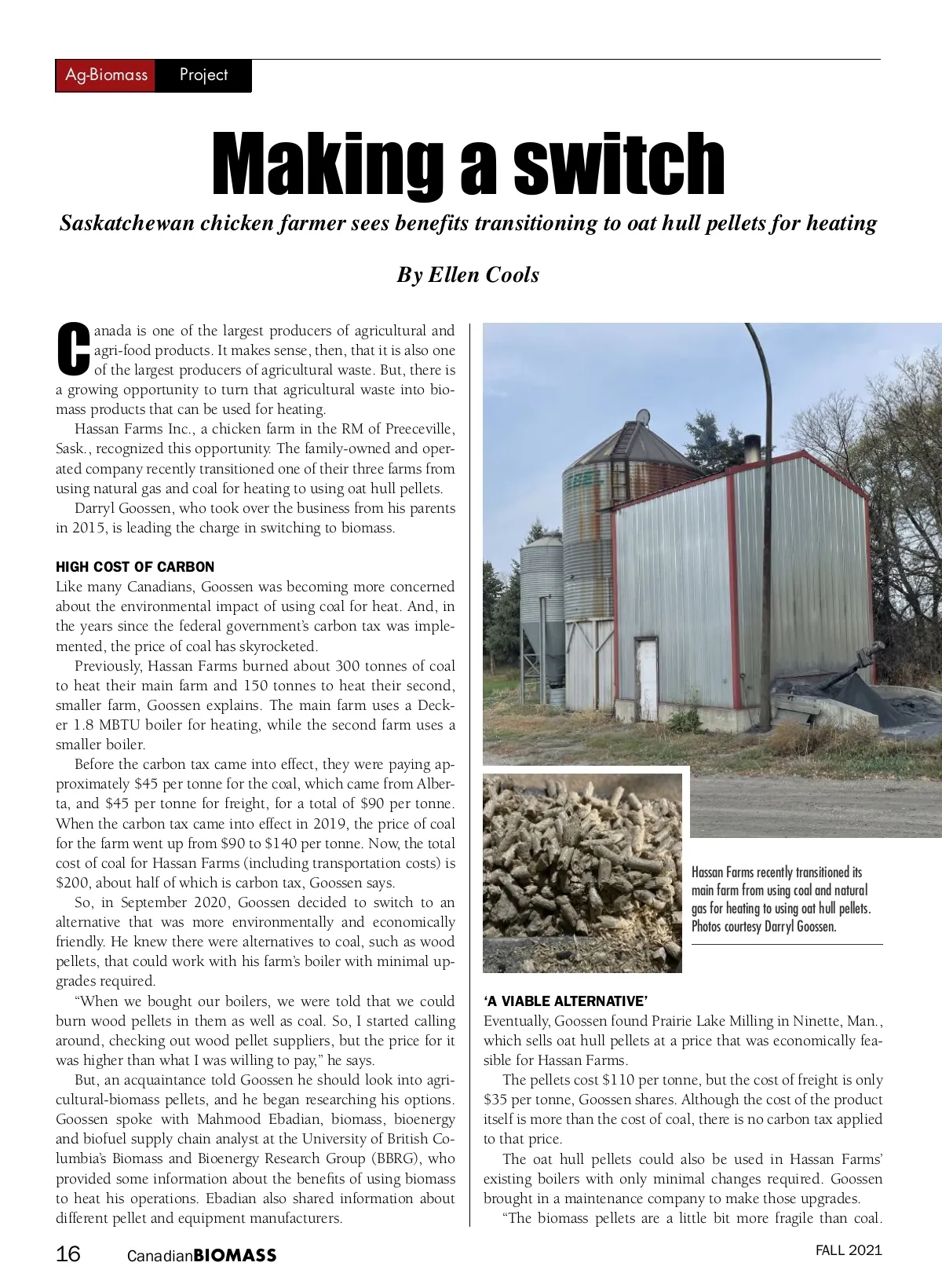
Ag-Biomass Project Saskatchewan chicken farmer sees benefits transitioning to oat hull pellets for heating By Ellen Cools Making a switch C anada is one of the largest producers of agricultural and agri-food products. It makes sense, then, that it is also one of the largest producers of agricultural waste. But, there is a growing opportunity to turn that agricultural waste into bio-mass products that can be used for heating. Hassan Farms Inc., a chicken farm in the RM of Preeceville, Sask., recognized this opportunity. The family-owned and oper-ated company recently transitioned one of their three farms from using natural gas and coal for heating to using oat hull pellets. Darryl Goossen, who took over the business from his parents in 2015, is leading the charge in switching to biomass. HIGH COST OF CARBON Like many Canadians, Goossen was becoming more concerned about the environmental impact of using coal for heat. And, in the years since the federal government’s carbon tax was imple-mented, the price of coal has skyrocketed. Previously, Hassan Farms burned about 300 tonnes of coal to heat their main farm and 150 tonnes to heat their second, smaller farm, Goossen explains. The main farm uses a Deck-er 1.8 MBTU boiler for heating, while the second farm uses a smaller boiler. Before the carbon tax came into effect, they were paying ap-proximately $45 per tonne for the coal, which came from Alber-ta, and $45 per tonne for freight, for a total of $90 per tonne. When the carbon tax came into effect in 2019, the price of coal for the farm went up from $90 to $140 per tonne. Now, the total cost of coal for Hassan Farms (including transportation costs) is $200, about half of which is carbon tax, Goossen says. So, in September 2020, Goossen decided to switch to an alternative that was more environmentally and economically friendly. He knew there were alternatives to coal, such as wood pellets, that could work with his farm’s boiler with minimal up-grades required. “When we bought our boilers, we were told that we could burn wood pellets in them as well as coal. So, I started calling around, checking out wood pellet suppliers, but the price for it was higher than what I was willing to pay,” he says. But, an acquaintance told Goossen he should look into agri-cultural-biomass pellets, and he began researching his options. Goossen spoke with Mahmood Ebadian, biomass, bioenergy and biofuel supply chain analyst at the University of British Co-lumbia’s Biomass and Bioenergy Research Group (BBRG), who provided some information about the benefits of using biomass to heat his operations. Ebadian also shared information about different pellet and equipment manufacturers. Hassan Farms recently transitioned its main farm from using coal and natural gas for heating to using oat hull pellets. Photos courtesy Darryl Goossen. ‘A VIABLE ALTERNATIVE’ Eventually, Goossen found Prairie Lake Milling in Ninette, Man., which sells oat hull pellets at a price that was economically fea-sible for Hassan Farms. The pellets cost $110 per tonne, but the cost of freight is only $35 per tonne, Goossen shares. Although the cost of the product itself is more than the cost of coal, there is no carbon tax applied to that price. The oat hull pellets could also be used in Hassan Farms’ existing boilers with only minimal changes required. Goossen brought in a maintenance company to make those upgrades. “The biomass pellets are a little bit more fragile than coal. FALL 2021 16 Canadian BIOMASS
Canadian Biomass Fall 2021: Page 16