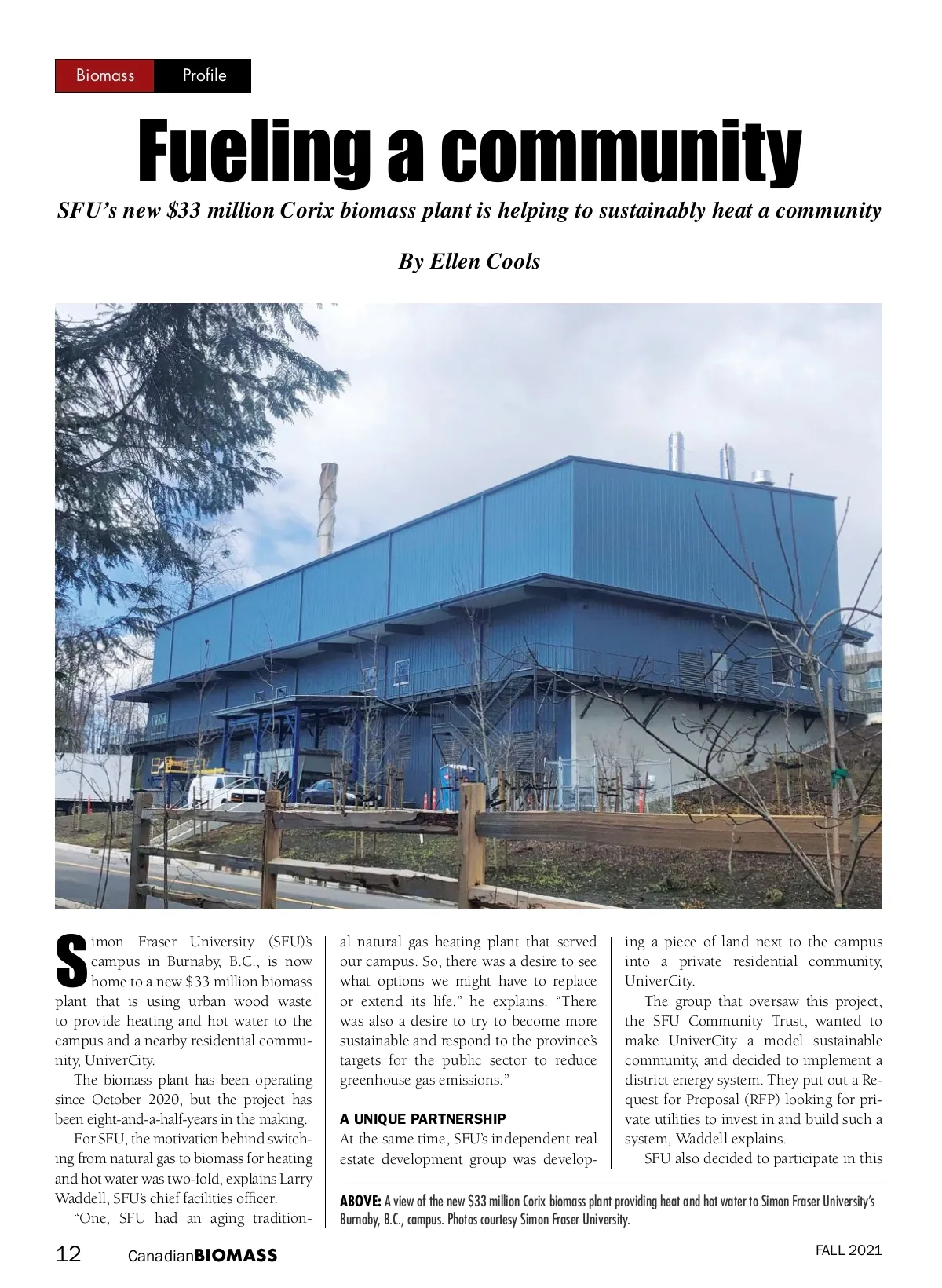
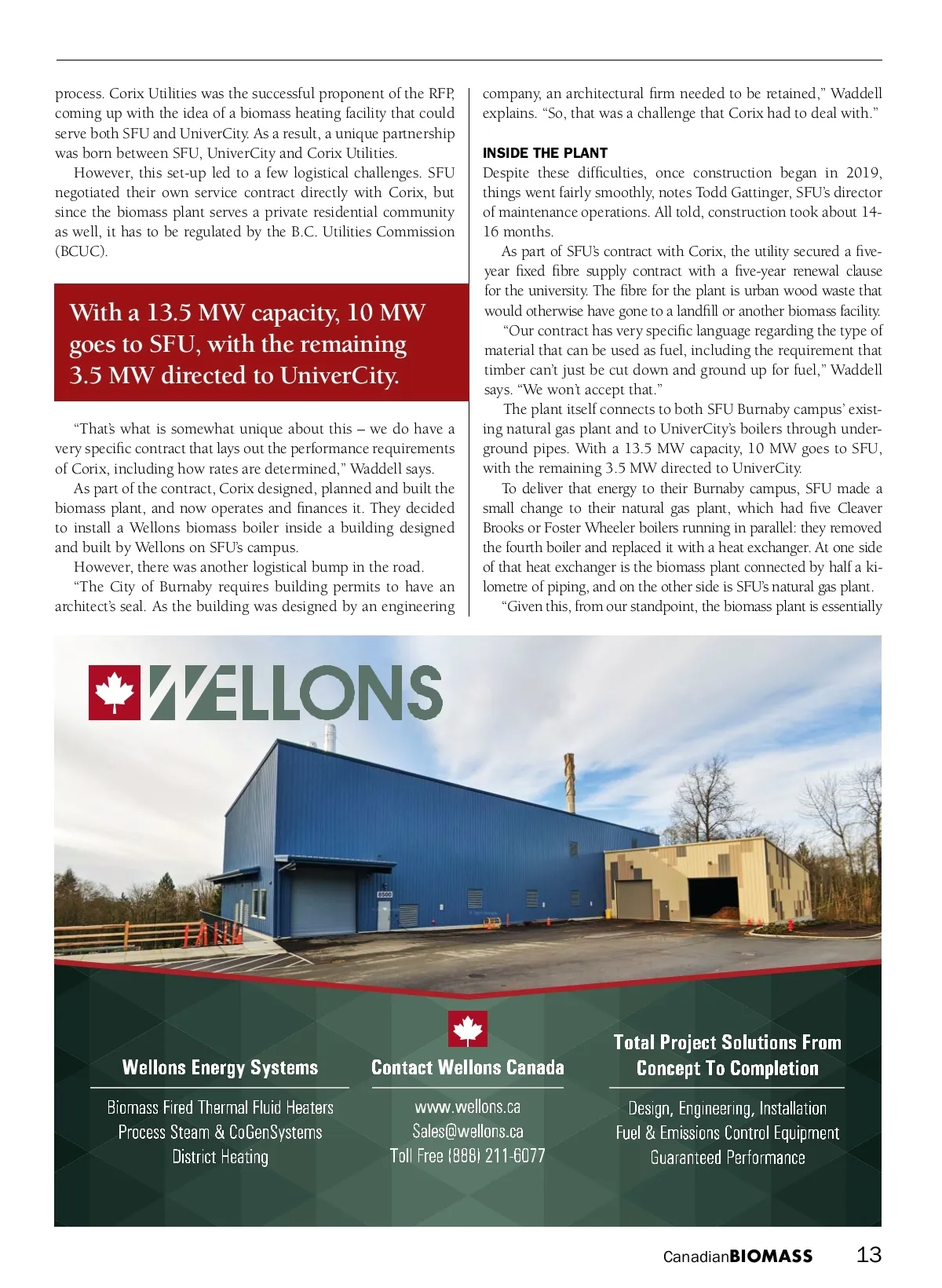
process. Corix Utilities was the successful proponent of the RFP, coming up with the idea of a biomass heating facility that could serve both SFU and UniverCity. As a result, a unique partnership was born between SFU, UniverCity and Corix Utilities. However, this set-up led to a few logistical challenges. SFU negotiated their own service contract directly with Corix, but since the biomass plant serves a private residential community as well, it has to be regulated by the B.C. Utilities Commission (BCUC). company, an architectural firm needed to be retained,” Waddell explains. “So, that was a challenge that Corix had to deal with.” INSIDE THE PLANT With a 13.5 MW capacity, 10 MW goes to SFU, with the remaining 3.5 MW directed to UniverCity. “That’s what is somewhat unique about this – we do have a very specific contract that lays out the performance requirements of Corix, including how rates are determined,” Waddell says. As part of the contract, Corix designed, planned and built the biomass plant, and now operates and finances it. They decided to install a Wellons biomass boiler inside a building designed and built by Wellons on SFU’s campus. However, there was another logistical bump in the road. “The City of Burnaby requires building permits to have an architect’s seal. As the building was designed by an engineering Despite these difficulties, once construction began in 2019, things went fairly smoothly, notes Todd Gattinger, SFU’s director of maintenance operations. All told, construction took about 14-16 months. As part of SFU’s contract with Corix, the utility secured a five-year fixed fibre supply contract with a five-year renewal clause for the university. The fibre for the plant is urban wood waste that would otherwise have gone to a landfill or another biomass facility. “Our contract has very specific language regarding the type of material that can be used as fuel, including the requirement that timber can’t just be cut down and ground up for fuel,” Waddell says. “We won’t accept that.” The plant itself connects to both SFU Burnaby campus’ exist-ing natural gas plant and to UniverCity’s boilers through under-ground pipes. With a 13.5 MW capacity, 10 MW goes to SFU, with the remaining 3.5 MW directed to UniverCity. To deliver that energy to their Burnaby campus, SFU made a small change to their natural gas plant, which had five Cleaver Brooks or Foster Wheeler boilers running in parallel: they removed the fourth boiler and replaced it with a heat exchanger. At one side of that heat exchanger is the biomass plant connected by half a ki-lometre of piping, and on the other side is SFU’s natural gas plant. “Given this, from our standpoint, the biomass plant is essentially CB_Wellons_Fall21_CSA.indd 1 Canadian BIOMASS 2021-10-12 12:01 PM 13
Canadian Biomass Fall 2021: Page 13