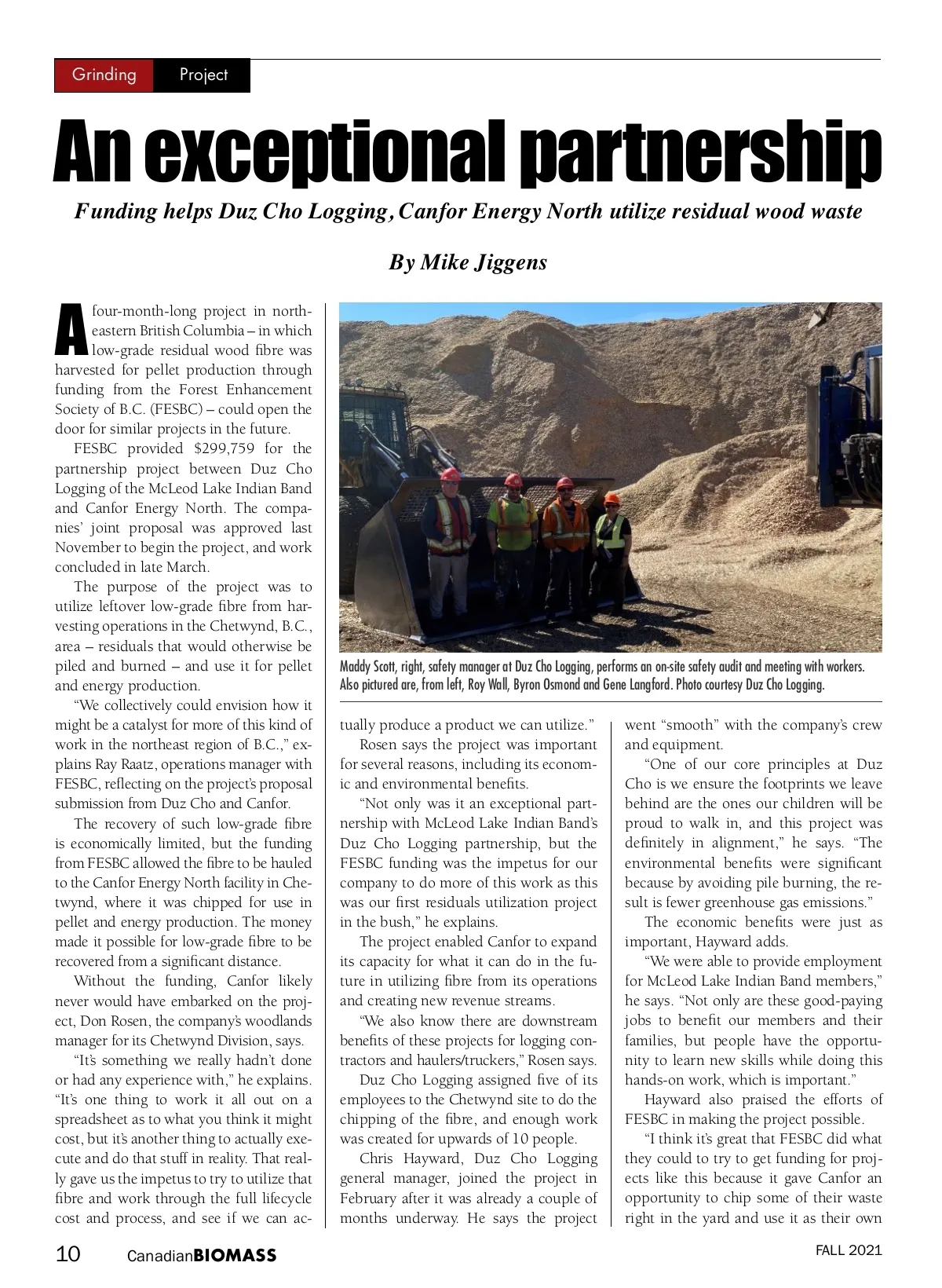
product,” he says. Raatz suggests there may be additional opportunities for other projects of this kind that FESBC can support down the road. “It’s all about the economic reach,” he says, adding the partnership between Canfor and Duz Cho allowed each of the parties to learn new efficiencies to help them venture further on their own. “Our goal is increasing utilization of low-grade fibre and, as a result of that, reducing burning and thereby reducing greenhouse gas emissions,” Raatz adds. Canfor had historically relied on sawmill residual fibre for its pellet plant, but wanted to determine how it could obtain material directly from its bush operation instead of relying on residuals from the sawmill. “It was an opportunity in a sense to provide some funding to try this out,” Raatz says. “They (Canfor and Duz Cho) had a large proposal, and we were only able to fund a portion of what they were proposing, but it gave them an opportu-nity to get some learning about how to implement this type of project and some of the economics associated with it.” Rosen says Canfor experimented a lit-tle bit with Duz Cho’s equipment, playing with some of the settings “to get a proper chip size and characteristics to work with our facility, and they were really good at accommodating us so that we could uti-lize that fibre.” The Peterson chipper used during the project was supported by two Caterpil-lar wheel loaders – one equipped with a log grapple to forward wood to the chip-per and another with a chip bucket that stacked the chips. Rosen adds it was more of the chip-ping product that changed as opposed to the plant. “We changed a little bit of the recipe and the blend to make that work through our facility,” he explains. “It was a really good opportunity to jump-start the uti-lization of that fibre and give us a better understanding of how it all works. That residual market is a very thin margin part of the business to be in.” The project utilized 14,742 cubic me-tres of residual waste fibre, which is ap-proximately equal to 295 truckloads. “This project was a great opportunity for members of the McLeod Lake Indian Band to participate in a project that helps utilize more of the wood fibre being har-vested within the traditional territories,” Hayward says. “We are creating a greener, more sustainable environment.” Employees from both Duz Cho and Canfor contributed to the Chetwynd economy throughout the project’s du-ration, through fuel and food purchases and accommodations. Additionally, a number of local trades people were hired to maintain the project’s equipment. “Our project showed true partnership,” Hayward adds. “So much happened be-hind the scenes in the planning and imple-mentation, and from start to finish it was truly a collaboration – a project in support of each other for the benefit of many.” The Duz Cho/Canfor project was one of 14 fibre utilization projects funded by FES-BC in several regions of the province as part of British Columbia’s StrongerBC funding allocation. FESBC was allocated $3 million in total from the B.C. government for the StrongerBC economic recovery plan. • 12 t/h up to MORE THAN 10 MILLION TONS. CAN ANYBODY TOP THAT? Our pellet mill 65-1500 outperforms the competition: With a throughput of up to 12 t/h, it is currently the largest flat die pellet mill for the wood sector. Worldwide, flat die pellet mills from AMANDUS KAHL produce more than 10 million tons of domestic fuel and industrial pellets from hardwoods and softwoods every year, and the trend is rising. Scan the QR code and learn more AMANDUS KAHL GmbH & Co. KG Germany · [email protected] shop.akahl.de · akahl.com CB_SARJ-Kahl _Spring21_CSA.indd 1 Canadian BIOMASS 2021-04-23 10:02 AM 11
Canadian Biomass Fall 2021: Page 11