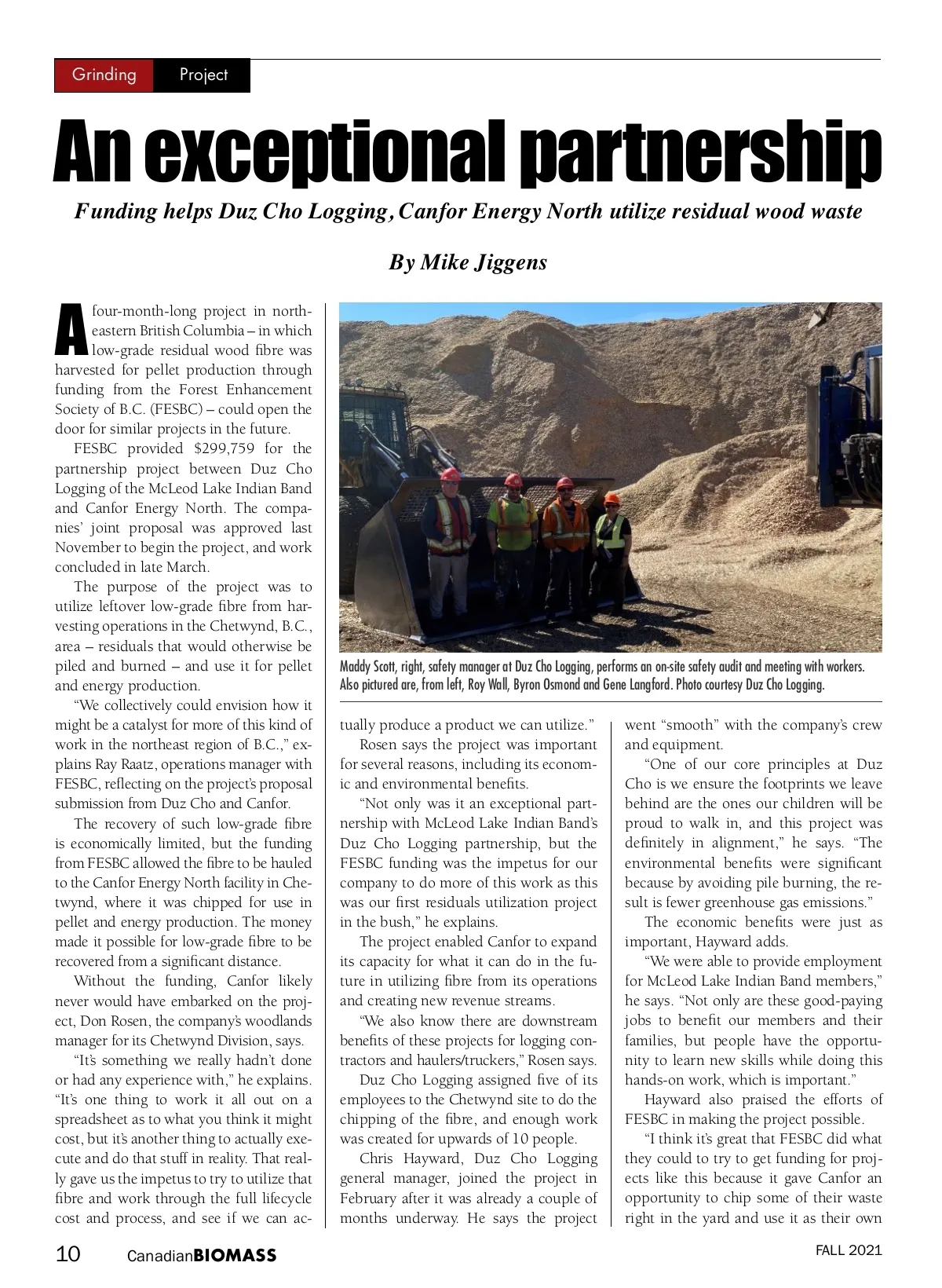
Grinding Project An exceptional partnership Funding helps Duz Cho Logging, Canfor Energy North utilize residual wood waste By Mike Jiggens A four-month-long project in north-eastern British Columbia – in which low-grade residual wood fibre was harvested for pellet production through funding from the Forest Enhancement Society of B.C. (FESBC) – could open the door for similar projects in the future. FESBC provided $299,759 for the partnership project between Duz Cho Logging of the McLeod Lake Indian Band and Canfor Energy North. The compa-nies’ joint proposal was approved last November to begin the project, and work concluded in late March. The purpose of the project was to utilize leftover low-grade fibre from har-vesting operations in the Chetwynd, B.C., area – residuals that would otherwise be piled and burned – and use it for pellet and energy production. “We collectively could envision how it might be a catalyst for more of this kind of work in the northeast region of B.C.,” ex-plains Ray Raatz, operations manager with FESBC, reflecting on the project’s proposal submission from Duz Cho and Canfor. The recovery of such low-grade fibre is economically limited, but the funding from FESBC allowed the fibre to be hauled to the Canfor Energy North facility in Che-twynd, where it was chipped for use in pellet and energy production. The money made it possible for low-grade fibre to be recovered from a significant distance. Without the funding, Canfor likely never would have embarked on the proj-ect, Don Rosen, the company’s woodlands manager for its Chetwynd Division, says. “It’s something we really hadn’t done or had any experience with,” he explains. “It’s one thing to work it all out on a spreadsheet as to what you think it might cost, but it’s another thing to actually exe-cute and do that stuff in reality. That real-ly gave us the impetus to try to utilize that fibre and work through the full lifecycle cost and process, and see if we can ac-Maddy Scott, right, safety manager at Duz Cho Logging, performs an on-site safety audit and meeting with workers. Also pictured are, from left, Roy Wall, Byron Osmond and Gene Langford. Photo courtesy Duz Cho Logging. tually produce a product we can utilize.” Rosen says the project was important for several reasons, including its econom-ic and environmental benefits. “Not only was it an exceptional part-nership with McLeod Lake Indian Band’s Duz Cho Logging partnership, but the FESBC funding was the impetus for our company to do more of this work as this was our first residuals utilization project in the bush,” he explains. The project enabled Canfor to expand its capacity for what it can do in the fu-ture in utilizing fibre from its operations and creating new revenue streams. “We also know there are downstream benefits of these projects for logging con-tractors and haulers/truckers,” Rosen says. Duz Cho Logging assigned five of its employees to the Chetwynd site to do the chipping of the fibre, and enough work was created for upwards of 10 people. Chris Hayward, Duz Cho Logging general manager, joined the project in February after it was already a couple of months underway. He says the project went “smooth” with the company’s crew and equipment. “One of our core principles at Duz Cho is we ensure the footprints we leave behind are the ones our children will be proud to walk in, and this project was definitely in alignment,” he says. “The environmental benefits were significant because by avoiding pile burning, the re-sult is fewer greenhouse gas emissions.” The economic benefits were just as important, Hayward adds. “We were able to provide employment for McLeod Lake Indian Band members,” he says. “Not only are these good-paying jobs to benefit our members and their families, but people have the opportu-nity to learn new skills while doing this hands-on work, which is important.” Hayward also praised the efforts of FESBC in making the project possible. “I think it’s great that FESBC did what they could to try to get funding for proj-ects like this because it gave Canfor an opportunity to chip some of their waste right in the yard and use it as their own FALL 2021 10 Canadian BIOMASS
Canadian Biomass Fall 2021: Page 10