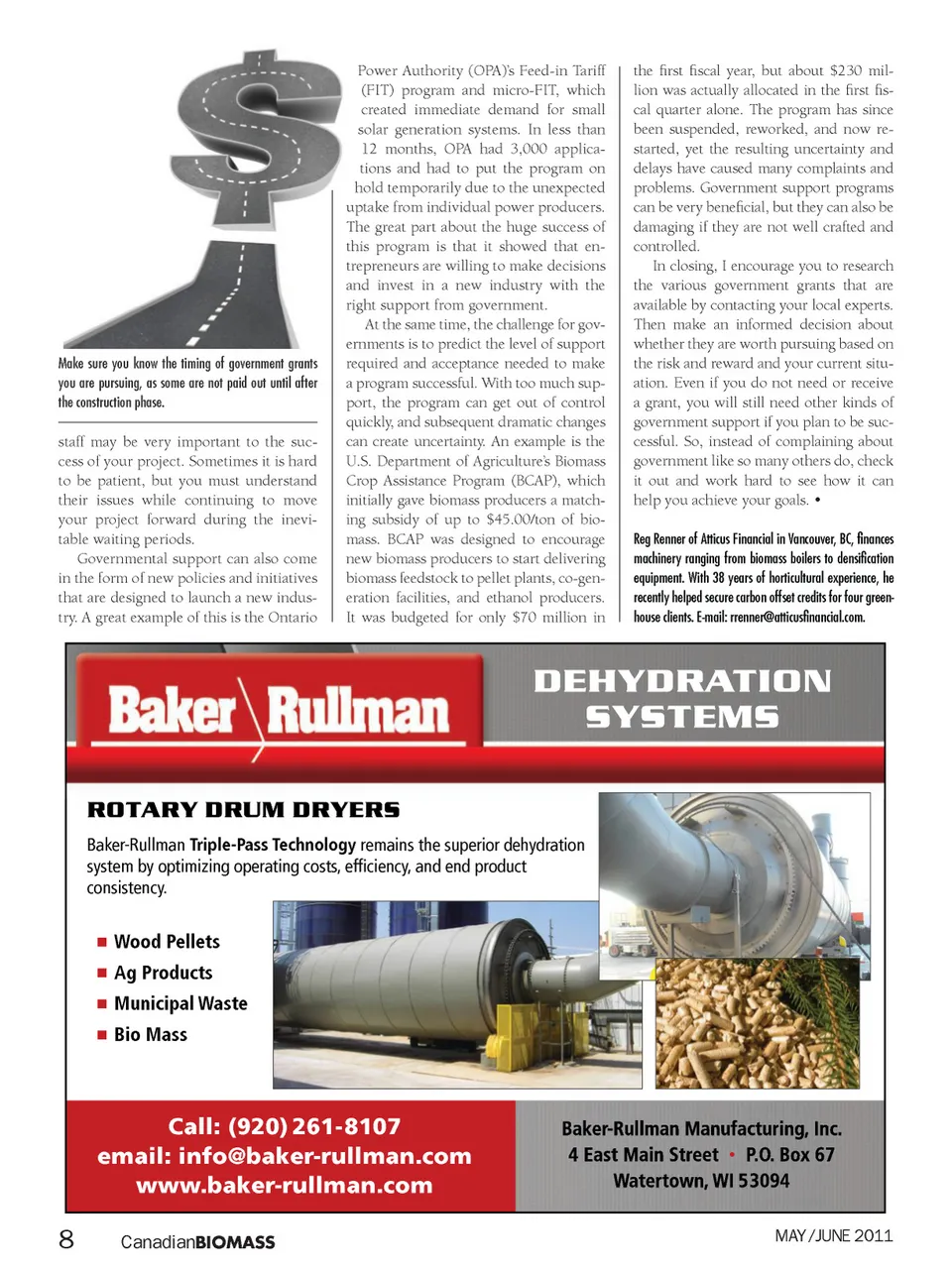
Make sure you know the timing of government grants you are pursuing, as some are not paid out until after the construction phase. staff may be very important to the suc-cess of your project. Sometimes it is hard to be patient, but you must understand their issues while continuing to move your project forward during the inevi-table waiting periods. Governmental support can also come in the form of new policies and initiatives that are designed to launch a new indus-try. A great example of this is the Ontario Power Authority (OPA)’s Feed-in Tariff (FIT) program and micro-FIT, which created immediate demand for small solar generation systems. In less than 12 months, OPA had 3,000 applica-tions and had to put the program on hold temporarily due to the unexpected uptake from individual power producers. The great part about the huge success of this program is that it showed that en-trepreneurs are willing to make decisions and invest in a new industry with the right support from government. At the same time, the challenge for gov-ernments is to predict the level of support required and acceptance needed to make a program successful. With too much sup-port, the program can get out of control quickly, and subsequent dramatic changes can create uncertainty. An example is the U.S. Department of Agriculture’s Biomass Crop Assistance Program (BCAP), which initially gave biomass producers a match-ing subsidy of up to $45.00/ton of bio-mass. BCAP was designed to encourage new biomass producers to start delivering biomass feedstock to pellet plants, co-gen-eration facilities, and ethanol producers. It was budgeted for only $70 million in the first fiscal year, but about $230 mil-lion was actually allocated in the first fis-cal quarter alone. The program has since been suspended, reworked, and now re-started, yet the resulting uncertainty and delays have caused many complaints and problems. Government support programs can be very beneficial, but they can also be damaging if they are not well crafted and controlled. In closing, I encourage you to research the various government grants that are available by contacting your local experts. Then make an informed decision about whether they are worth pursuing based on the risk and reward and your current situ-ation. Even if you do not need or receive a grant, you will still need other kinds of government support if you plan to be suc-cessful. So, instead of complaining about government like so many others do, check it out and work hard to see how it can i«ÊÞÕÊ>V iÛiÊÞÕÀÊ}>ðÊU J]_J]ff]jg^9lla[mk>afYf[aYdafNYf[gmn]j$:;$ÚfYf[]k eY[`af]jq jYf_af_ ^jge ZageYkk Zgad]jk lg \]fkaÚ[Ylagf equipment. With 38 years of horticultural experience, he recently helped secure carbon offset credits for four green-`gmk][da]flk&=%eYad2jj]ff]j8Ylla[mkÚfYf[aYd&[ge& DEHYDRATIO N S Y S TEMS RO TA RY DR UM DRYER S Baker-Rullman Triple-Pass Technology remains the superior dehydration system by optimizing operating costs, efficiency, and end product consistency. Q Q Q Q Wood Pellets Ag Products Municipal Waste Bio Mass Call: (920) 261-8107 email: [email protected] www.baker-rullman.com 8 Canadian BIOMASS MAY/JUNE 2011
Canadian Biomass May/June 2011: Page 8