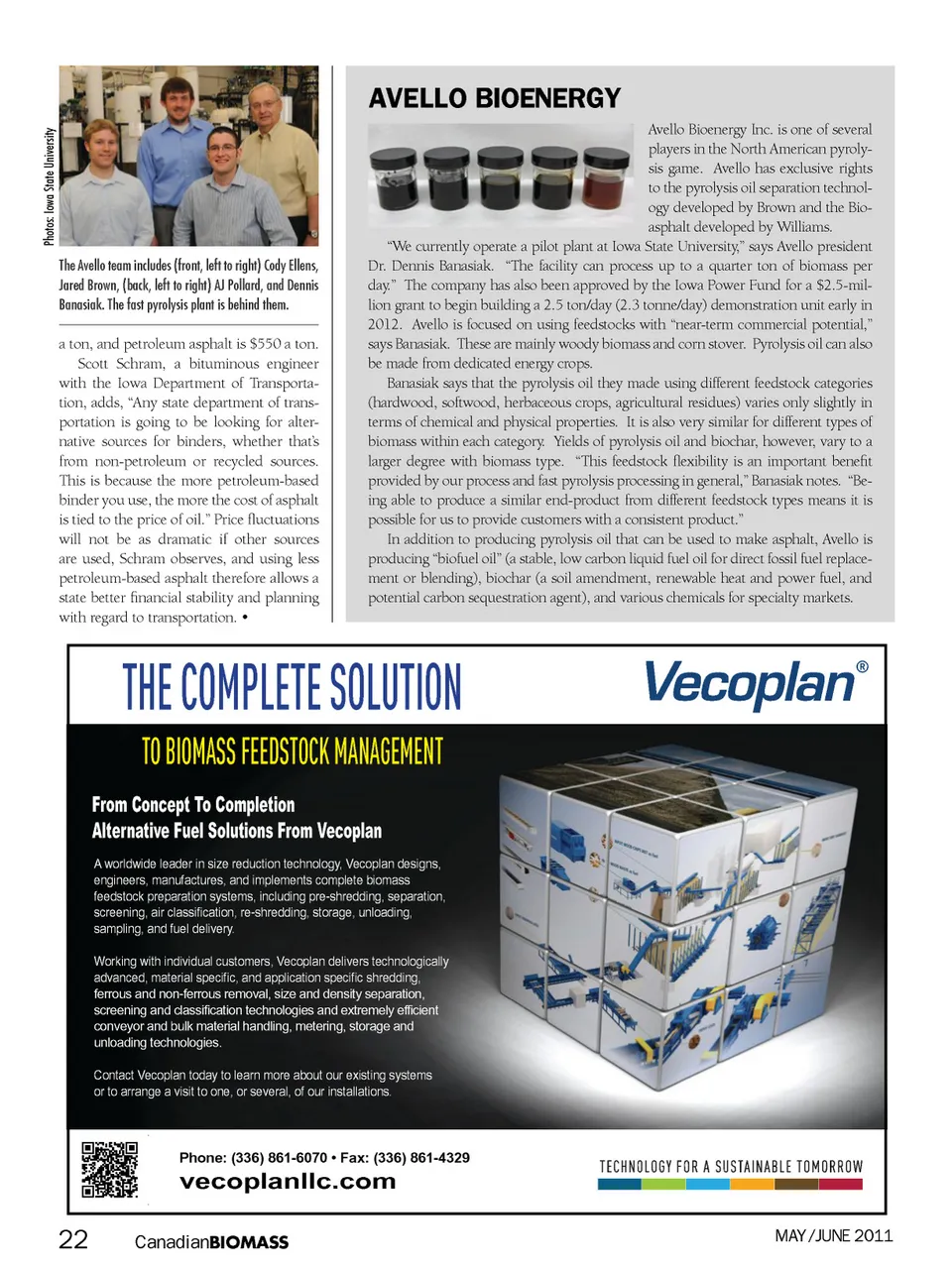
aveLLo bioenergy Avello Bioenergy Inc. is one of several players in the North American pyroly-sis game. Avello has exclusive rights to the pyrolysis oil separation technol-ogy developed by Brown and the Bio-asphalt developed by Williams. “We currently operate a pilot plant at Iowa State University,” says Avello president Dr. Dennis Banasiak. “The facility can process up to a quarter ton of biomass per day.” The company has also been approved by the Iowa Power Fund for a $2.5-mil-lion grant to begin building a 2.5 ton/day (2.3 tonne/day) demonstration unit early in 2012. Avello is focused on using feedstocks with “near-term commercial potential,” says Banasiak. These are mainly woody biomass and corn stover. Pyrolysis oil can also be made from dedicated energy crops. Banasiak says that the pyrolysis oil they made using different feedstock categories (hardwood, softwood, herbaceous crops, agricultural residues) varies only slightly in terms of chemical and physical properties. It is also very similar for different types of biomass within each category. Yields of pyrolysis oil and biochar, however, vary to a larger degree with biomass type. “This feedstock flexibility is an important benefit provided by our process and fast pyrolysis processing in general,” Banasiak notes. “Be-ing able to produce a similar end-product from different feedstock types means it is possible for us to provide customers with a consistent product.” In addition to producing pyrolysis oil that can be used to make asphalt, Avello is producing “biofuel oil” (a stable, low carbon liquid fuel oil for direct fossil fuel replace-ment or blending), biochar (a soil amendment, renewable heat and power fuel, and potential carbon sequestration agent), and various chemicals for specialty markets. Photos: Iowa State University The Avello team includes (front, left to right) Cody Ellens, Jared Brown, (back, left to right) AJ Pollard, and Dennis Banasiak. The fast pyrolysis plant is behind them. a ton, and petroleum asphalt is $550 a ton. Scott Schram, a bituminous engineer with the Iowa Department of Transporta-tion, adds, “Any state department of trans-portation is going to be looking for alter-native sources for binders, whether that’s from non-petroleum or recycled sources. This is because the more petroleum-based binder you use, the more the cost of asphalt is tied to the price of oil.” Price fluctuations will not be as dramatic if other sources are used, Schram observes, and using less petroleum-based asphalt therefore allows a state better financial stability and planning with regard to transportation. • THE COMPLETE SOLUTION TO BIOMASS FEEDSTOCK MANAGEMENT From Concept To Completion Alternative Fuel Solutions From Vecoplan A worldwide leader in size reduction technology, Vecoplan designs, engineers, manufactures, and implements complete biomass feedstock preparation systems, including pre-shredding, separation, screening, air classification, re-shredding, storage, unloading, sampling, and fuel delivery. Working with individual customers, Vecoplan delivers technologically advanced, material specific, and application specific shredding, ferrous and non-ferrous removal, size and density separation, screening and classification technologies and extremely efficient conveyor and bulk material handling, metering, storage and unloading technologies. Contact Vecoplan today to learn more about our existing systems or to arrange a visit to one, or several, of our installations. Phone: (336) 861-6070 • Fax: (336) 861-4329 vecoplanllc.com 22 Canadian BIOMASS MAY/JUNE 2011
Canadian Biomass May/June 2011: Page 22