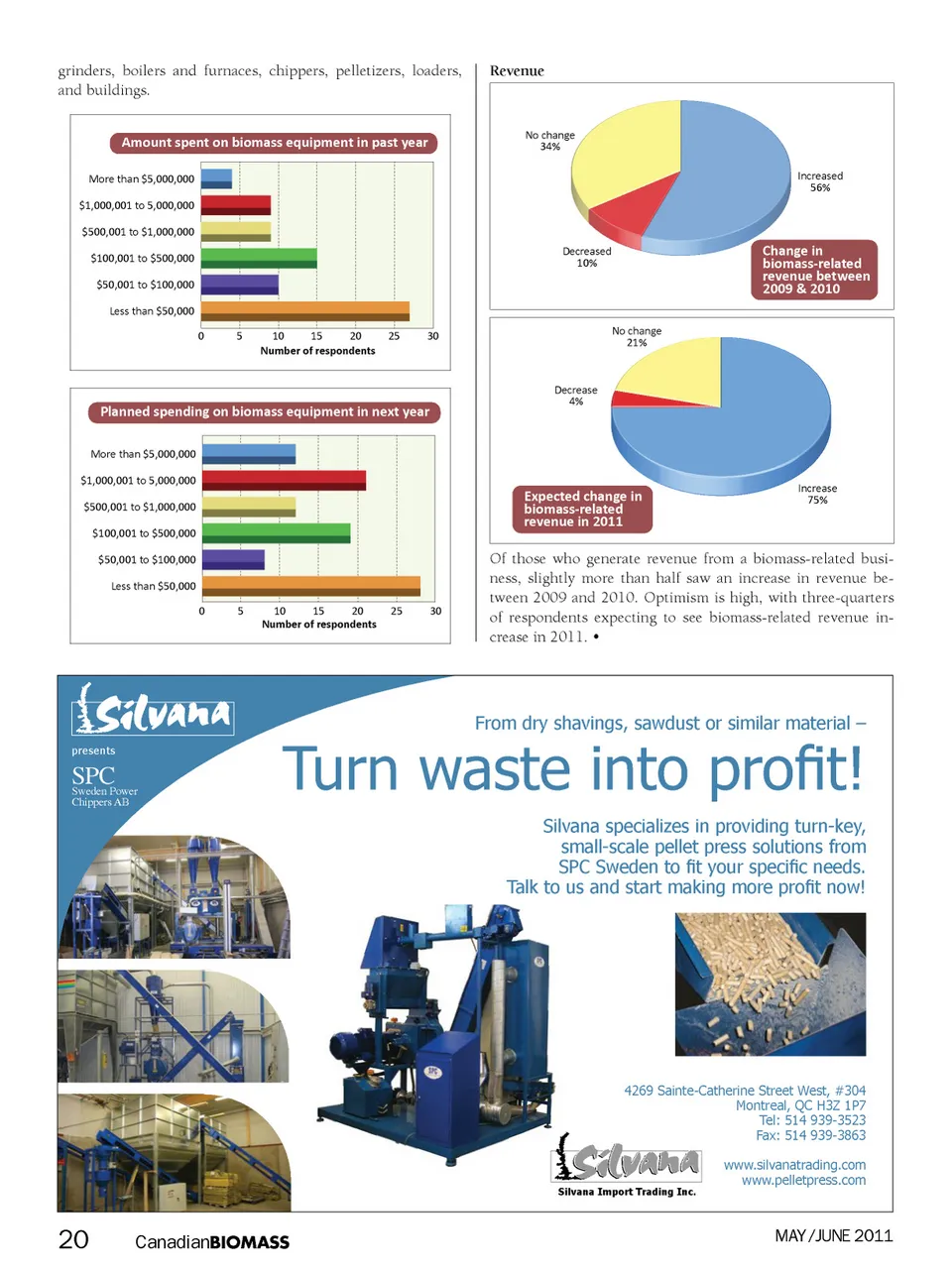
Biomass Innovations Paving with Wood Photo: Anthony Pollard, Avello BioEnergy Pyrolysis oil from wood is being used to make new asphalt that costs less than the old standby. By Treena Hein A lmosT everywhere on the planet, peo-ple are taking a hard look at fuel and other products made from petroleum, and some are coming up with exciting renewable alternatives. One of these is Bioasphalt, made from wood-based, fractionated pyrolysis oil and cur-rently being tested on a bike trail near Iowa State University (ISU). “I was down at the trail last week with other people and we couldn’t discern any difference between Bioasphalt and the pe-troleum-based material,” says Dr. Christo-pher Williams, associate ISU professor of civil, construction, and environmental en-gineering, who created Bioasphalt. “It was placed October 6 and has made it through the winter with no low-temperature crack-ing. We’re also doing lab test comparisons and have so far found that moisture sensi-tivity is better with the Bioasphalt.” The idea came from Williams’ thinking on the plastics industry. “In plastics, they use lignin as an antioxidant; it prevents materials from losing their pliability and elasticity,” he says. “This is the same thing we want to have with asphalt. We want to protect it from temperature-related crack-ing and oxidative aging cracking, and so testing a wood-based bio-oil to replace the crude petroleum component of asphalt was a logical first step.” The pyrolysis oil used by Williams to make the Bioasphalt was produced at the fast pyrolysis pilot plant at ISU’s BioCentury Research Farm. The research and develop-ment of the technologies used at this facility were led by Dr. Robert C. Brown, an Anson Marston Distinguished Professor of Engi-neering, the Gary and Donna Hoover Chair in Mechanical Engineering, and director of ISU’s Bioeconomy Institute. Three of Brown’s former graduate students, Jared Brown, Cody Ellens, and Anthony Pollard, have cre-ated a startup company called Avello Bioen-ergy Inc., which is currently leasing ISU’s py-rolysis pilot plant (see sidebar on page 22). Fast pyrolysis is a thermochemical process in which some type of biomass is quickly heated without oxygen, resulting in liquid pyrolysis oil, solid biochar, and other products. “Avello fractionates this in a process analogous to petroleum refining,” notes Williams. “With the bio-oil used in Bioasphalt, the heavy fractions with low moisture content are taken, and all the wa-ter is removed. At the same time, a polymer matrix is created.” The bike trail Bioasphalt contains 3% Avello pyrolysis oil and 97% crude petro-leum. These proportions were mainly due to the small size of the pilot plant. “It took two weeks to produce the 600 pounds (272 kilo-grams) of bio-oil we needed,” says Williams. “If we had wanted to use 25%, it would have taken two to three months with our pilot plant. Avello is in the process of planning and building a demonstration-scale facility capable of producing much larger quanti-ties for additional demonstration projects.” He believes a little more tweaking of low-temperature performance is needed before 100% Bioasphalt could be used throughout the United States and Canada. Williams sees the product as providing many important benefits. “It could create a new market for crop residues and provide jobs in rural areas,” he says. “Bioasphalt can be mixed and paved at lower temperatures than conventional asphalt, and once you get above 10%, the cost savings really start to become realized.” Bioasphalt costs $400 Grimes Asphalt and Paving Corp. of Grimes, Iowa, uses an asphalt-pyrolysis oil formulation to test-pave a bike trail near Iowa State University. Canadian BIOMASS 21
Canadian Biomass May/June 2011: Page 21