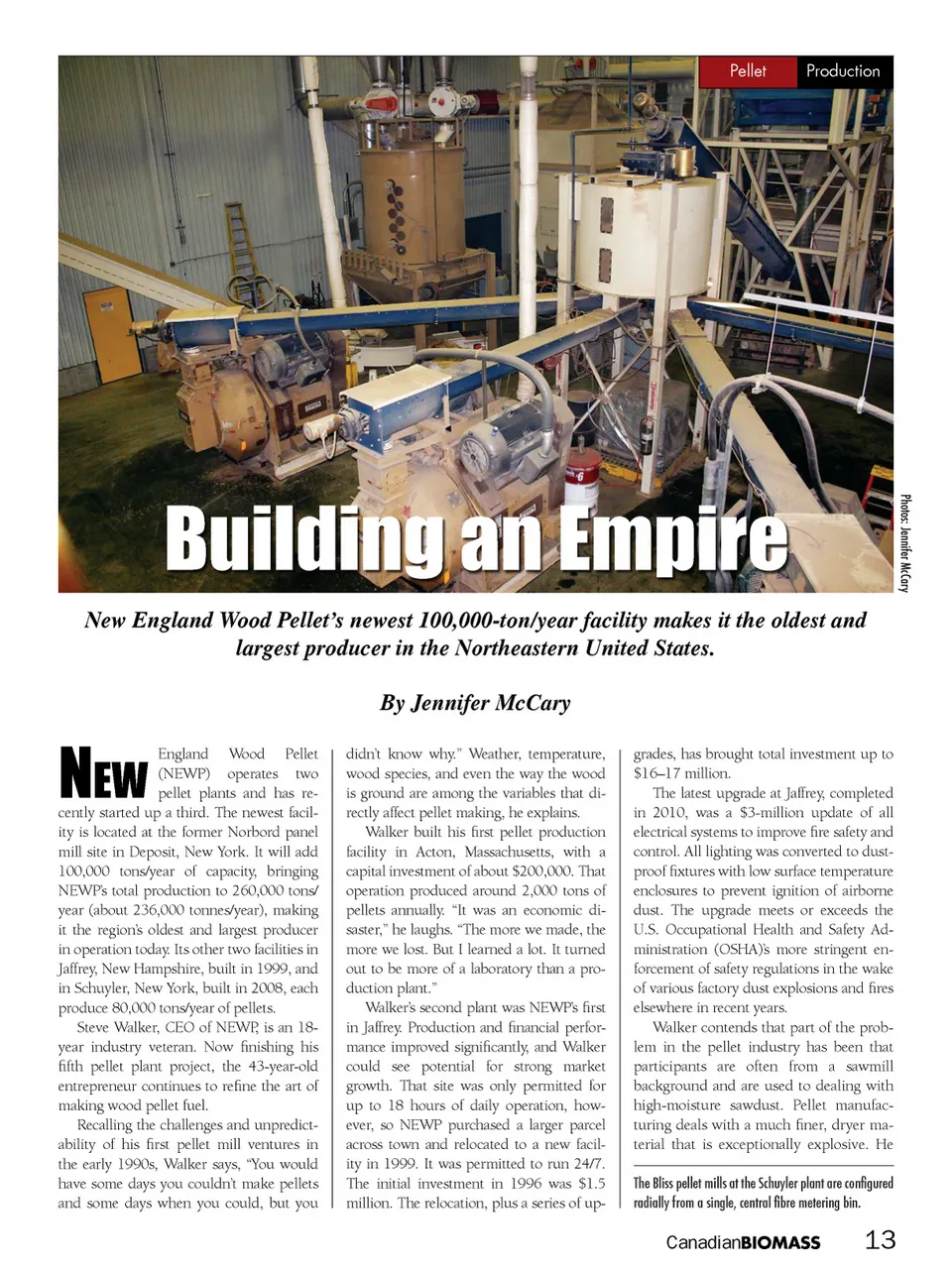
Pellet Production Building an Empire New England Wood Pellet’s newest 100,000-ton/year facility makes it the oldest and largest producer in the Northeastern United States. By Jennifer McCary England Wood Pellet (NEWP) operates two pellet plants and has re-cently started up a third. The newest facil-ity is located at the former Norbord panel mill site in Deposit, New York. It will add 100,000 tons/year of capacity, bringing NEWP’s total production to 260,000 tons/ year (about 236,000 tonnes/year), making it the region’s oldest and largest producer in operation today. Its other two facilities in Jaffrey, New Hampshire, built in 1999, and in Schuyler, New York, built in 2008, each produce 80,000 tons/year of pellets. Steve Walker, CEO of NEWP , is an 18-year industry veteran. Now finishing his fifth pellet plant project, the 43-year-old entrepreneur continues to refine the art of making wood pellet fuel. Recalling the challenges and unpredict-ability of his first pellet mill ventures in the early 1990s, Walker says, “You would have some days you couldn’t make pellets and some days when you could, but you Photos: Jennifer McCary n Ew didn’t know why.” Weather, temperature, wood species, and even the way the wood is ground are among the variables that di-rectly affect pellet making, he explains. Walker built his first pellet production facility in Acton, Massachusetts, with a capital investment of about $200,000. That operation produced around 2,000 tons of pellets annually. “It was an economic di-saster,” he laughs. “The more we made, the more we lost. But I learned a lot. It turned out to be more of a laboratory than a pro-duction plant.” Walker’s second plant was NEWP’s first in Jaffrey. Production and financial perfor-mance improved significantly, and Walker could see potential for strong market growth. That site was only permitted for up to 18 hours of daily operation, how-ever, so NEWP purchased a larger parcel across town and relocated to a new facil-ity in 1999. It was permitted to run 24/7. The initial investment in 1996 was $1.5 million. The relocation, plus a series of up-grades, has brought total investment up to $16–17 million. The latest upgrade at Jaffrey, completed in 2010, was a $3-million update of all electrical systems to improve fire safety and control. All lighting was converted to dust-proof fixtures with low surface temperature enclosures to prevent ignition of airborne dust. The upgrade meets or exceeds the U.S. Occupational Health and Safety Ad-ministration (OSHA)’s more stringent en-forcement of safety regulations in the wake of various factory dust explosions and fires elsewhere in recent years. Walker contends that part of the prob-lem in the pellet industry has been that participants are often from a sawmill background and are used to dealing with high-moisture sawdust. Pellet manufac-turing deals with a much finer, dryer ma-terial that is exceptionally explosive. He The Bliss pellet mills at the Schuyler plant are configured radially from a single, central fibre metering bin. Canadian BIOMASS 13
Canadian Biomass May/June 2011: Page 13