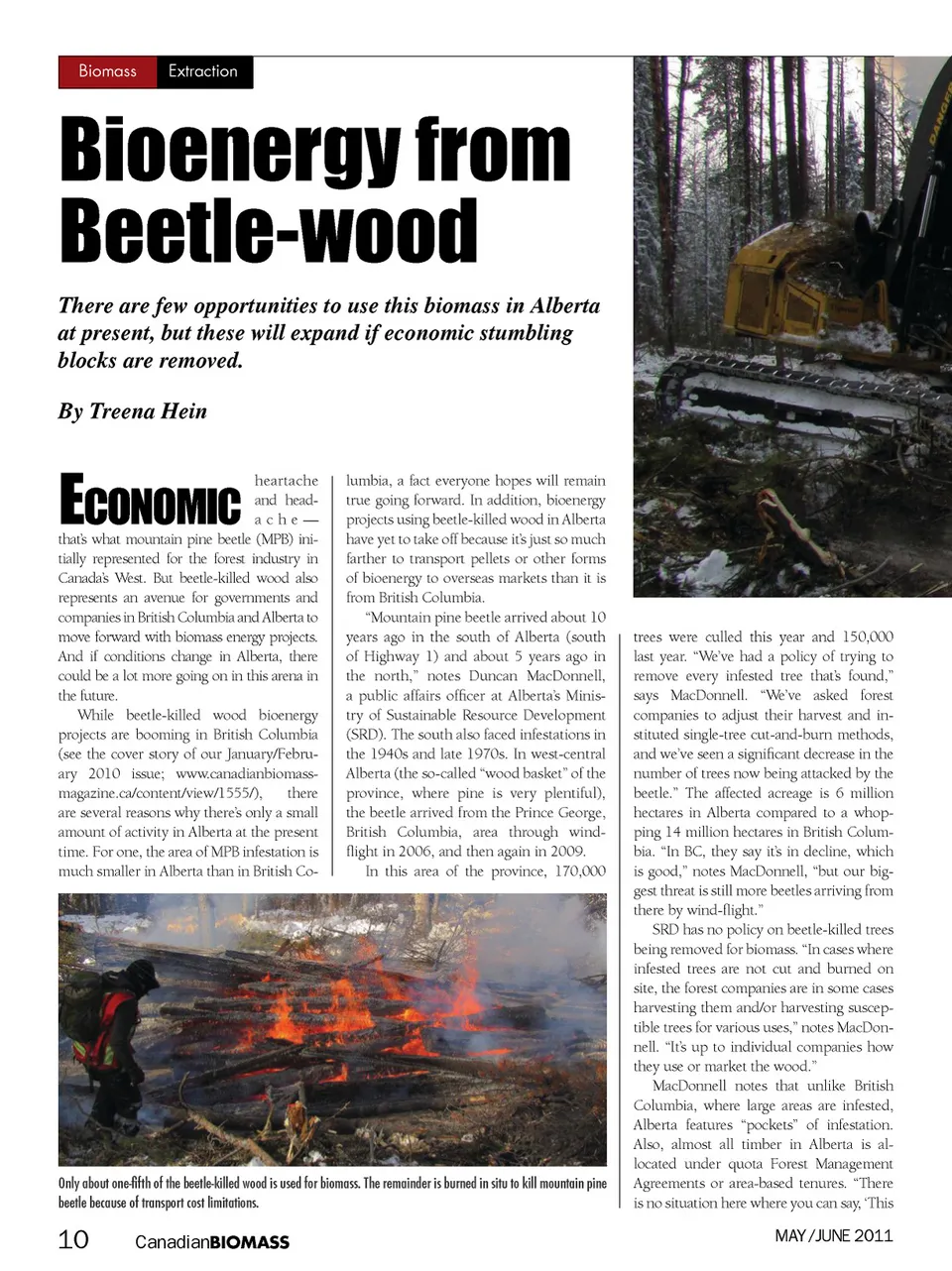
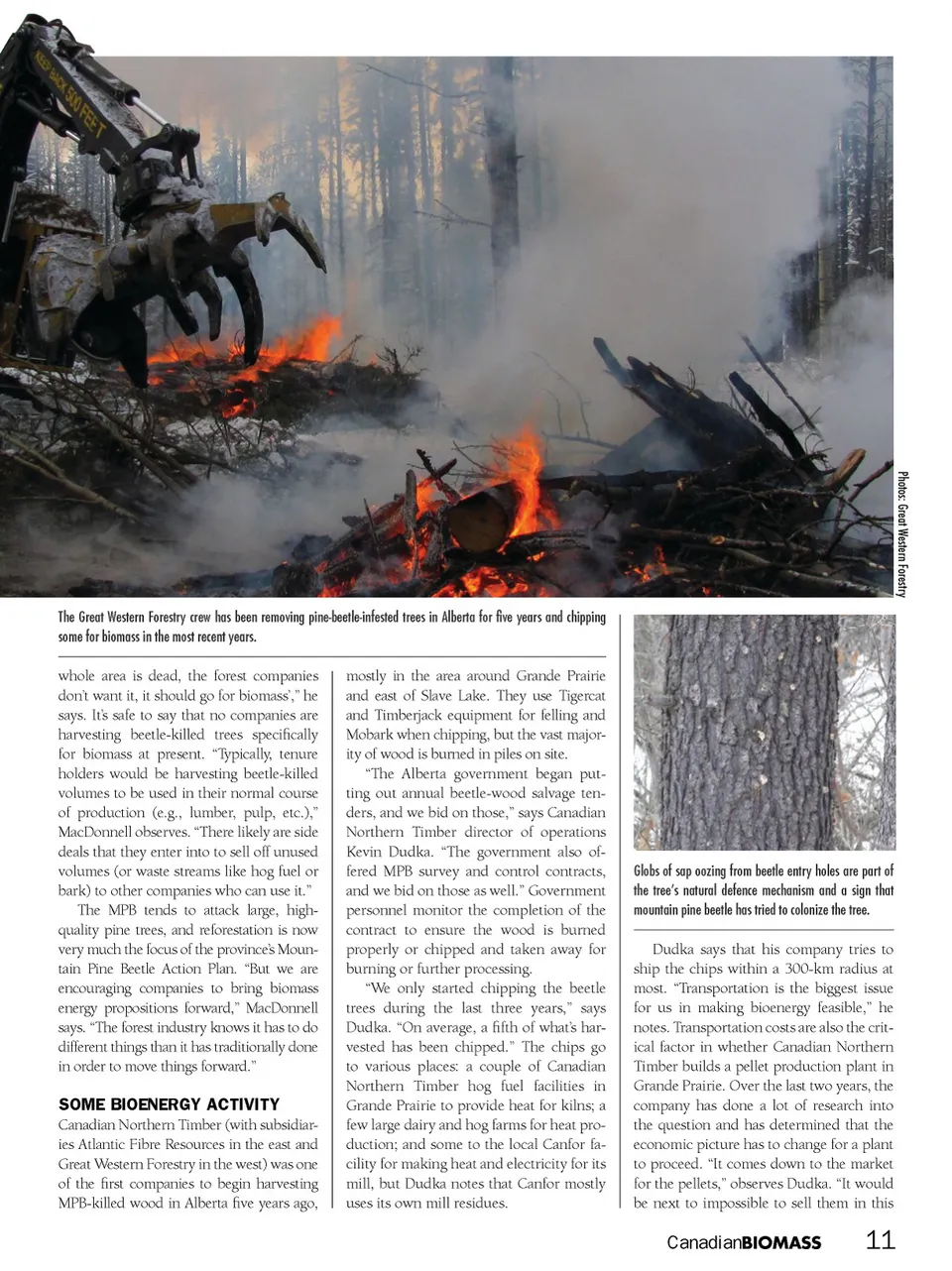
Photos: Great Western Forestry The Great Western Forestry crew has been removing pine-beetle-infested trees in Alberta for five years and chipping some for biomass in the most recent years. whole area is dead, the forest companies don’t want it, it should go for biomass’,” he says. It’s safe to say that no companies are harvesting beetle-killed trees specifically for biomass at present. “Typically, tenure holders would be harvesting beetle-killed volumes to be used in their normal course of production (e.g., lumber, pulp, etc.),” MacDonnell observes. “There likely are side deals that they enter into to sell off unused volumes (or waste streams like hog fuel or bark) to other companies who can use it.” The MPB tends to attack large, high-quality pine trees, and reforestation is now very much the focus of the province’s Moun-tain Pine Beetle Action Plan. “But we are encouraging companies to bring biomass energy propositions forward,” MacDonnell says. “The forest industry knows it has to do different things than it has traditionally done in order to move things forward.” some bioenergy activity Canadian Northern Timber (with subsidiar-ies Atlantic Fibre Resources in the east and Great Western Forestry in the west) was one of the first companies to begin harvesting MPB-killed wood in Alberta five years ago, mostly in the area around Grande Prairie and east of Slave Lake. They use Tigercat and Timberjack equipment for felling and Mobark when chipping, but the vast major-ity of wood is burned in piles on site. “The Alberta government began put-ting out annual beetle-wood salvage ten-ders, and we bid on those,” says Canadian Northern Timber director of operations Kevin Dudka. “The government also of-fered MPB survey and control contracts, and we bid on those as well.” Government personnel monitor the completion of the contract to ensure the wood is burned properly or chipped and taken away for burning or further processing. “We only started chipping the beetle trees during the last three years,” says Dudka. “On average, a fifth of what’s har-vested has been chipped.” The chips go to various places: a couple of Canadian Northern Timber hog fuel facilities in Grande Prairie to provide heat for kilns; a few large dairy and hog farms for heat pro-duction; and some to the local Canfor fa-cility for making heat and electricity for its mill, but Dudka notes that Canfor mostly uses its own mill residues. Globs of sap oozing from beetle entry holes are part of the tree’s natural defence mechanism and a sign that mountain pine beetle has tried to colonize the tree. Dudka says that his company tries to ship the chips within a 300-km radius at most. “Transportation is the biggest issue for us in making bioenergy feasible,” he notes. Transportation costs are also the crit-ical factor in whether Canadian Northern Timber builds a pellet production plant in Grande Prairie. Over the last two years, the company has done a lot of research into the question and has determined that the economic picture has to change for a plant to proceed. “It comes down to the market for the pellets,” observes Dudka. “It would be next to impossible to sell them in this Canadian BIOMASS 11
Canadian Biomass May/June 2011: Page 11