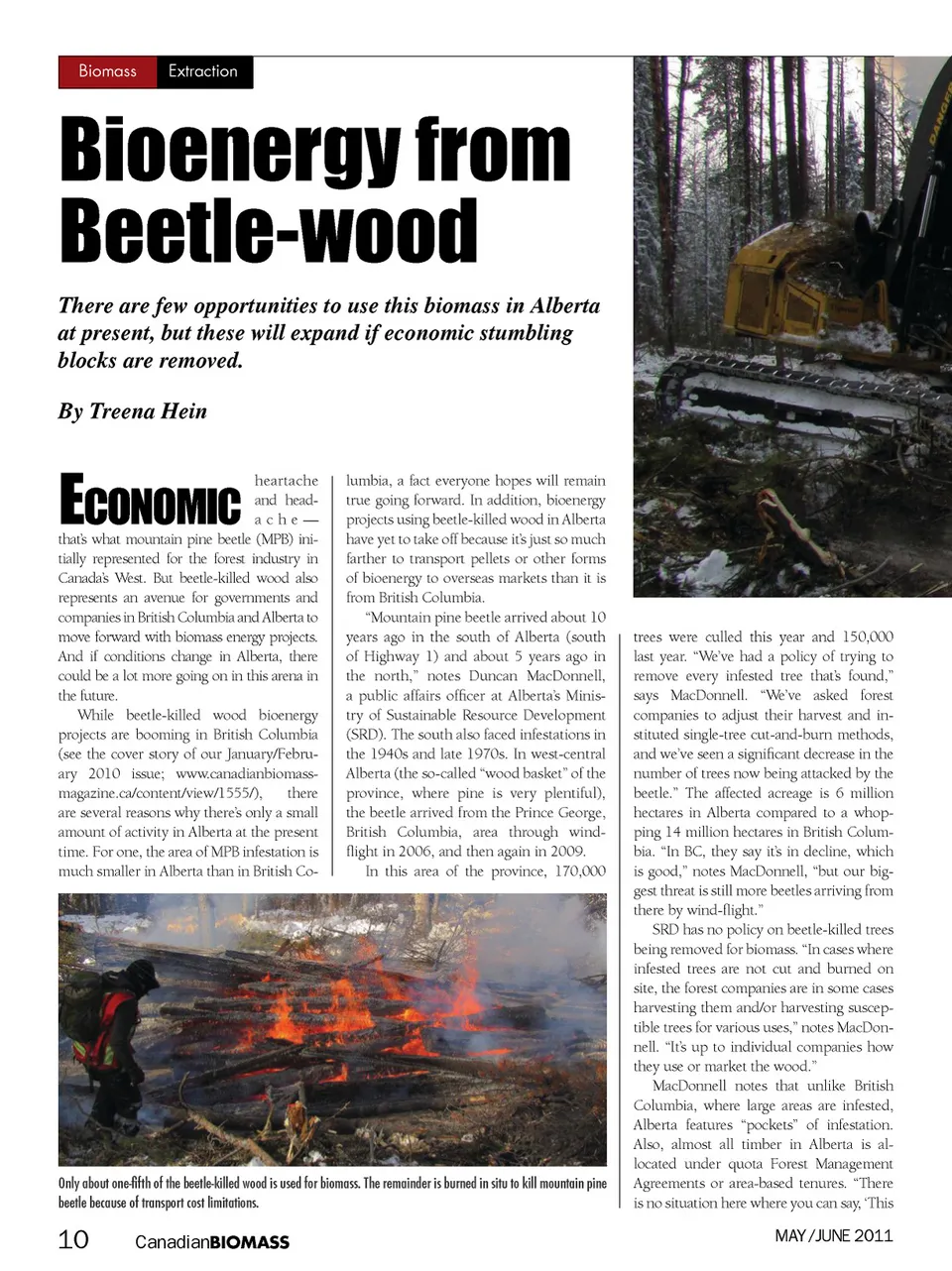
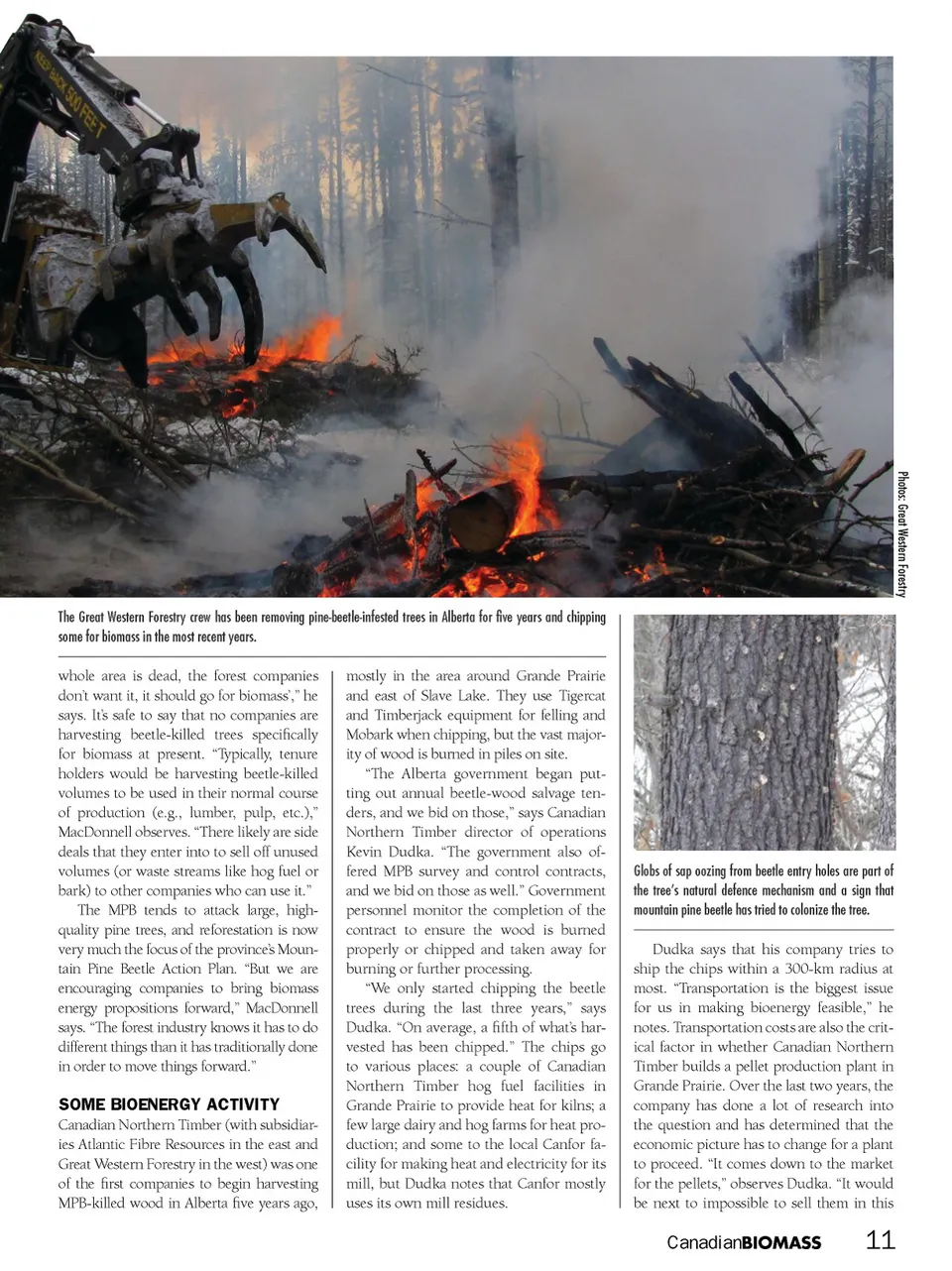
Biomass Extraction Bioenergy from Beetle-wood There are few opportunities to use this biomass in Alberta at present, but these will expand if economic stumbling blocks are removed. By Treena Hein heartache and head-ache— that’s what mountain pine beetle (MPB) ini-tially represented for the forest industry in Canada’s West. But beetle-killed wood also represents an avenue for governments and companies in British Columbia and Alberta to move forward with biomass energy projects. And if conditions change in Alberta, there could be a lot more going on in this arena in the future. While beetle-killed wood bioenergy projects are booming in British Columbia (see the cover story of our January/Febru-ary 2010 issue; www.canadianbiomass-magazine.ca/content/view/1555/), there are several reasons why there’s only a small amount of activity in Alberta at the present time. For one, the area of MPB infestation is much smaller in Alberta than in British Co-E conomic lumbia, a fact everyone hopes will remain true going forward. In addition, bioenergy projects using beetle-killed wood in Alberta have yet to take off because it’s just so much farther to transport pellets or other forms of bioenergy to overseas markets than it is from British Columbia. “Mountain pine beetle arrived about 10 years ago in the south of Alberta (south of Highway 1) and about 5 years ago in the north,” notes Duncan MacDonnell, a public affairs officer at Alberta’s Minis-try of Sustainable Resource Development (SRD). The south also faced infestations in the 1940s and late 1970s. In west-central Alberta (the so-called “wood basket” of the province, where pine is very plentiful), the beetle arrived from the Prince George, British Columbia, area through wind-flight in 2006, and then again in 2009. In this area of the province, 170,000 Only about one-fifth of the beetle-killed wood is used for biomass. The remainder is burned in situ to kill mountain pine beetle because of transport cost limitations. trees were culled this year and 150,000 last year. “We’ve had a policy of trying to remove every infested tree that’s found,” says MacDonnell. “We’ve asked forest companies to adjust their harvest and in-stituted single-tree cut-and-burn methods, and we’ve seen a significant decrease in the number of trees now being attacked by the beetle.” The affected acreage is 6 million hectares in Alberta compared to a whop-ping 14 million hectares in British Colum-bia. “In BC, they say it’s in decline, which is good,” notes MacDonnell, “but our big-gest threat is still more beetles arriving from there by wind-flight.” SRD has no policy on beetle-killed trees being removed for biomass. “In cases where infested trees are not cut and burned on site, the forest companies are in some cases harvesting them and/or harvesting suscep-tible trees for various uses,” notes MacDon-nell. “It’s up to individual companies how they use or market the wood.” MacDonnell notes that unlike British Columbia, where large areas are infested, Alberta features “pockets” of infestation. Also, almost all timber in Alberta is al-located under quota Forest Management Agreements or area-based tenures. “There is no situation here where you can say, ‘This MAY/JUNE 2011 10 Canadian BIOMASS
Canadian Biomass May/June 2011: Page 10