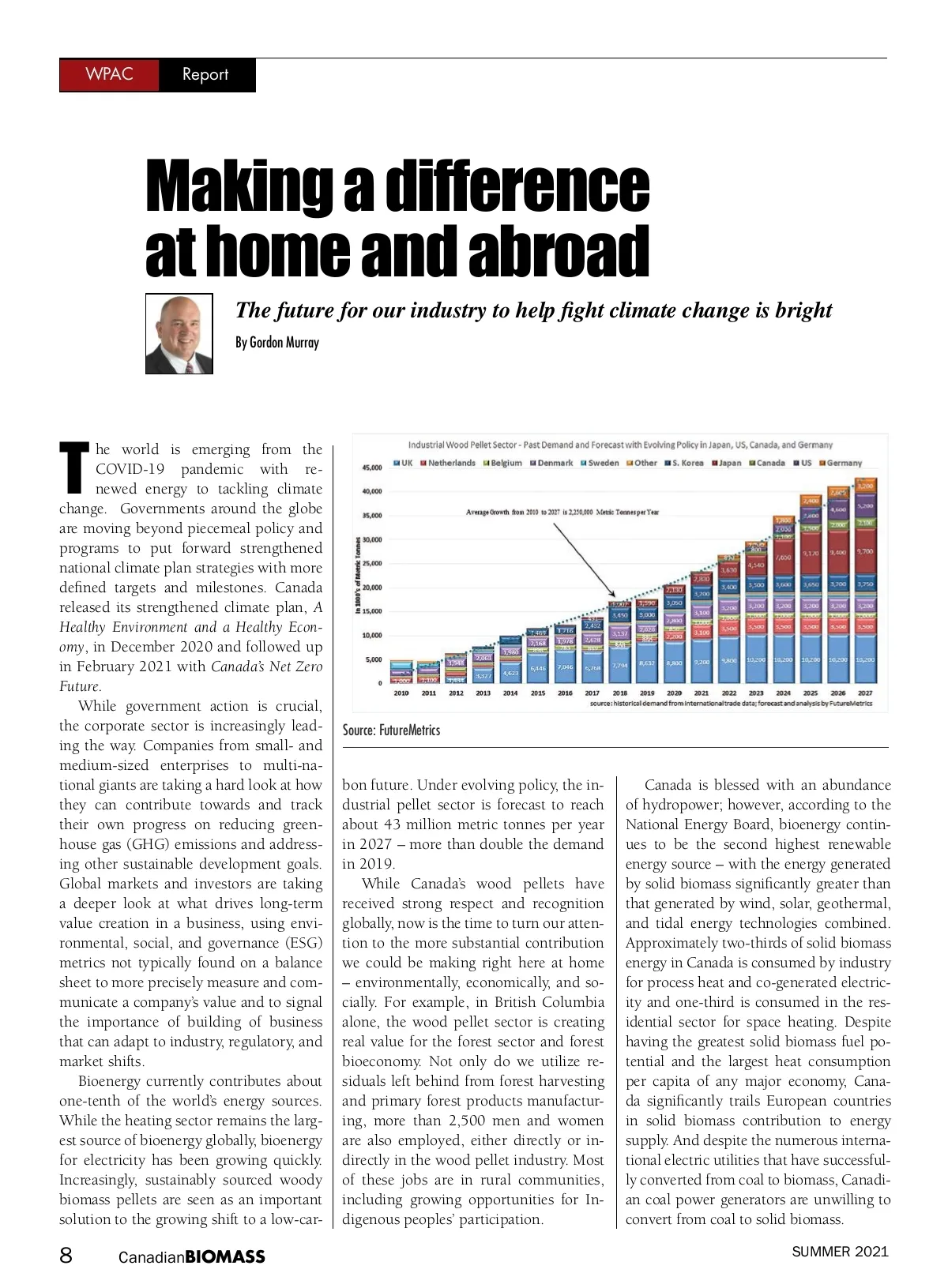
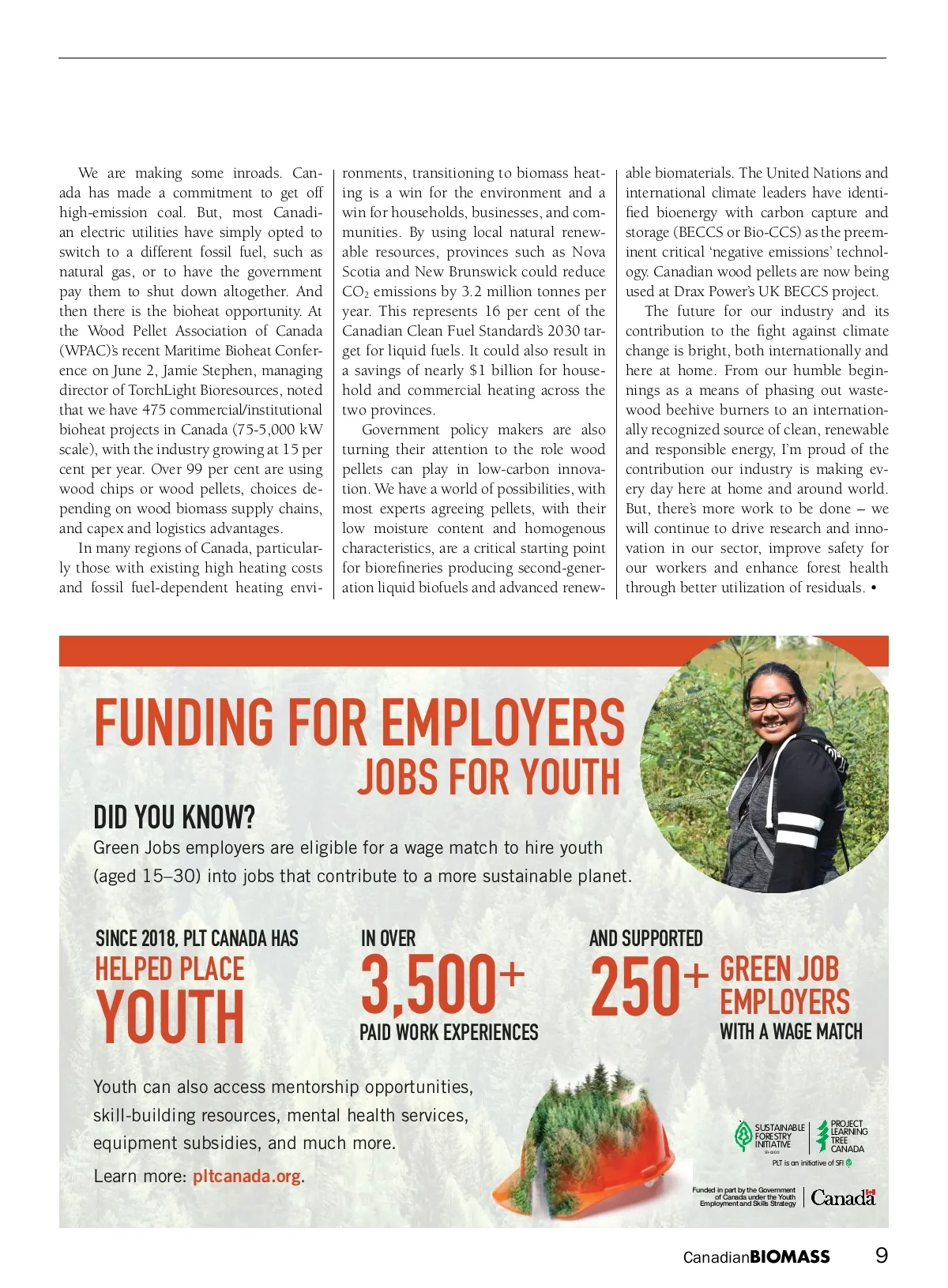
WPAC Report Making a difference at home and abroad By Gordon Murray The future for our industry to help fight climate change is bright he world is emerging from the COVID-19 pandemic with re-newed energy to tackling climate change. Governments around the globe are moving beyond piecemeal policy and programs to put forward strengthened national climate plan strategies with more defined targets and milestones. Canada released its strengthened climate plan, A Healthy Environment and a Healthy Econ-omy , in December 2020 and followed up in February 2021 with Canada’s Net Zero Future. While government action is crucial, the corporate sector is increasingly lead-ing the way. Companies from small-and medium-sized enterprises to multi-na-tional giants are taking a hard look at how they can contribute towards and track their own progress on reducing green-house gas (GHG) emissions and address-ing other sustainable development goals. Global markets and investors are taking a deeper look at what drives long-term value creation in a business, using envi-ronmental, social, and governance (ESG) metrics not typically found on a balance sheet to more precisely measure and com-municate a company’s value and to signal the importance of building of business that can adapt to industry, regulatory, and market shifts. Bioenergy currently contributes about one-tenth of the world’s energy sources. While the heating sector remains the larg-est source of bioenergy globally, bioenergy for electricity has been growing quickly. Increasingly, sustainably sourced woody biomass pellets are seen as an important solution to the growing shift to a low-car-T Source: FutureMetrics bon future. Under evolving policy, the in-dustrial pellet sector is forecast to reach about 43 million metric tonnes per year in 2027 – more than double the demand in 2019. While Canada’s wood pellets have received strong respect and recognition globally, now is the time to turn our atten-tion to the more substantial contribution we could be making right here at home – environmentally, economically, and so-cially. For example, in British Columbia alone, the wood pellet sector is creating real value for the forest sector and forest bioeconomy. Not only do we utilize re-siduals left behind from forest harvesting and primary forest products manufactur-ing, more than 2,500 men and women are also employed, either directly or in-directly in the wood pellet industry. Most of these jobs are in rural communities, including growing opportunities for In-digenous peoples’ participation. Canada is blessed with an abundance of hydropower; however, according to the National Energy Board, bioenergy contin-ues to be the second highest renewable energy source – with the energy generated by solid biomass significantly greater than that generated by wind, solar, geothermal, and tidal energy technologies combined. Approximately two-thirds of solid biomass energy in Canada is consumed by industry for process heat and co-generated electric-ity and one-third is consumed in the res-idential sector for space heating. Despite having the greatest solid biomass fuel po-tential and the largest heat consumption per capita of any major economy, Cana-da significantly trails European countries in solid biomass contribution to energy supply. And despite the numerous interna-tional electric utilities that have successful-ly converted from coal to biomass, Canadi-an coal power generators are unwilling to convert from coal to solid biomass. SUMMER 2021 8 Canadian BIOMASS
Canadian Biomass Summer 2021: Page 8