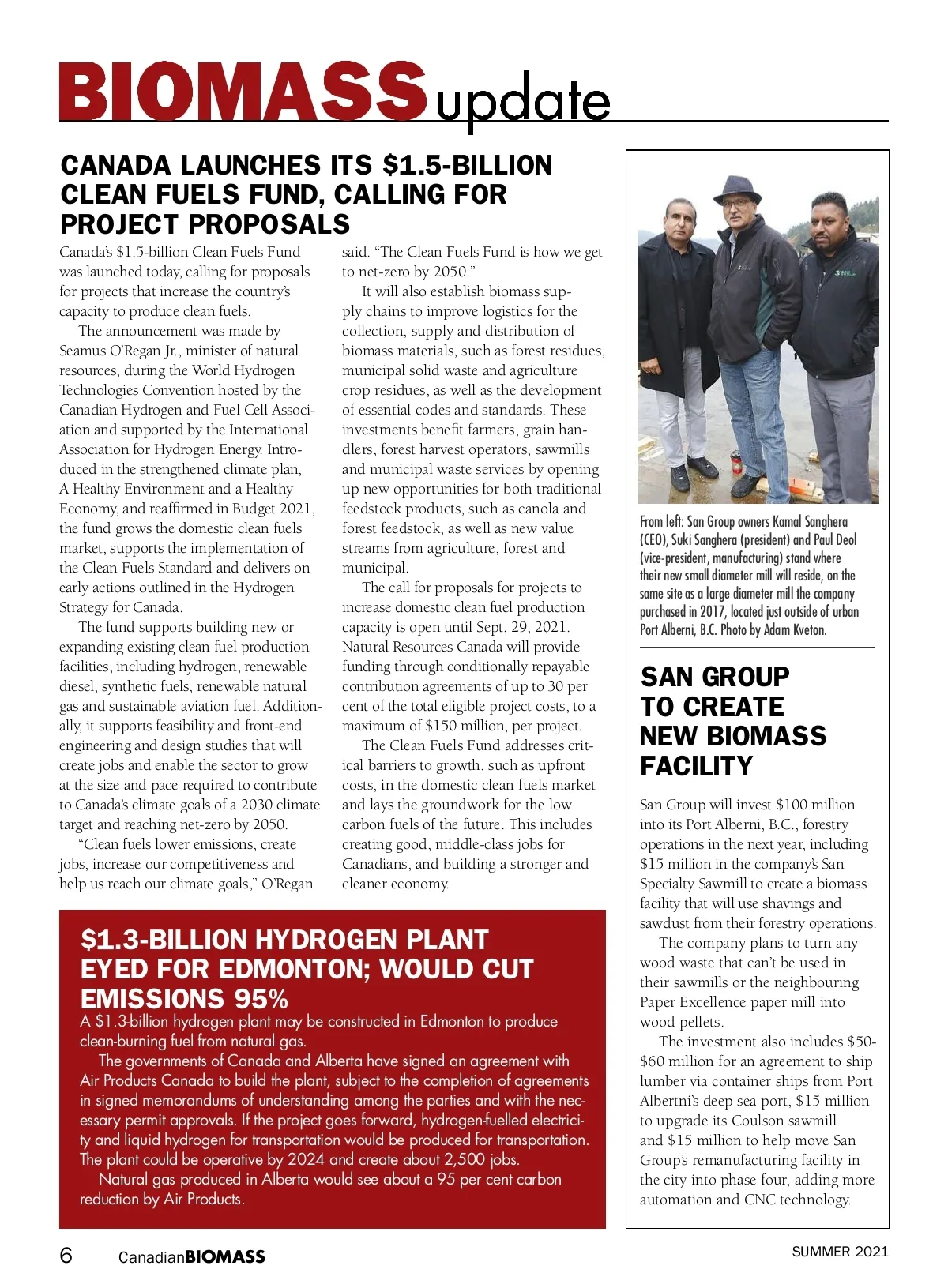
CANADA LAUNCHES ITS $1.5-BILLION CLEAN FUELS FUND, CALLING FOR PROJECT PROPOSALS Canada’s $1.5-billion Clean Fuels Fund was launched today, calling for proposals for projects that increase the country’s capacity to produce clean fuels. The announcement was made by Seamus O’Regan Jr., minister of natural resources, during the World Hydrogen Technologies Convention hosted by the Canadian Hydrogen and Fuel Cell Associ-ation and supported by the International Association for Hydrogen Energy. Intro-duced in the strengthened climate plan, A Healthy Environment and a Healthy Economy, and reaffirmed in Budget 2021, the fund grows the domestic clean fuels market, supports the implementation of the Clean Fuels Standard and delivers on early actions outlined in the Hydrogen Strategy for Canada. The fund supports building new or expanding existing clean fuel production facilities, including hydrogen, renewable diesel, synthetic fuels, renewable natural gas and sustainable aviation fuel. Addition-ally, it supports feasibility and front-end engineering and design studies that will create jobs and enable the sector to grow at the size and pace required to contribute to Canada’s climate goals of a 2030 climate target and reaching net-zero by 2050. “Clean fuels lower emissions, create jobs, increase our competitiveness and help us reach our climate goals,” O’Regan said. “The Clean Fuels Fund is how we get to net-zero by 2050.” It will also establish biomass sup-ply chains to improve logistics for the collection, supply and distribution of biomass materials, such as forest residues, municipal solid waste and agriculture crop residues, as well as the development of essential codes and standards. These investments benefit farmers, grain han-dlers, forest harvest operators, sawmills and municipal waste services by opening up new opportunities for both traditional feedstock products, such as canola and forest feedstock, as well as new value streams from agriculture, forest and municipal. The call for proposals for projects to increase domestic clean fuel production capacity is open until Sept. 29, 2021. Natural Resources Canada will provide funding through conditionally repayable contribution agreements of up to 30 per cent of the total eligible project costs, to a maximum of $150 million, per project. The Clean Fuels Fund addresses crit-ical barriers to growth, such as upfront costs, in the domestic clean fuels market and lays the groundwork for the low carbon fuels of the future. This includes creating good, middle-class jobs for Canadians, and building a stronger and cleaner economy. From left: San Group owners Kamal Sanghera (CEO), Suki Sanghera (president) and Paul Deol (vice-president, manufacturing) stand where their new small diameter mill will reside, on the same site as a large diameter mill the company purchased in 2017, located just outside of urban Port Alberni, B.C. Photo by Adam Kveton. SAN GROUP TO CREATE NEW BIOMASS FACILITY San Group will invest $100 million into its Port Alberni, B.C., forestry operations in the next year, including $15 million in the company’s San Specialty Sawmill to create a biomass facility that will use shavings and sawdust from their forestry operations. The company plans to turn any wood waste that can’t be used in their sawmills or the neighbouring Paper Excellence paper mill into wood pellets. The investment also includes $50-$60 million for an agreement to ship lumber via container ships from Port Albertni’s deep sea port, $15 million to upgrade its Coulson sawmill and $15 million to help move San Group’s remanufacturing facility in the city into phase four, adding more automation and CNC technology. SUMMER 2021 $1.3-BILLION HYDROGEN PLANT EYED FOR EDMONTON; WOULD CUT EMISSIONS 95% A $1.3-billion hydrogen plant may be constructed in Edmonton to produce clean-burning fuel from natural gas. The governments of Canada and Alberta have signed an agreement with Air Products Canada to build the plant, subject to the completion of agreements in signed memorandums of understanding among the parties and with the nec-essary permit approvals. If the project goes forward, hydrogen-fuelled electrici-ty and liquid hydrogen for transportation would be produced for transportation. The plant could be operative by 2024 and create about 2,500 jobs. Natural gas produced in Alberta would see about a 95 per cent carbon reduction by Air Products. 6 Canadian BIOMASS
Canadian Biomass Summer 2021: Page 6