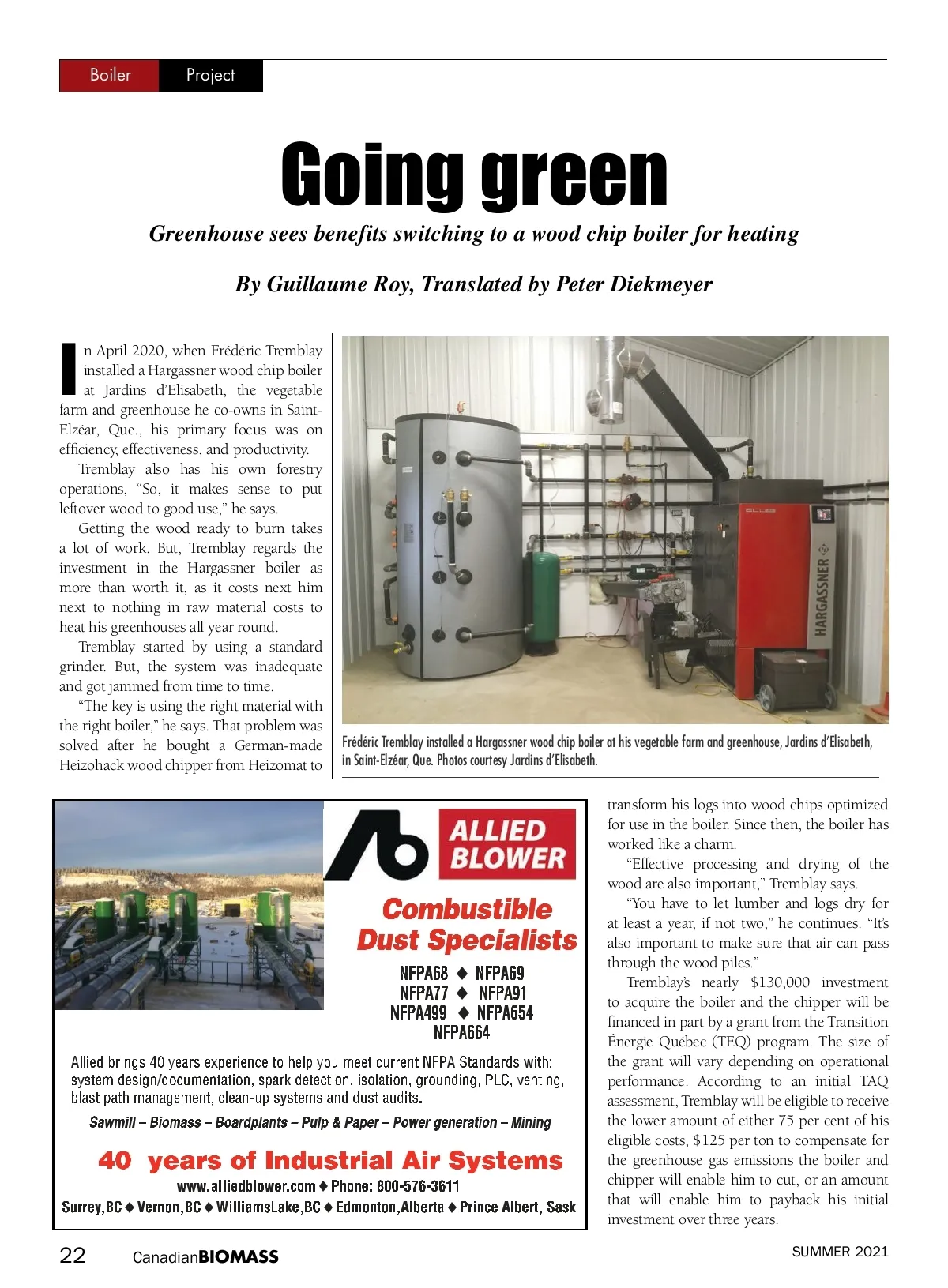
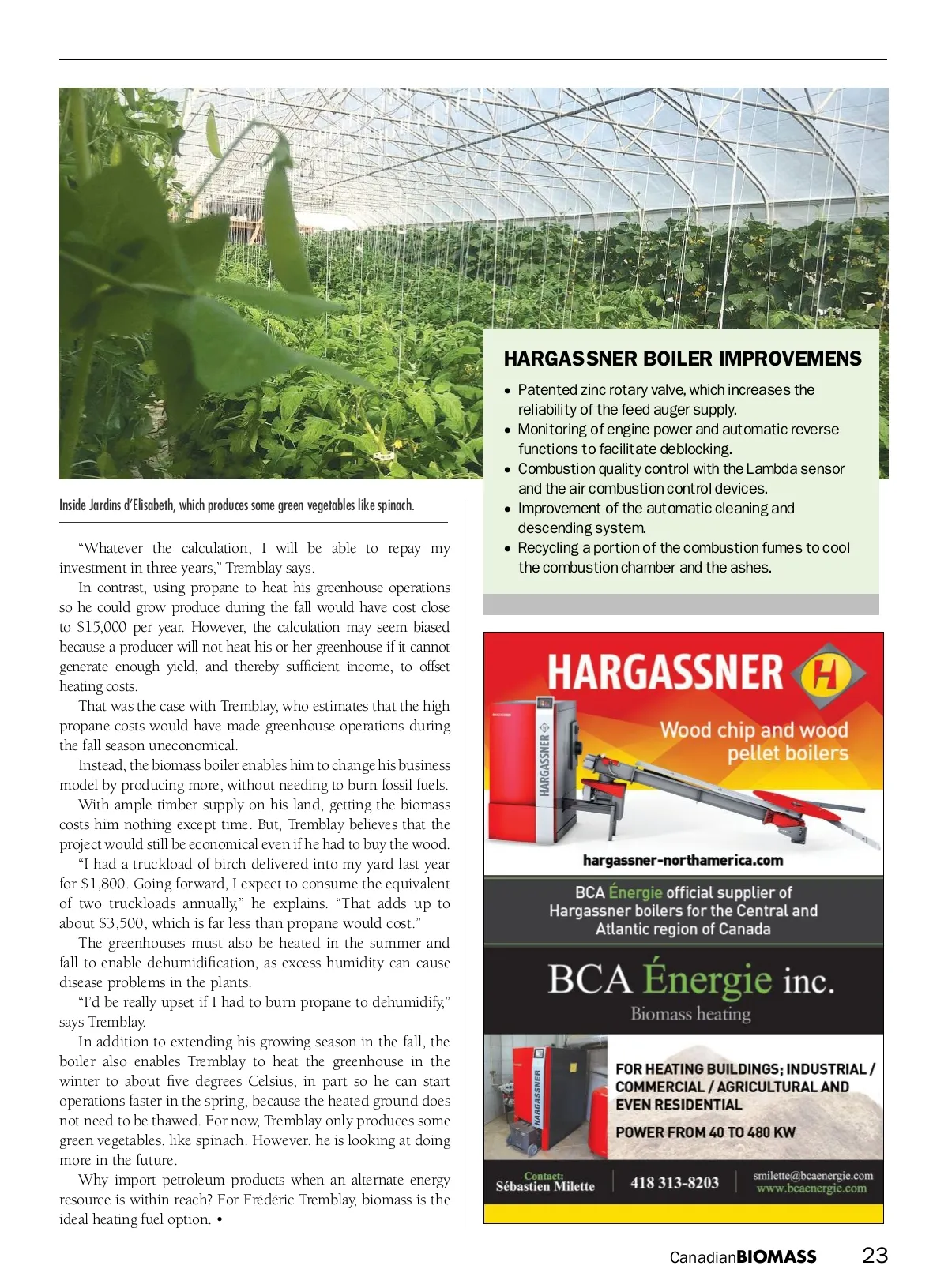
HARGASSNER BOILER IMPROVEMENS • Patented zinc rotary valve, which increases the reliability of the feed auger supply. • Monitoring of engine power and automatic reverse functions to facilitate deblocking. • Combustion quality control with the Lambda sensor and the air combustion control devices. • Improvement of the automatic cleaning and descending system. • Recycling a portion of the combustion fumes to cool the combustion chamber and the ashes. Inside Jardins d’Elisabeth, which produces some green vegetables like spinach. “Whatever the calculation, I will be able to repay my investment in three years,” Tremblay says. In contrast, using propane to heat his greenhouse operations so he could grow produce during the fall would have cost close to $15,000 per year. However, the calculation may seem biased because a producer will not heat his or her greenhouse if it cannot generate enough yield, and thereby sufficient income, to offset heating costs. That was the case with Tremblay, who estimates that the high propane costs would have made greenhouse operations during the fall season uneconomical. Instead, the biomass boiler enables him to change his business model by producing more, without needing to burn fossil fuels. With ample timber supply on his land, getting the biomass costs him nothing except time. But, Tremblay believes that the project would still be economical even if he had to buy the wood. “I had a truckload of birch delivered into my yard last year for $1,800. Going forward, I expect to consume the equivalent of two truckloads annually,” he explains. “That adds up to about $3,500, which is far less than propane would cost.” The greenhouses must also be heated in the summer and fall to enable dehumidification, as excess humidity can cause disease problems in the plants. “I’d be really upset if I had to burn propane to dehumidify,” says Tremblay. In addition to extending his growing season in the fall, the boiler also enables Tremblay to heat the greenhouse in the winter to about five degrees Celsius, in part so he can start operations faster in the spring, because the heated ground does not need to be thawed. For now, Tremblay only produces some green vegetables, like spinach. However, he is looking at doing more in the future. Why import petroleum products when an alternate energy resource is within reach? For Frédéric Tremblay, biomass is the ideal heating fuel option. • Canadian BIOMASS CPM_BCA_Eng_Summer_GWJ.indd 1 23 2021-06-11 11:20 AM
Canadian Biomass Summer 2021: Page 23