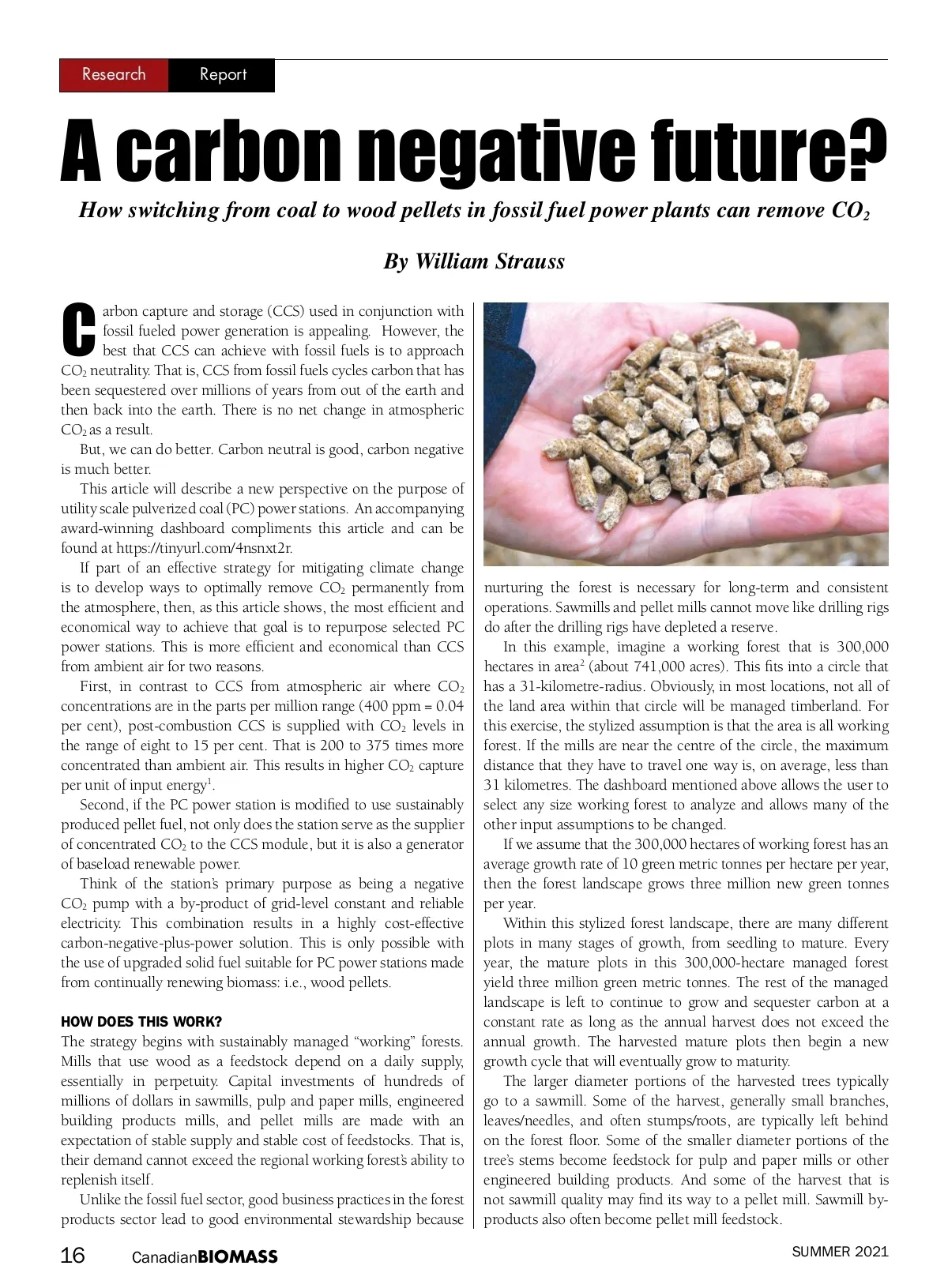
In this model, and in the default settings of the dashboard, five per cent is left on the forest floor, 35 per cent becomes building materials (lumber, flooring, furniture, veneer, OSB, etc.), 20 per cent becomes paper or packaging, and the rest is available to the pellet mill (which also includes some of the sawmill’s sawdust and chip by-products). After accounting for the five per cent left in the forest, of the 2.85 million metric tonnes that is removed from the mature plots, just over 1.1 million green tonnes are available for pellet production. The output of the pellet mill in our stylized model is about 524,000 tonnes per year. The pellet fuel is then transported to the “power” station. Power is in quotes because the station’s purpose is not just for the generation of electricity. The re-purposed power station with bioenergy carbon capture and storage (BECCS) takes the hydrocarbons in the pellet fuel and concentrates the carbon as CO 2 . The BECCS unit permanently removes the CO 2 from the atmosphere. The “by-product” of the CO 2 capture and sequestration is electricity. A FEASIBLE STRATEGY electricity that, in contrast to wind and solar generation, is not intermittent or variable, but is baseload. Many nations are already using pellet fuel in place of coal in PC power stations to lower net CO 2 emissions. The use of pellet fuel in power plants sets the foundation for the strategy outlined in this paper. Wind and solar generation do not have the capacity to be used as efficient negative carbon pumps. Integrating sustainably sourced biomass-based solid fuel that is easily substituted for coal means that some of the existing power stations should have very long lives – not for the primary purpose of renewable power generation (which they will do) but for the purpose of efficiently lowering atmospheric CO 2 concentrations. This is a very attractive strategy that is totally feasible with the current state of technology. It should be part of a portfolio of decarbonization strategies going forward. NOTES Wood, on average, is about 50 per cent carbon. One tonne of carbon atoms produces 3.67 tonnes of CO 2 . The 283,000 tonnes of carbon in the carbohydrate-based pellet fuel releases about 1,040,000 tonnes per year of CO 2 in combustion. Without BECCS, that CO 2 is released into the atmosphere. The new growth in the managed timberlands absorbs all of that and more, since only 40 per cent of the annual new growth becomes pellets. Even without BECCS, the atmosphere sees no net increase in CO 2 from the combustion of pellets that are sourced, provided the total stock of forest resources in the mill’s supply region cannot be depleted. But with BECCS, that 1,040,000 tonnes of CO 2 are permanently subtracted from the atmosphere. The re-purposed PC power station in this model is doing the equivalent of permanently taking about 250,000 cars off the road. And as a valued by-product of an already valuable environmental service, under the assumptions of the model, the equivalent of almost 103,000 homes are supplied with 100 per cent renewable 1. “Current economic analysis estimates a cost of $70–100/tonne of CO2 for carbon capture from flue gas (Vitillo et al., 2017). With only 400 ppm CO2 in air, a DACC process requires a cost between $300 and $1,500 per tonne of CO2 captured (National Academies of Sciences, Engineering, and Medicine, 2019)”. Frontiers in Energy Research, December, 2020; https://www.frontiersin.org/ articles/10.3389/fenrg.2020.560849/pdf 2. To put this into perspective, British Columbia has about 25,000,000 hectares available for logging; or about 83 times more than is in the model used in this analysis. That represents about 42 per cent of the total forested area in B.C. The rest is not available and/or is protected. Source B.C. Ministry of Forests. The states of Georgia, South Carolina, and North Carolina in the U.S. have about a combined 22,240,000 hectares of managed timberland, or about 74 times more than is in the model used in this analysis. Source: American Forest & Paper Association. • William Strauss is the president of FutureMetrics LLC. FIKE DFI™ AVAILABLE IN SIZES UP TO DN800 (32 INCHES) A Flap Valve You Can Trust Tested to exceed EN16447 standards. Validated to work in real-world applications. Because so much is at stake.™ CB_Fike_Summer21_CSA.indd 1 Canadian BIOMASS 2021-07-13 8:08 AM 17
Canadian Biomass Summer 2021: Page 17