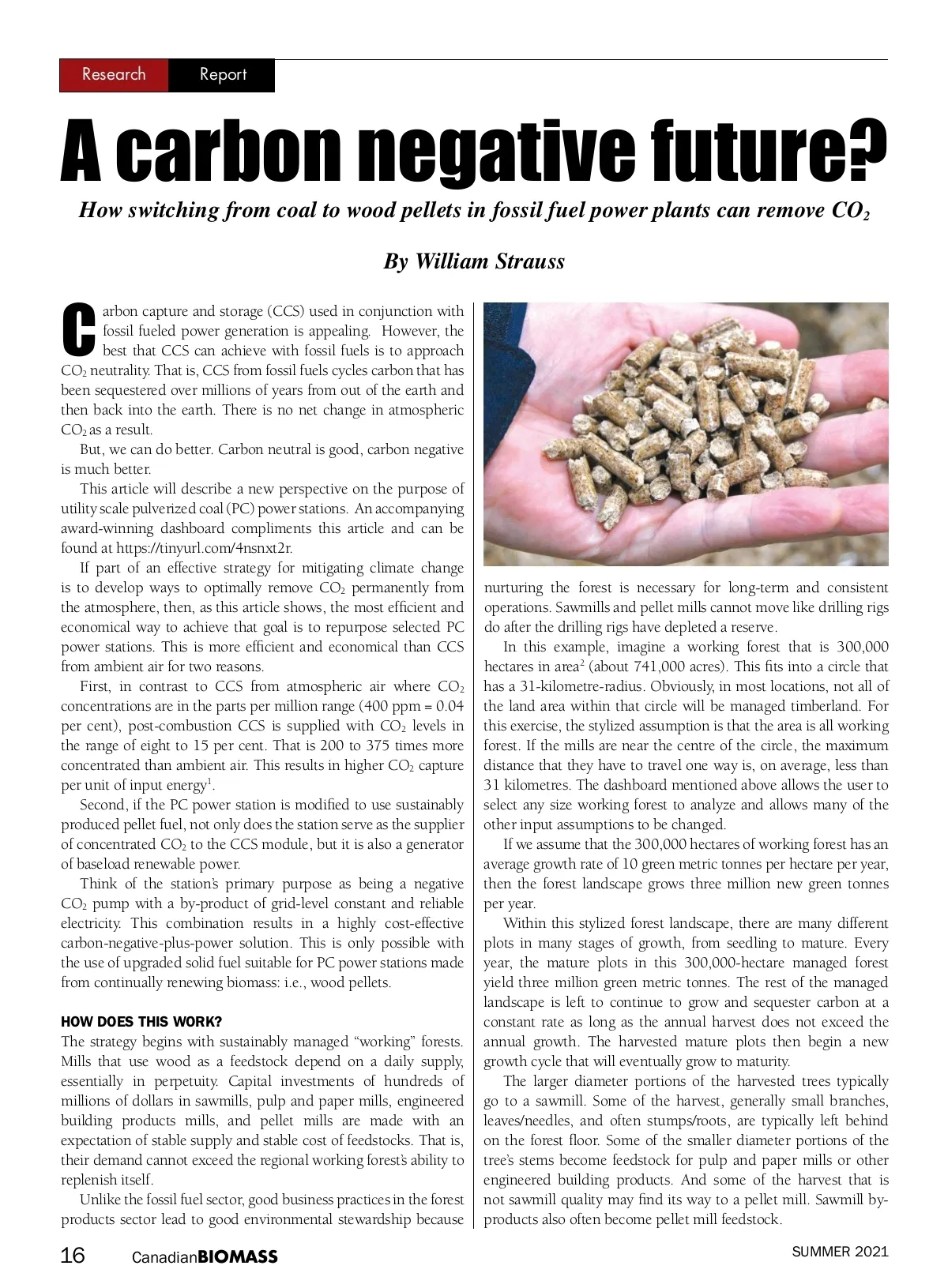
Research Report A carbon negative future? How switching from coal to wood pellets in fossil fuel power plants can remove CO 2 By William Strauss arbon capture and storage (CCS) used in conjunction with fossil fueled power generation is appealing. However, the best that CCS can achieve with fossil fuels is to approach CO 2 neutrality. That is, CCS from fossil fuels cycles carbon that has been sequestered over millions of years from out of the earth and then back into the earth. There is no net change in atmospheric CO 2 as a result. But, we can do better. Carbon neutral is good, carbon negative is much better. This article will describe a new perspective on the purpose of utility scale pulverized coal (PC) power stations. An accompanying award-winning dashboard compliments this article and can be found at https://tinyurl.com/4nsnxt2r. If part of an effective strategy for mitigating climate change is to develop ways to optimally remove CO 2 permanently from the atmosphere, then, as this article shows, the most efficient and economical way to achieve that goal is to repurpose selected PC power stations. This is more efficient and economical than CCS from ambient air for two reasons. First, in contrast to CCS from atmospheric air where CO 2 concentrations are in the parts per million range (400 ppm = 0.04 per cent), post-combustion CCS is supplied with CO 2 levels in the range of eight to 15 per cent. That is 200 to 375 times more concentrated than ambient air. This results in higher CO 2 capture per unit of input energy 1 . Second, if the PC power station is modified to use sustainably produced pellet fuel, not only does the station serve as the supplier of concentrated CO 2 to the CCS module, but it is also a generator of baseload renewable power. Think of the station’s primary purpose as being a negative CO 2 pump with a by-product of grid-level constant and reliable electricity. This combination results in a highly cost-effective carbon-negative-plus-power solution. This is only possible with the use of upgraded solid fuel suitable for PC power stations made from continually renewing biomass: i.e., wood pellets. HOW DOES THIS WORK? C The strategy begins with sustainably managed “working” forests. Mills that use wood as a feedstock depend on a daily supply, essentially in perpetuity. Capital investments of hundreds of millions of dollars in sawmills, pulp and paper mills, engineered building products mills, and pellet mills are made with an expectation of stable supply and stable cost of feedstocks. That is, their demand cannot exceed the regional working forest’s ability to replenish itself. Unlike the fossil fuel sector, good business practices in the forest products sector lead to good environmental stewardship because nurturing the forest is necessary for long-term and consistent operations. Sawmills and pellet mills cannot move like drilling rigs do after the drilling rigs have depleted a reserve. In this example, imagine a working forest that is 300,000 hectares in area 2 (about 741,000 acres). This fits into a circle that has a 31-kilometre-radius. Obviously, in most locations, not all of the land area within that circle will be managed timberland. For this exercise, the stylized assumption is that the area is all working forest. If the mills are near the centre of the circle, the maximum distance that they have to travel one way is, on average, less than 31 kilometres. The dashboard mentioned above allows the user to select any size working forest to analyze and allows many of the other input assumptions to be changed. If we assume that the 300,000 hectares of working forest has an average growth rate of 10 green metric tonnes per hectare per year, then the forest landscape grows three million new green tonnes per year. Within this stylized forest landscape, there are many different plots in many stages of growth, from seedling to mature. Every year, the mature plots in this 300,000-hectare managed forest yield three million green metric tonnes. The rest of the managed landscape is left to continue to grow and sequester carbon at a constant rate as long as the annual harvest does not exceed the annual growth. The harvested mature plots then begin a new growth cycle that will eventually grow to maturity. The larger diameter portions of the harvested trees typically go to a sawmill. Some of the harvest, generally small branches, leaves/needles, and often stumps/roots, are typically left behind on the forest floor. Some of the smaller diameter portions of the tree’s stems become feedstock for pulp and paper mills or other engineered building products. And some of the harvest that is not sawmill quality may find its way to a pellet mill. Sawmill by-products also often become pellet mill feedstock. SUMMER 2021 16 Canadian BIOMASS
Canadian Biomass Summer 2021: Page 16