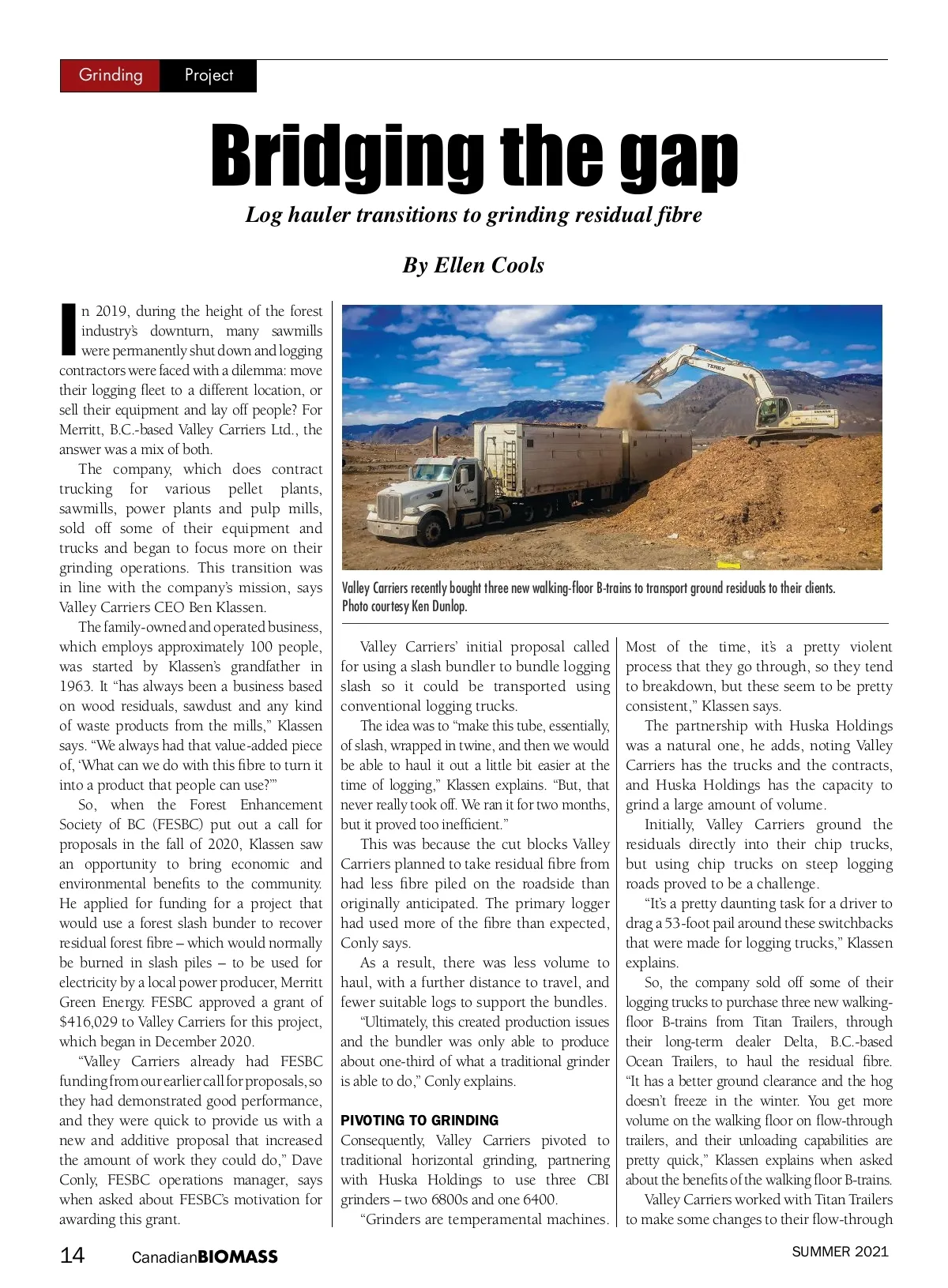
B-train, such as adding a hydraulic fifth-wheel plate so the trailers can slide together without needing traction. This means that, if operators are unloading the trucks in the winter, the hydraulics hold the trailers together, rather than the traditional method “where you try to lock your brakes, then undo an air lock and try to use your truck’s dry tires to slide the two trailers together.” Although these types of trailers can’t carry as much fibre as traditional chip trailers, they are more robust because they are welded together, while traditional chip trailers are pot-riveted, Klassen says. And Valley Carriers can unload these trailers in 23 minutes on average, compared to around 40 minutes for a traditional B-train. Overall, transitioning from slash bundling to horizontal grinding was the right move, and FESBC’s funding made it possible for Valley Carriers to extend their grinding operations, keeping 10 people employed for the project. Employment included the operation of the grinders, a log loader, four Western Star 53-foot trucks with a mix of Titan and TyCroft walking floors, a John Deere D7 grader, and a John Deere 7000 dozer for road building. IMPACT OF GRINDING volume to keep our business strong. It’s not the biggest part of our business, by any stretch, but adding that capacity of four or five trucks and diversified revenue stream keeps us being able to hold a fibre basket for the small mills that we service,” he adds. Valley Carriers plans to execute similar grinding projects this spring on private land. The company has only used approximately half of the FESBC funding, so they have lined up some cut blocks where they can grind residual fibre in August and September using the remaining funds. Klassen expects the FESBC grant to generate $1.75 million in revenue overall. “We’re hoping to see FESBC get re-funded, and if it does, this is something we can continue for the next four to five years,” he says. “There’s fibre around and available that’s getting under-utilized, being burned, so it would be nice to see that opportunity come again.” According to Conly, FESBC is planning to support similar projects to help forestry companies find new ways to utilize fibre and avoid burning wood waste in the forest. “We have encouraged the industry transformation to be more focused on bioenergy opportunities,” he says. “Contractors have been able to adjust their programs, their capital and their workflow.” Both Klassen and Conly believe grinding wood waste is a good way for loggers to overcome the effects of B.C.’s decreasing fibre supply, but acknowledge that the economics are very tight. “The economics of bush grinding are hard just because it’s an expensive process. The end users – the pellet mills and power plants – their business models usually don’t support that fibre. So, that’s where FESBC comes in and tries to bridge that gap. The end users can’t afford it at $55 per tonne, but they can afford it at $45, so FESBC funds our operations so that we’re able to keep our production prices attainable for the end users,” Klassen says. “It’s definitely been a struggle, and some people say we shouldn’t be doing it, but it’s still employment, it’s still value, it turns into power,” he adds. “I can’t see a downside to it.” • The benefits of this project made the effort worth it. For one thing, grinding wood waste rather than burning it in slash piles provides environmental and public health benefits. “By not burning these piles, we are avoiding emissions that are harmful to the atmosphere,” Conly explains. “In addition, in areas close to communities, smoke is avoided when the fibre can be utilized. Delivering this wood to a green energy plant produces clean electricity for public use and distribution. This means less small particulate in our air that we breathe.” By March 31, Valley Carriers had met its commitment to FESBC, which was to provide Merritt Green Energy with enough fibre for 37 days of run time. “We overachieved on our contracted commitments at a time when, 18 months ago, the power plant in Merritt was running at 70 per cent capacity because they didn’t have enough fibre,” Klassen says. “This year, they have not been down due to a lack of fibre. So, that I would say is a success. “For us in particular, to have our people employed and our equipment continuing to move, it just tells us that it may take 4.625in x 5in -Detroit Combustion Equipment -Canadian Biomass 2019-03-29 OUTLINE.indd 1 CBM_Detroit Stoker_Spring19_CSA.indd 1 Canadian BIOMASS 3/29/2019 15 2:12:59 PM 2019-03-29 2:38 PM
Canadian Biomass Summer 2021: Page 15