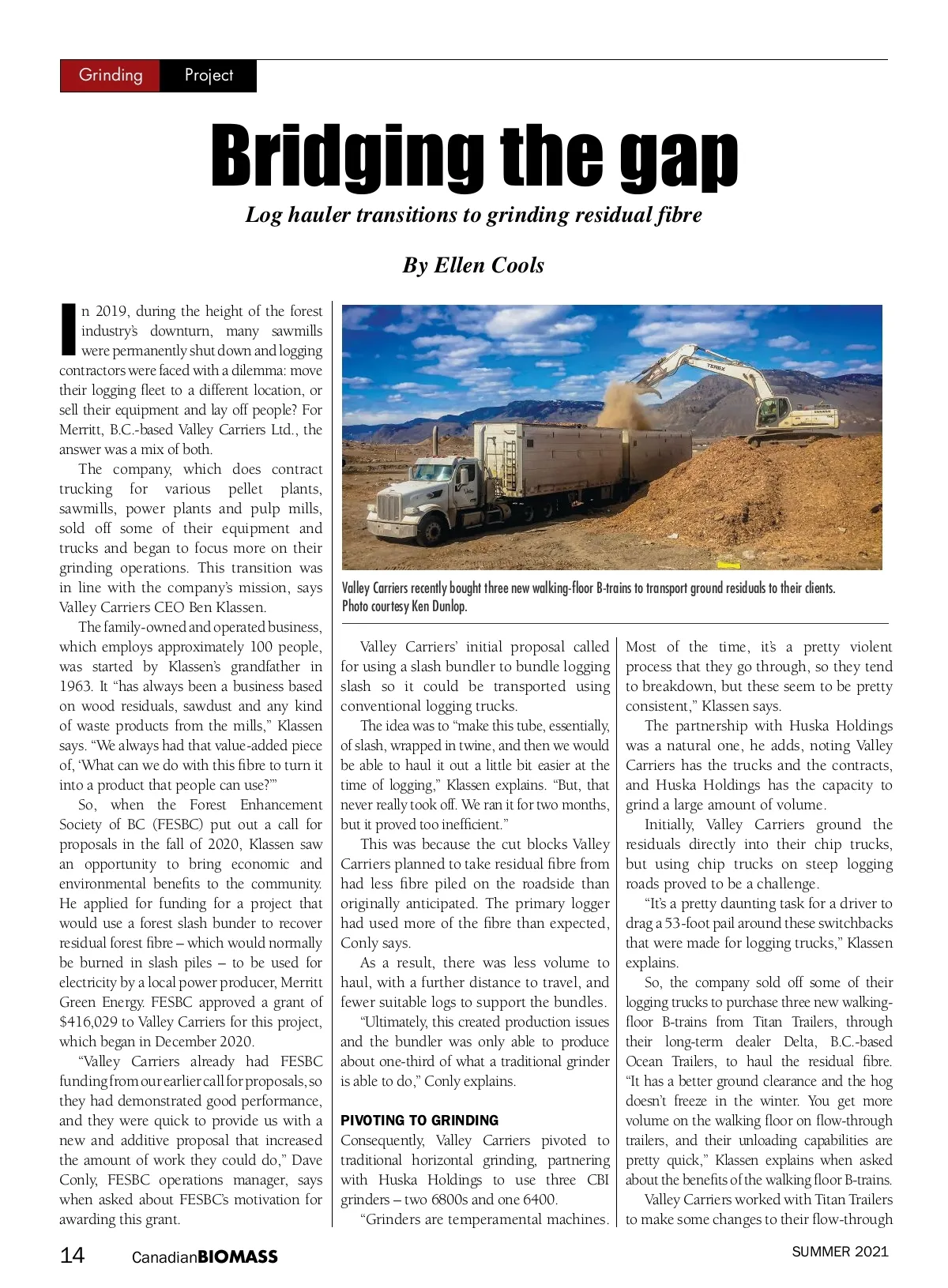
Grinding Project Bridging the gap Log hauler transitions to grinding residual fibre By Ellen Cools n 2019, during the height of the forest industry’s downturn, many sawmills were permanently shut down and logging contractors were faced with a dilemma: move their logging fleet to a different location, or sell their equipment and lay off people? For Merritt, B.C.-based Valley Carriers Ltd., the answer was a mix of both. The company, which does contract trucking for various pellet plants, sawmills, power plants and pulp mills, sold off some of their equipment and trucks and began to focus more on their grinding operations. This transition was in line with the company’s mission, says Valley Carriers CEO Ben Klassen. The family-owned and operated business, which employs approximately 100 people, was started by Klassen’s grandfather in 1963. It “has always been a business based on wood residuals, sawdust and any kind of waste products from the mills,” Klassen says. “We always had that value-added piece of, ‘What can we do with this fibre to turn it into a product that people can use?’” So, when the Forest Enhancement Society of BC (FESBC) put out a call for proposals in the fall of 2020, Klassen saw an opportunity to bring economic and environmental benefits to the community. He applied for funding for a project that would use a forest slash bunder to recover residual forest fibre – which would normally be burned in slash piles – to be used for electricity by a local power producer, Merritt Green Energy. FESBC approved a grant of $416,029 to Valley Carriers for this project, which began in December 2020. “Valley Carriers already had FESBC funding from our earlier call for proposals, so they had demonstrated good performance, and they were quick to provide us with a new and additive proposal that increased the amount of work they could do,” Dave Conly, FESBC operations manager, says when asked about FESBC’s motivation for awarding this grant. I Valley Carriers recently bought three new walking-floor B-trains to transport ground residuals to their clients. Photo courtesy Ken Dunlop. Valley Carriers’ initial proposal called for using a slash bundler to bundle logging slash so it could be transported using conventional logging trucks. The idea was to “make this tube, essentially, of slash, wrapped in twine, and then we would be able to haul it out a little bit easier at the time of logging,” Klassen explains. “But, that never really took off. We ran it for two months, but it proved too inefficient.” This was because the cut blocks Valley Carriers planned to take residual fibre from had less fibre piled on the roadside than originally anticipated. The primary logger had used more of the fibre than expected, Conly says. As a result, there was less volume to haul, with a further distance to travel, and fewer suitable logs to support the bundles. “Ultimately, this created production issues and the bundler was only able to produce about one-third of what a traditional grinder is able to do,” Conly explains. PIVOTING TO GRINDING Consequently, Valley Carriers pivoted to traditional horizontal grinding, partnering with Huska Holdings to use three CBI grinders – two 6800s and one 6400. “Grinders are temperamental machines. Most of the time, it’s a pretty violent process that they go through, so they tend to breakdown, but these seem to be pretty consistent,” Klassen says. The partnership with Huska Holdings was a natural one, he adds, noting Valley Carriers has the trucks and the contracts, and Huska Holdings has the capacity to grind a large amount of volume. Initially, Valley Carriers ground the residuals directly into their chip trucks, but using chip trucks on steep logging roads proved to be a challenge. “It’s a pretty daunting task for a driver to drag a 53-foot pail around these switchbacks that were made for logging trucks,” Klassen explains. So, the company sold off some of their logging trucks to purchase three new walking-floor B-trains from Titan Trailers, through their long-term dealer Delta, B.C.-based Ocean Trailers, to haul the residual fibre. “It has a better ground clearance and the hog doesn’t freeze in the winter. You get more volume on the walking floor on flow-through trailers, and their unloading capabilities are pretty quick,” Klassen explains when asked about the benefits of the walking floor B-trains. Valley Carriers worked with Titan Trailers to make some changes to their flow-through SUMMER 2021 14 Canadian BIOMASS
Canadian Biomass Summer 2021: Page 14