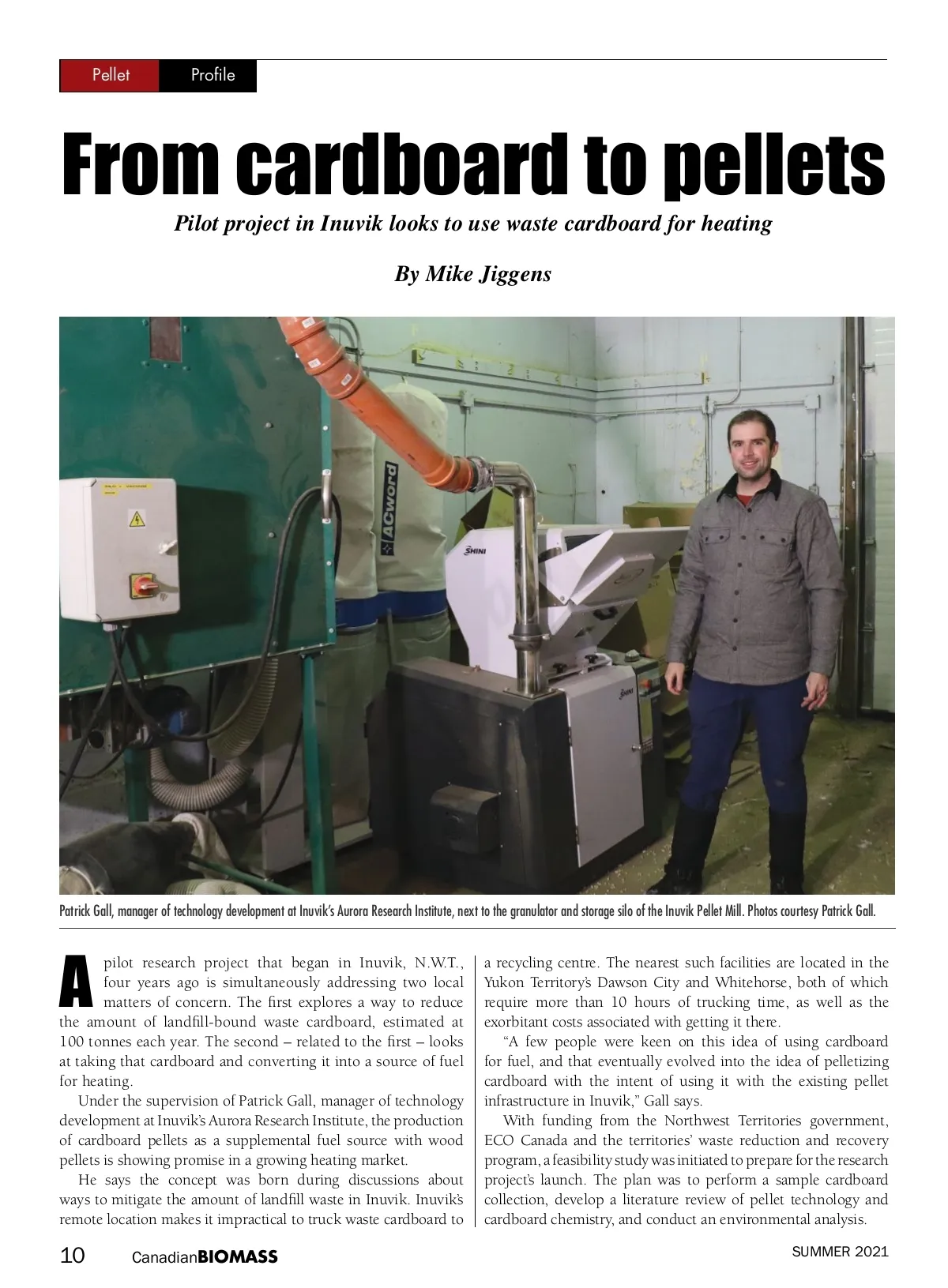
It was determined only corrugated cardboard material – what Gall defines as “classic” cardboard used in shipping containers – would be used in the research project. Obtained from grocery stores, hospitals and other large institutions, the carboard is stripped of staples, plastic brackets, labels and any other unwanted material and then weighed. The mass of polymers and non-fibrous materials in the cardboard is also weighed to get a better idea of how much of it is in the cardboard waste stream. WOOD VS. CARDBOARD PELLETS During initial discussions about waste diversion, the focus was originally on plastics before it turned to cardboard, Gall says. The research team contacted mill manufacturers to see if cardboard pellets could be produced in a conventional pellet plant. “We knew the process was certainly feasible on the manufacturing side,” Gall explains. “The combustion side was a bit more challenging.” There were concerns about the amount of resultant ash, and cardboard pellets produced today are still being lab tested in order to “check some of the boxes.” Gall says the information he’s gathered is “scattered,” but the research team has been able to make the most of it. The team now has a better understanding of the project’s technical, economic and environmental considerations. From a manufacturing perspective, the biggest difference between wood and cardboard pellets is that cardboard had originally gone through a pulping process to make the transition from wood to cardboard fibre. The process strips much of the lignin content – which is what predominantly binds wood pellets – from the wood. Cardboard pellets require cellulose fibre for bonding. Gall says the cardboard pellets are being made at a temperature slightly higher than that required for wood pellet production. A greater reliance is placed on the cellulose fibres to hold the cardboard pellets’ shape. The production of wood pellets from waste wood involves a higher-density feedstock than that in cardboard pellet manufacturing. Shredded cardboard, on the other hand, is “super fluffy,” he says, adding that, in a dry climate, it creates concerns that it may not be sufficiently compressed. “It’s dramatically different from making wood pellets from sawdust,” he says. TEST RESULTS But, the process involved in cardboard pellet manufacturing is similar to that of making wood pellets. Once the source cardboard is stripped of any staples, plastics and other unwanted materials, it is shredded in a granulator, producing pieces of cardboard two to three millimetres in size. “The shredder (manufactured by Shini USA Industries) is working harder than the equivalent wood chipper/granulator combination,” Gall says. The shredded bits of cardboard are fed into a pellet mill, where they are subjected to considerable heat and pressure. The temperature inside the pelleting chamber can reach 150 C, Successful solutions for aspiration systems and industrial processes DESIGN MANUFACTURING INSTALLATION MAINTENANCE 1839, St-Joseph blvd West , Saint-Majorique, Quebec J2B 8A8 | Tel.: 819 475-0041 | Toll free: 1 866 644-0041 www.concept-air.ca CMB_ConceptAir_Summer21.indd 1 Canadian BIOMASS 2021-06-09 3:02 PM 11
Canadian Biomass Summer 2021: Page 11