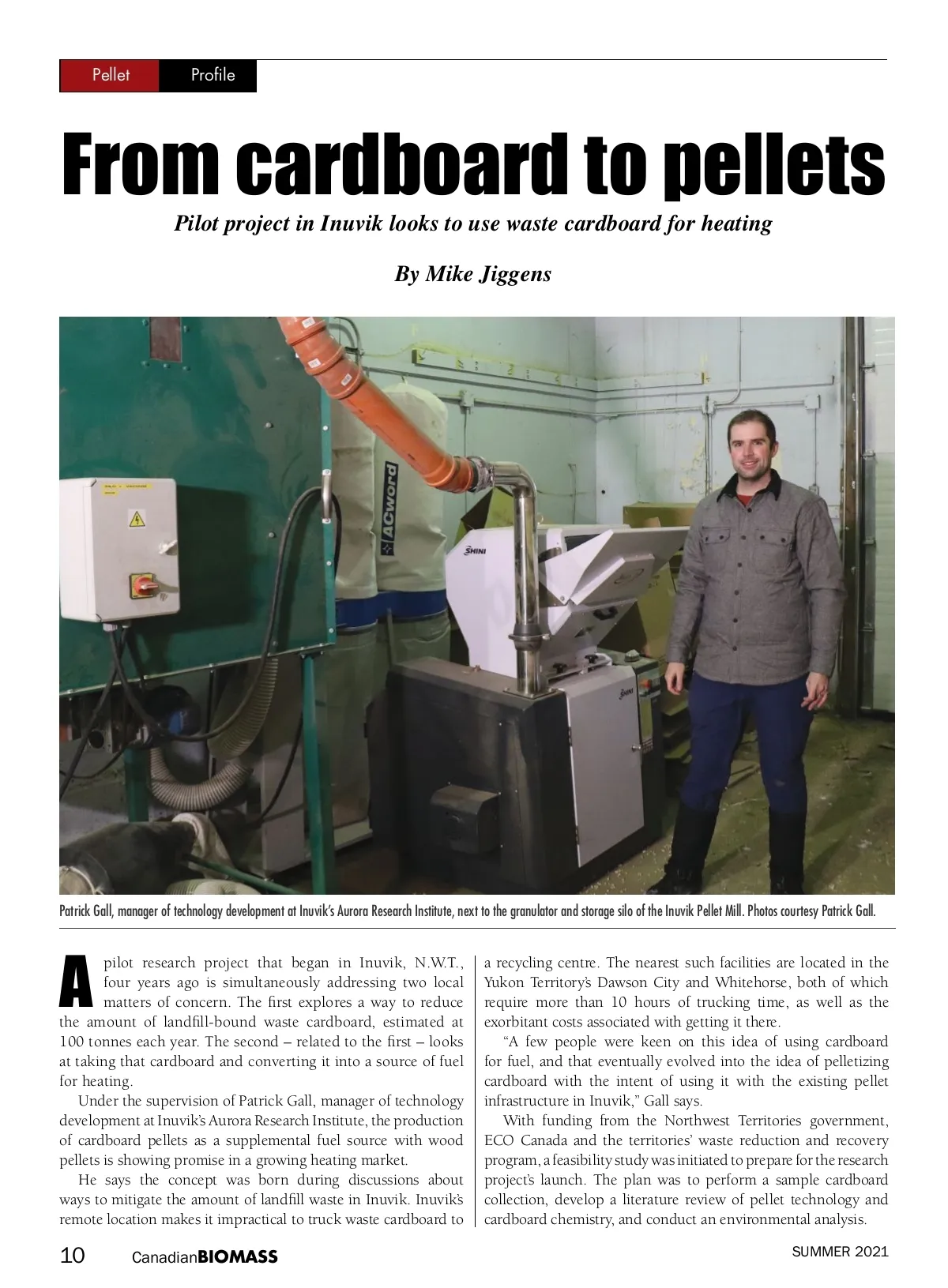
Pellet Profile From cardboard to pellets Pilot project in Inuvik looks to use waste cardboard for heating By Mike Jiggens Patrick Gall, manager of technology development at Inuvik’s Aurora Research Institute, next to the granulator and storage silo of the Inuvik Pellet Mill. Photos courtesy Patrick Gall. pilot research project that began in Inuvik, N.W.T., four years ago is simultaneously addressing two local matters of concern. The first explores a way to reduce the amount of landfill-bound waste cardboard, estimated at 100 tonnes each year. The second – related to the first – looks at taking that cardboard and converting it into a source of fuel for heating. Under the supervision of Patrick Gall, manager of technology development at Inuvik’s Aurora Research Institute, the production of cardboard pellets as a supplemental fuel source with wood pellets is showing promise in a growing heating market. He says the concept was born during discussions about ways to mitigate the amount of landfill waste in Inuvik. Inuvik’s remote location makes it impractical to truck waste cardboard to A a recycling centre. The nearest such facilities are located in the Yukon Territory’s Dawson City and Whitehorse, both of which require more than 10 hours of trucking time, as well as the exorbitant costs associated with getting it there. “A few people were keen on this idea of using cardboard for fuel, and that eventually evolved into the idea of pelletizing cardboard with the intent of using it with the existing pellet infrastructure in Inuvik,” Gall says. With funding from the Northwest Territories government, ECO Canada and the territories’ waste reduction and recovery program, a feasibility study was initiated to prepare for the research project’s launch. The plan was to perform a sample cardboard collection, develop a literature review of pellet technology and cardboard chemistry, and conduct an environmental analysis. SUMMER 2021 10 Canadian BIOMASS
Canadian Biomass Summer 2021: Page 10