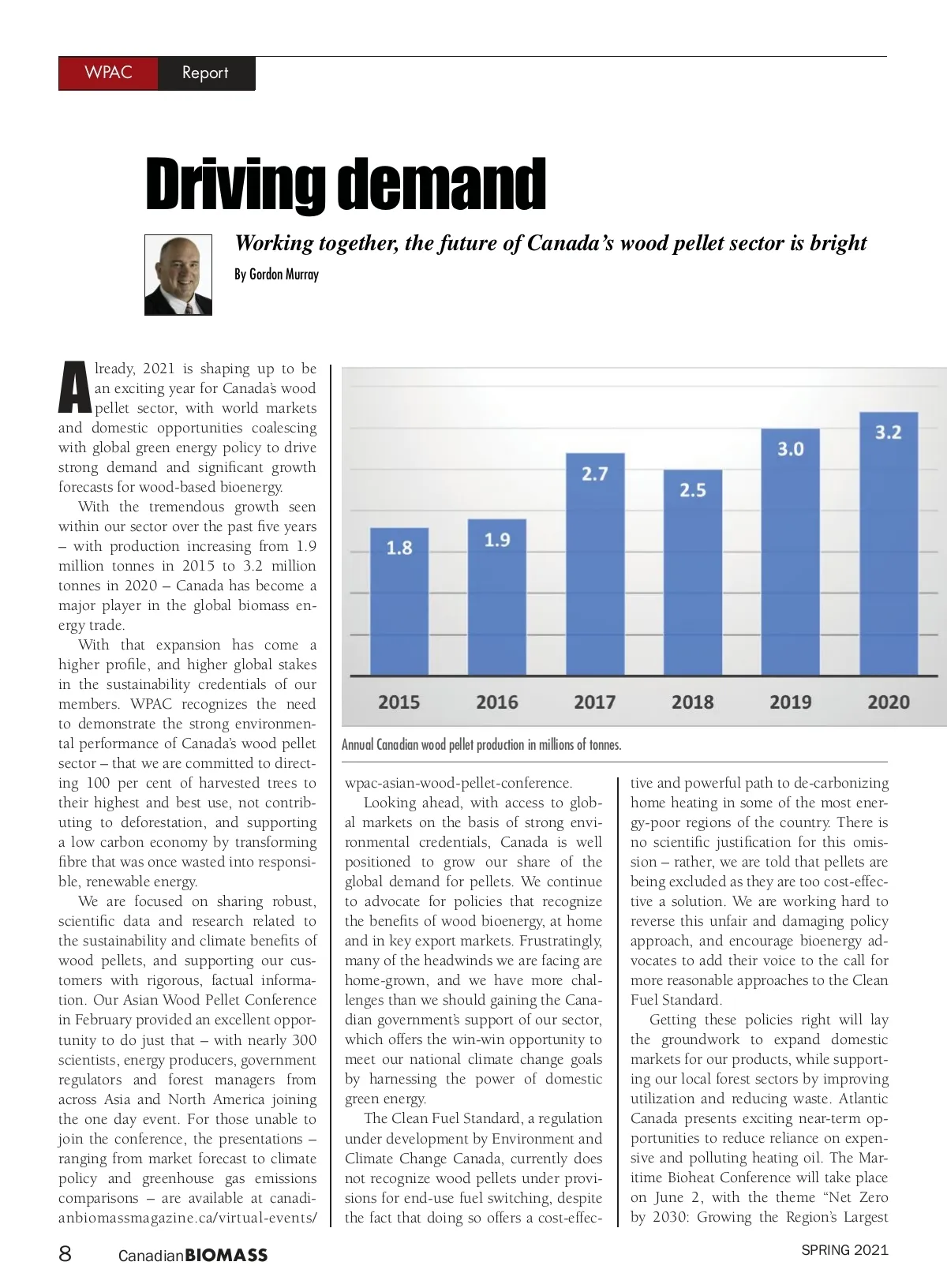
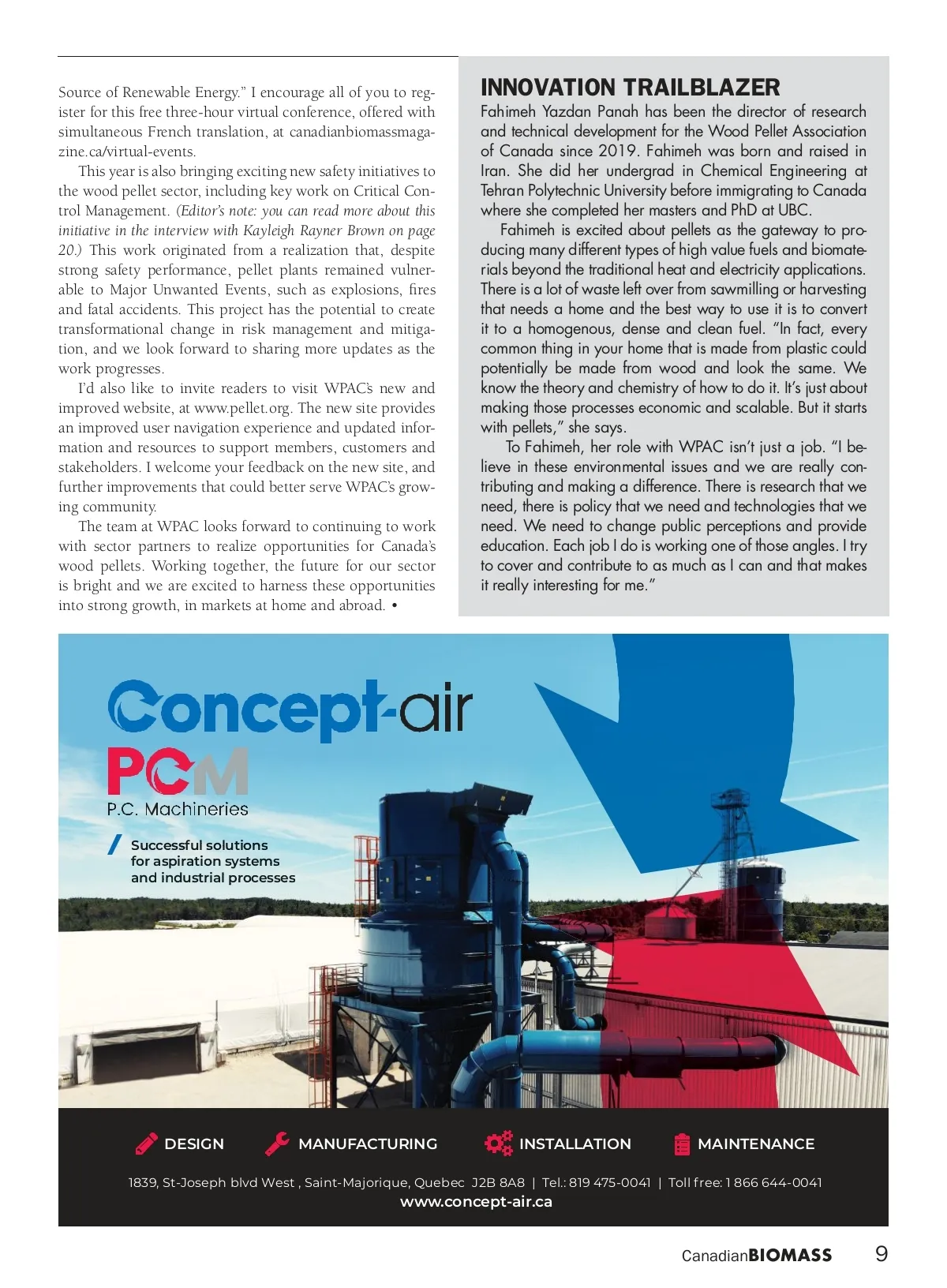
WPAC Report 'ULYLQJGHPDQG Working together, the future of Canada’s wood pellet sector is bright By Gordon Murray A lready, 2021 is shaping up to be an exciting year for Canada’s wood pellet sector, with world markets and domestic opportunities coalescing with global green energy policy to drive strong demand and significant growth forecasts for wood-based bioenergy. With the tremendous growth seen within our sector over the past five years – with production increasing from 1.9 million tonnes in 2015 to 3.2 million tonnes in 2020 – Canada has become a major player in the global biomass en-ergy trade. With that expansion has come a higher profile, and higher global stakes in the sustainability credentials of our members. WPAC recognizes the need to demonstrate the strong environmen-tal performance of Canada’s wood pellet sector – that we are committed to direct-ing 100 per cent of harvested trees to their highest and best use, not contrib-uting to deforestation, and supporting a low carbon economy by transforming fibre that was once wasted into responsi-ble, renewable energy. We are focused on sharing robust, scientific data and research related to the sustainability and climate benefits of wood pellets, and supporting our cus-tomers with rigorous, factual informa-tion. Our Asian Wood Pellet Conference in February provided an excellent oppor-tunity to do just that – with nearly 300 scientists, energy producers, government regulators and forest managers from across Asia and North America joining the one day event. For those unable to join the conference, the presentations – ranging from market forecast to climate policy and greenhouse gas emissions comparisons – are available at canadi-anbiomassmagazine.ca/virtual-events/ Annual Canadian wood pellet production in millions of tonnes. wpac-asian-wood-pellet-conference. Looking ahead, with access to glob-al markets on the basis of strong envi-ronmental credentials, Canada is well positioned to grow our share of the global demand for pellets. We continue to advocate for policies that recognize the benefits of wood bioenergy, at home and in key export markets. Frustratingly, many of the headwinds we are facing are home-grown, and we have more chal-lenges than we should gaining the Cana-dian government’s support of our sector, which offers the win-win opportunity to meet our national climate change goals by harnessing the power of domestic green energy. The Clean Fuel Standard, a regulation under development by Environment and Climate Change Canada, currently does not recognize wood pellets under provi-sions for end-use fuel switching, despite the fact that doing so offers a cost-effec-tive and powerful path to de-carbonizing home heating in some of the most ener-gy-poor regions of the country. There is no scientific justification for this omis-sion – rather, we are told that pellets are being excluded as they are too cost-effec-tive a solution. We are working hard to reverse this unfair and damaging policy approach, and encourage bioenergy ad-vocates to add their voice to the call for more reasonable approaches to the Clean Fuel Standard. Getting these policies right will lay the groundwork to expand domestic markets for our products, while support-ing our local forest sectors by improving utilization and reducing waste. Atlantic Canada presents exciting near-term op-portunities to reduce reliance on expen-sive and polluting heating oil. The Mar-itime Bioheat Conference will take place on June 2, with the theme “Net Zero by 2030: Growing the Region’s Largest SPRING 2021 8 Canadian BIOMASS
Canadian Biomass Spring 2021: Page 8