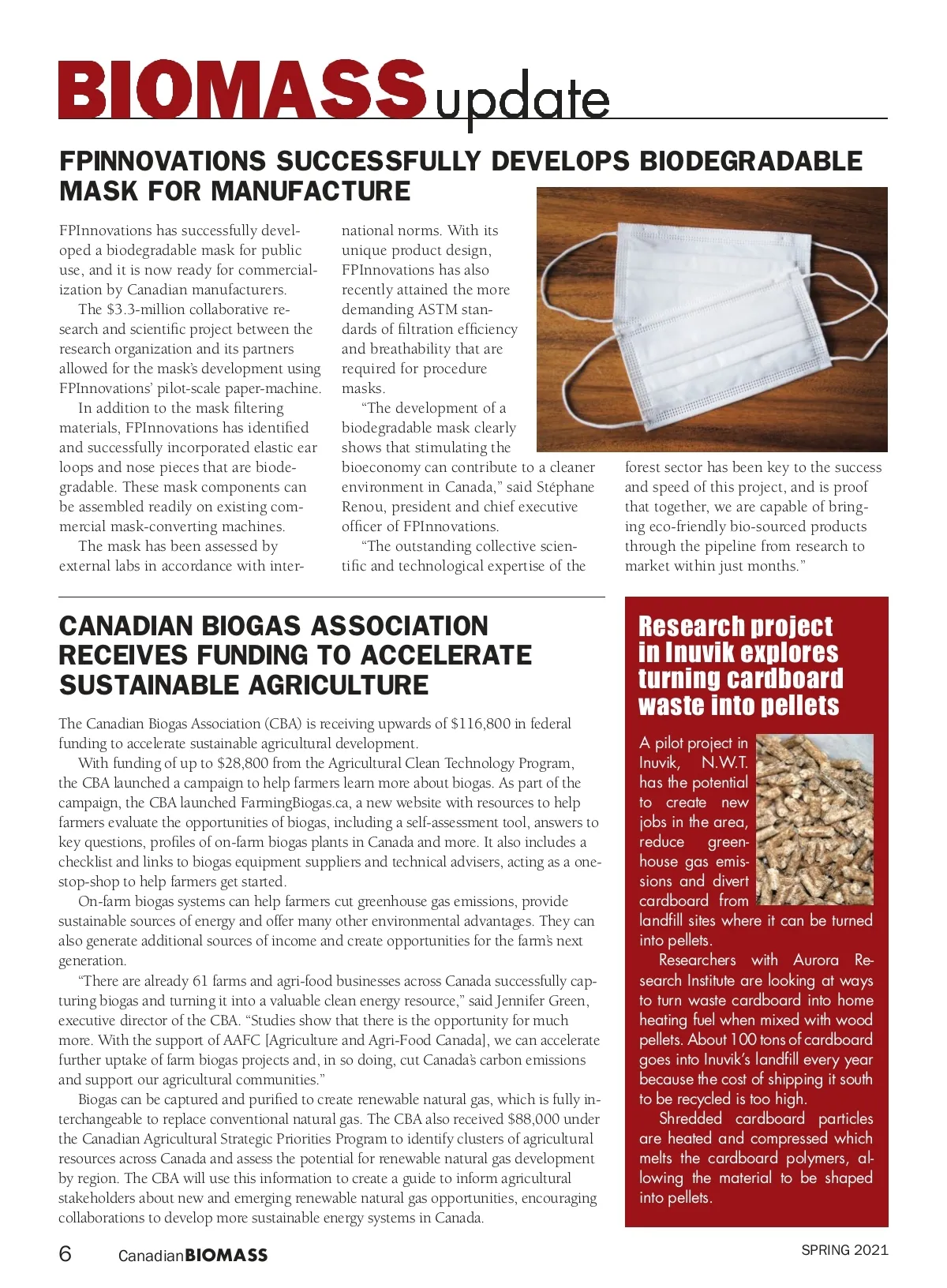
DRAX COMPLETES ACQUISITION OF PINNACLE RENEWABLE ENERGY Drax Group has completed its acquisition of Pinnacle Renew-able Energy Inc. Pinnacle, headquartered in British Columbia, will operate as a subsidiary of Drax. Its workforce of more than 480 employees, including its leadership, have been welcomed into the Drax fold. As a result of the acquisition, Drax Group, based in the U.K., now owns or has an interest in 17 pellet plants and development projects across Canada and the southern United States. The company has the capacity to produce 4.9 million tonnes of bioenergy wood pellets annually from 2022, with access to four deep water port facilities and three major wood fibre baskets. Duncan Davies, chief executive officer at Pinnacle, said the transaction marks the beginning of an exciting new future for Pinnacle. “Drax is a world-class organization with an ambitious vision for sustainable biomass and a willingness to invest in the business,” he said. “As part of Drax, we will continue to build a positive, inclusive and safe workplace and support the commu-nities in which we operate through our partnerships with First Nations and local businesses. Bioenergy has an important role in enhancing forest health, and we look forward to working with the Drax team on our shared commitment to world-lead-ing sustainability standards.” CANADA’S FIRST BIOMASS GAS-TO-LIQUIDS PLANT GETS ENVIRONMENTAL PERMIT The Slave Lake, Alta., biomass/gas-to-liquids proposed project has received an environmental permit from Alberta Environ-ment and Parks (AEP) to establish Canada’s first biomass gas-to-liquids plant next to Vanderwell’s sawmill site. Expander Energy Inc. and Vanderwell Contractors (1971) Ltd. are behind the project. The plant will produce more than 6.5 million litres per year of low-carbon intensity, clean-burning synthetic diesel fuel (trade named SynDiesel) made from sawmill and forestry residuals. The plant will concurrently produce marketable volumes of hydrogen from the process. The AEP permit is the last significant permit required to enable the construction and operation of the project. The plant will use Expander’s patented process and wood waste from Vanderwell’s operations as feedstock to create a low-carbon diesel fuel. The project is well under way with construction expected to begin in late 2021. The first phase is a commercial demon-stration plant producing 6.5 million litres per year of SynDiesel followed by a commercial expansion to more than 20 million litres per year. The proposed $30-million plant will create local construction jobs as well as permanent operating and mainte-nance jobs. SBP PUBLISHES 2020 ANNUAL REVIEW The Sustainable Biomass Program (SBP) has published its 2020 annual review. “Despite the challenging times, I am pleased to report that we continued to see growth in our certificate holder base during 2020, an increase of almost 50 per cent on 2019 numbers, and we extended our geographic reach to 31 countries – up six on 2019. The volume of SBP-certified biomass in the market place reached a record high at 14.95 million tonnes, with every tonne produced and sold carrying the promise of good biomass,” said Carsten Huljus, SBP’s chief executive officer. New to the review, on the theme of data, is an analysis of the feedstock data collected from biomass producers. For 2020, the breakdown of feedstock by type and origin reveals that the vast majority of feedstock used in biomass production came from the stems of trees that were non-merchantable as saw timber, tops and branches, and processing residues. “We made solid progress in what was the first year of our three-year work plan to deliver our strategy, including our three key priorities for the year of standards develop-ment, monitoring and evaluation, and digitalization,” Huljus said. The standards development process was launched in May 2020, and by the end of the year some 1,500 hours of stakeholder participation had been chalked up through the various working group and sub-group meetings. In support of the process, a series of workshops, attracting more than 650 participants in total, was held to explore the key issues in detail. The process continues and is scheduled to conclude with the publi-cation of a set of revised standards at the end of this year. “During 2020, we took the first steps to evolve our existing key impacts that we re-port against into a more sophisticated monitoring and evaluation system commensurate with the certification scheme that we have become,” Huljus said. “And our new audit management platform – the audit portal – was launched in October 2020, representing a significant leap in realizing best practice across our operations. Through digitalizing the routine aspects of certification, in terms of reporting requirements and processes, data entry and collection is much simpler and more robust.” FEDS SUPPORT WASTE-TO-BIOMASS PROJECT The federal government is investing $530,000 to support a project in Banff, Alta., that converts municipal waste to biomass energy. The town will build a biomass district heating system that will see a reduction of about 6,000 tonnes of greenhouse gas emis-sions over the lifetime of this project. That is equivalent to removing approximatively 1,800 cars from the road for one year by replacing natural gas with sustainable wood waste to heat four municipal buildings. The $1.3-million biomass system reduces the need to haul waste to the landfill. “This effort will save costs for our taxpay-ers, while helping protect the local natural environment that makes Banff so special,” Banff Mayor Karen Sorenson said in a press release. “Locally, this project will grow as pri-vate-sector companies join our sustainable district heating system. At the same time, with four million visitors a year to Banff National Park, we believe our small com-munity’s big actions to fight climate change can inspire individuals, organizations and countries around the world.” Canadian BIOMASS 7
Canadian Biomass Spring 2021: Page 7