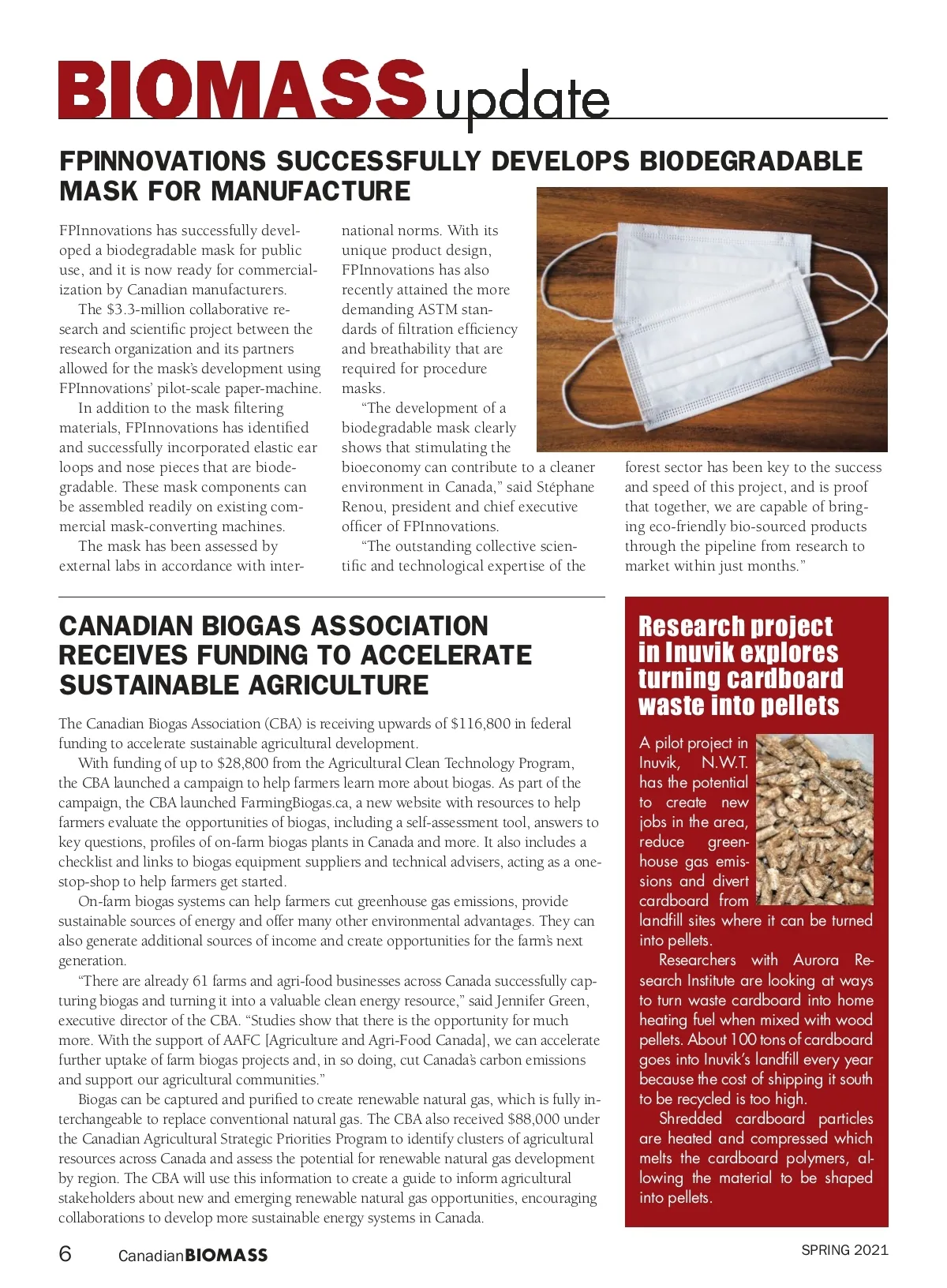
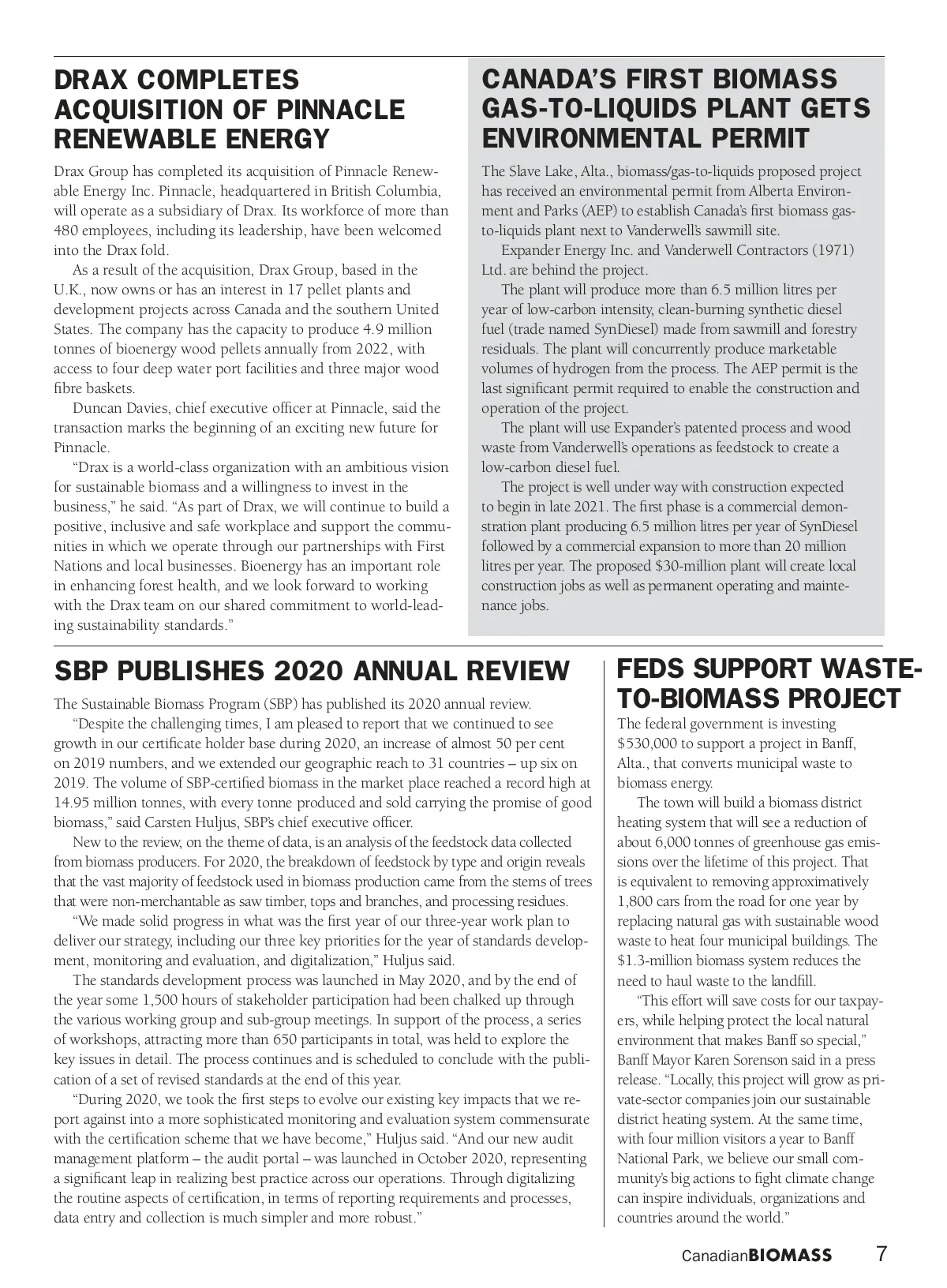
FPINNOVATIONS SUCCESSFULLY DEVELOPS BIODEGRADABLE MASK FOR MANUFACTURE FPInnovations has successfully devel-oped a biodegradable mask for public use, and it is now ready for commercial-ization by Canadian manufacturers. The $3.3-million collaborative re-search and scientific project between the research organization and its partners allowed for the mask’s development using FPInnovations’ pilot-scale paper-machine. In addition to the mask filtering materials, FPInnovations has identified and successfully incorporated elastic ear loops and nose pieces that are biode-gradable. These mask components can be assembled readily on existing com-mercial mask-converting machines. The mask has been assessed by external labs in accordance with inter-national norms. With its unique product design, FPInnovations has also recently attained the more demanding ASTM stan-dards of filtration efficiency and breathability that are required for procedure masks. “The development of a biodegradable mask clearly shows that stimulating the bioeconomy can contribute to a cleaner environment in Canada,” said Stéphane Renou, president and chief executive officer of FPInnovations. “The outstanding collective scien-tific and technological expertise of the forest sector has been key to the success and speed of this project, and is proof that together, we are capable of bring-ing eco-friendly bio-sourced products through the pipeline from research to market within just months.” CANADIAN BIOGAS ASSOCIATION RECEIVES FUNDING TO ACCELERATE SUSTAINABLE AGRICULTURE The Canadian Biogas Association (CBA) is receiving upwards of $116,800 in federal funding to accelerate sustainable agricultural development. With funding of up to $28,800 from the Agricultural Clean Technology Program, the CBA launched a campaign to help farmers learn more about biogas. As part of the campaign, the CBA launched FarmingBiogas.ca, a new website with resources to help farmers evaluate the opportunities of biogas, including a self-assessment tool, answers to key questions, profiles of on-farm biogas plants in Canada and more. It also includes a checklist and links to biogas equipment suppliers and technical advisers, acting as a one-stop-shop to help farmers get started. On-farm biogas systems can help farmers cut greenhouse gas emissions, provide sustainable sources of energy and offer many other environmental advantages. They can also generate additional sources of income and create opportunities for the farm’s next generation. “There are already 61 farms and agri-food businesses across Canada successfully cap-turing biogas and turning it into a valuable clean energy resource,” said Jennifer Green, executive director of the CBA. “Studies show that there is the opportunity for much more. With the support of AAFC [Agriculture and Agri-Food Canada], we can accelerate further uptake of farm biogas projects and, in so doing, cut Canada’s carbon emissions and support our agricultural communities.” Biogas can be captured and purified to create renewable natural gas, which is fully in-terchangeable to replace conventional natural gas. The CBA also received $88,000 under the Canadian Agricultural Strategic Priorities Program to identify clusters of agricultural resources across Canada and assess the potential for renewable natural gas development by region. The CBA will use this information to create a guide to inform agricultural stakeholders about new and emerging renewable natural gas opportunities, encouraging collaborations to develop more sustainable energy systems in Canada. 5HVHDUFKSURMHFW LQ,QXYLNH[SORUHV WXUQLQJFDUGERDUG ZDVWHLQWRSHOOHWV A pilot project in Inuvik, N.W.T. has the potential to create new jobs in the area, reduce green-house gas emis-sions and divert cardboard from landfill sites where it can be turned into pellets. Researchers with Aurora Re-search Institute are looking at ways to turn waste cardboard into home heating fuel when mixed with wood pellets. About 100 tons of cardboard goes into Inuvik’s landfill every year because the cost of shipping it south to be recycled is too high. Shredded cardboard particles are heated and compressed which melts the cardboard polymers, al-lowing the material to be shaped into pellets. SPRING 2021 6 Canadian BIOMASS
Canadian Biomass Spring 2021: Page 6