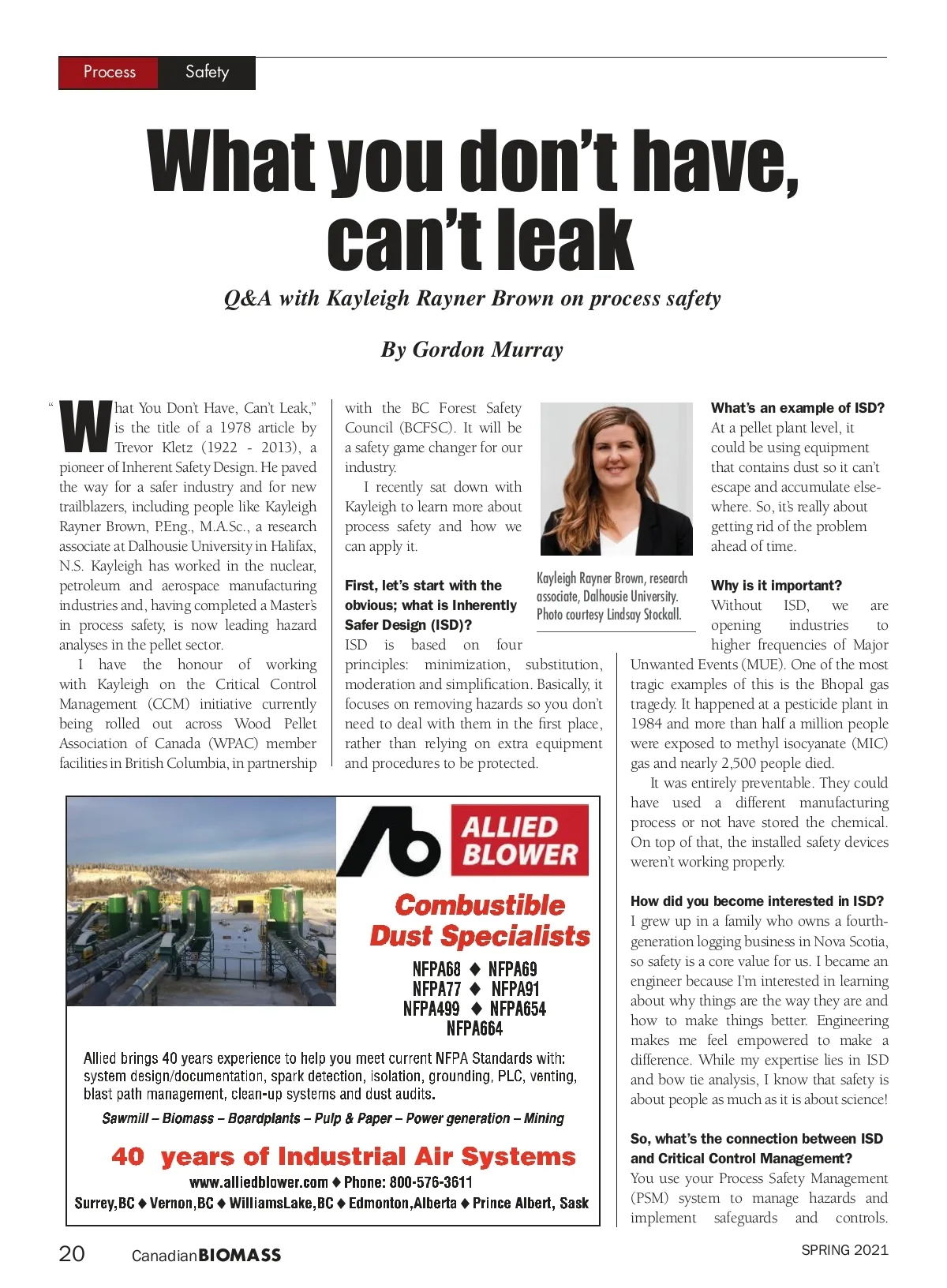
Process Safety :KDW\RXGRQ·WKDYH�f; FDQ·WOHDN Q&A with Kayleigh Rayner Brown on process safety By Gordon Murray “ hat You Don’t Have, Can’t Leak,” is the title of a 1978 article by Trevor Kletz (1922 -2013), a pioneer of Inherent Safety Design. He paved the way for a safer industry and for new trailblazers, including people like Kayleigh Rayner Brown, P.Eng., M.A.Sc., a research associate at Dalhousie University in Halifax, N.S. Kayleigh has worked in the nuclear, petroleum and aerospace manufacturing industries and, having completed a Master’s in process safety, is now leading hazard analyses in the pellet sector. I have the honour of working with Kayleigh on the Critical Control Management (CCM) initiative currently being rolled out across Wood Pellet Association of Canada (WPAC) member facilities in British Columbia, in partnership W with the BC Forest Safety Council (BCFSC). It will be a safety game changer for our industry. I recently sat down with Kayleigh to learn more about process safety and how we can apply it. First, let’s start with the obvious; what is Inherently Safer Design (ISD)? Kayleigh Rayner Brown, research associate, Dalhousie University. Photo courtesy Lindsay Stockall. What’s an example of ISD? At a pellet plant level, it could be using equipment that contains dust so it can’t escape and accumulate else-where. So, it’s really about getting rid of the problem ahead of time. Why is it important? ISD is based on four principles: minimization, substitution, moderation and simplification. Basically, it focuses on removing hazards so you don’t need to deal with them in the first place, rather than relying on extra equipment and procedures to be protected. Without ISD, we are opening industries to higher frequencies of Major Unwanted Events (MUE). One of the most tragic examples of this is the Bhopal gas tragedy. It happened at a pesticide plant in 1984 and more than half a million people were exposed to methyl isocyanate (MIC) gas and nearly 2,500 people died. It was entirely preventable. They could have used a different manufacturing process or not have stored the chemical. On top of that, the installed safety devices weren’t working properly. How did you become interested in ISD? I grew up in a family who owns a fourth-generation logging business in Nova Scotia, so safety is a core value for us. I became an engineer because I’m interested in learning about why things are the way they are and how to make things better. Engineering makes me feel empowered to make a difference. While my expertise lies in ISD and bow tie analysis, I know that safety is about people as much as it is about science! So, what’s the connection between ISD and Critical Control Management? You use your Process Safety Management (PSM) system to manage hazards and implement safeguards and controls. 20 Canadian BIOMASS SPRING 2021
Canadian Biomass Spring 2021: Page 20