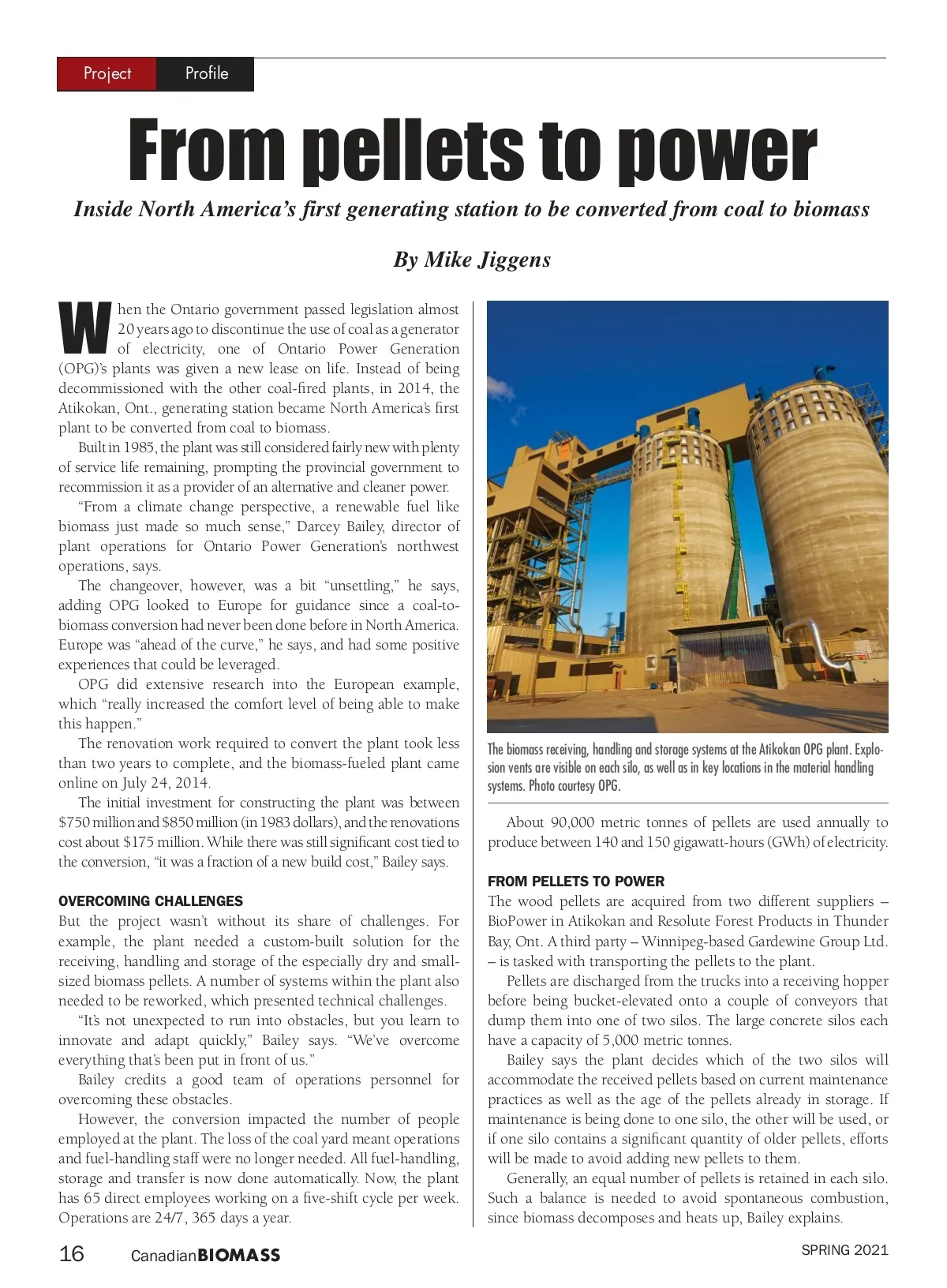
The silos discharge the pellets from the bottom. The plant decides from which quadrant of the silo the pellets are drawn based on temperature profiles. Readouts provide a three-dimensional map of the temperatures inside each silo as a safety measure, allowing the targeted pellets to be drawn based on either a higher raw temperature or a higher rate of rise in a certain area of the silo. The pellets are sent through another series of conveyor belts and bucket elevators before entering the plant. Inside is a surge storage of pellets of about 50 tonnes per bin which are maintained above each of the feeders leading to the boiler. The pellets entering the plant must be distributed among the five surge bins, each of which sits atop a feeder belt, metering the pellets into a pulverizing system. At this stage of the process, the pellets are still a standard six-millimetre industrial wood pellet size, but are then “depelletized” in the pulverizer. The pellets are crushed and returned back to their constituent fibre size. The fibre is then conveyed by primary combustion air systems from B&W and Howden Fans, picking up the wood dust and moving it into the actual burners of the boiler. Each pulverizer feeds three burners. There are five pulverizers and five ‘sets’ of burners, which can be used to produce power, based on the region’s electricity needs. The silos were constructed by FWS Group of Winnipeg, a company that works mainly with the grain industry and with products that are combustible and biological. Aecon Industrial was responsible for material handling and storage. Most of the equipment inside the plant was either already in place or retrofitted, Bailey says. “Those surge bins were a portion of the same bins we used to store the coal inside the plant with,” he explains. OPG re-used only 50 tonnes of its 850-tonne bunkers, capping only the bottom cone to serve as the surge bin. The B&W MPS75 pulverizers and Stock Gravimetric feeders have been retrofitted with different pieces to handle the different material, Bailey says. The burners were replaced with Hitachi DS-W and Doosan models, but the B&W Radiant Tower boiler and other major pieces of equipment remain the same. ’BUMPS AND BRUISES’ Since converting the plant, the most significant change OPG has dealt with is fuel delivery logistics. “For coal, we would receive a unit train of 10,000 tonnes at a time, and that unit train would unload and be stored on site outside,” Bailey explains. “You’d get one of these deliveries perhaps once a week. We’re now getting 15 to 20 trucks a day of deliveries. “The other difficulty we had to get around is that the pellets need to constantly arrive and constantly be consumed because we only have 10,000 tonnes of storage and the pellets are arriving every day,” he adds. “So, we have to manage that inventory much tighter than we had ever been accustomed to before.” Bailey says managing inventory wasn’t a formidable challenge in the days of coal because there was plenty of room for flexibility, but things are tighter with pellets. “The whole logistics of the pellets’ receipt, storage and overall inventory control was a major challenge to overcome, and that 12 t/h up to MORE THAN 10 MILLION TONS. CAN ANYBODY TOP THAT? Our pellet mill 65-1500 outperforms the competition: With a throughput of up to 12 t/h, it is currently the largest flat die pellet mill for the wood sector. Worldwide, flat die pellet mills from AMANDUS KAHL produce more than 10 million tons of domestic fuel and industrial pellets from hardwoods and softwoods every year, and the trend is rising. Scan the QR code and learn more AMANDUS KAHL GmbH & Co. KG Germany · [email protected] shop.akahl.de · akahl.com Canadian BIOMASS 17
Canadian Biomass Spring 2021: Page 17