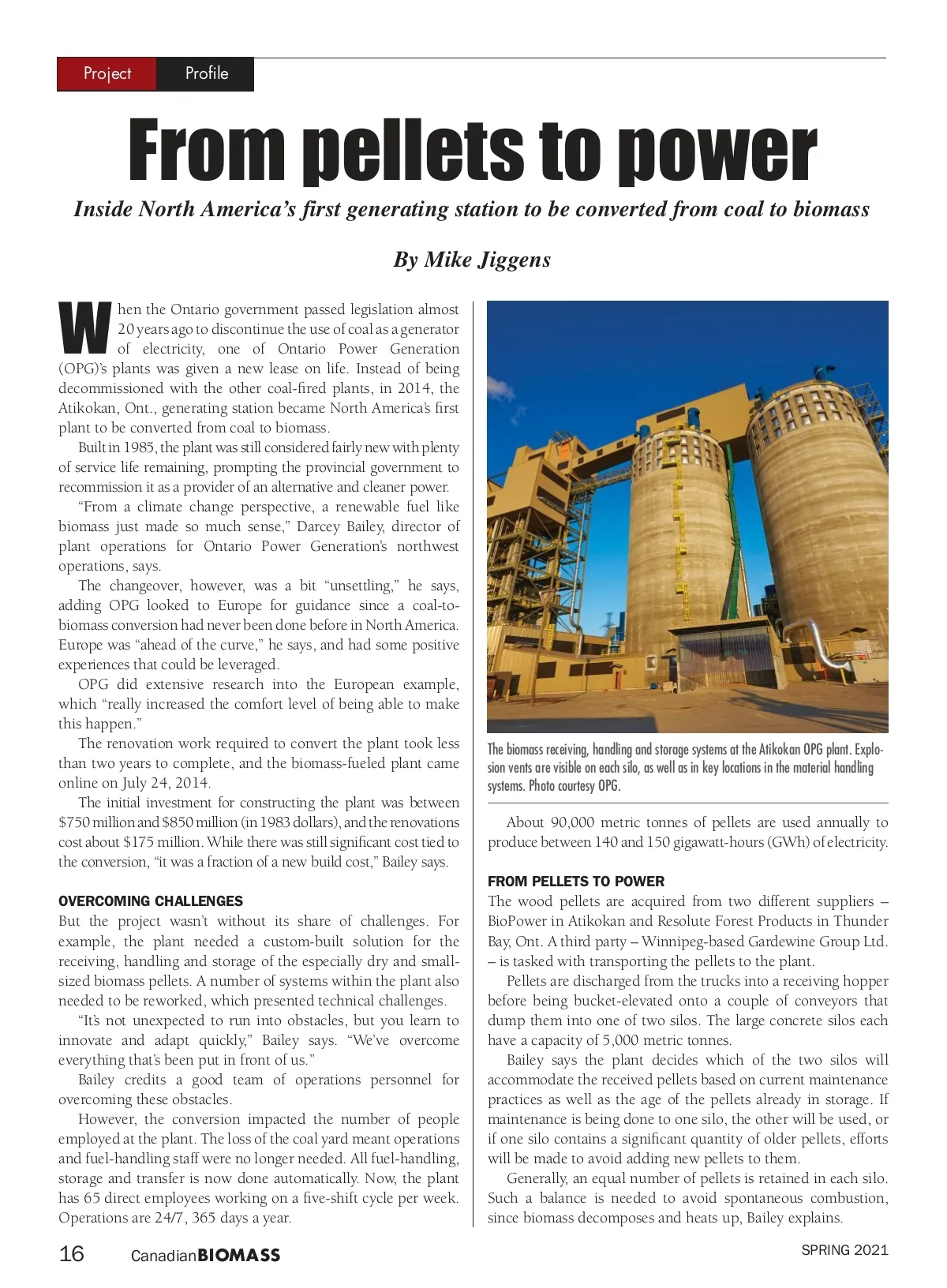
Project Profile Inside North America’s first generating station to be converted from coal to biomass By Mike Jiggens hen the Ontario government passed legislation almost 20 years ago to discontinue the use of coal as a generator of electricity, one of Ontario Power Generation (OPG)’s plants was given a new lease on life. Instead of being decommissioned with the other coal-fired plants, in 2014, the Atikokan, Ont., generating station became North America’s first plant to be converted from coal to biomass. Built in 1985, the plant was still considered fairly new with plenty of service life remaining, prompting the provincial government to recommission it as a provider of an alternative and cleaner power. “From a climate change perspective, a renewable fuel like biomass just made so much sense,” Darcey Bailey, director of plant operations for Ontario Power Generation’s northwest operations, says. The changeover, however, was a bit “unsettling,” he says, adding OPG looked to Europe for guidance since a coal-to-biomass conversion had never been done before in North America. Europe was “ahead of the curve,” he says, and had some positive experiences that could be leveraged. OPG did extensive research into the European example, which “really increased the comfort level of being able to make this happen.” The renovation work required to convert the plant took less than two years to complete, and the biomass-fueled plant came online on July 24, 2014. The initial investment for constructing the plant was between $750 million and $850 million (in 1983 dollars), and the renovations cost about $175 million. While there was still significant cost tied to the conversion, “it was a fraction of a new build cost,” Bailey says. OVERCOMING CHALLENGES )URPSHOOHWVWRSRZHU W The biomass receiving, handling and storage systems at the Atikokan OPG plant. Explo-sion vents are visible on each silo, as well as in key locations in the material handling systems. Photo courtesy OPG. About 90,000 metric tonnes of pellets are used annually to produce between 140 and 150 gigawatt-hours (GWh) of electricity. FROM PELLETS TO POWER But the project wasn’t without its share of challenges. For example, the plant needed a custom-built solution for the receiving, handling and storage of the especially dry and small-sized biomass pellets. A number of systems within the plant also needed to be reworked, which presented technical challenges. “It’s not unexpected to run into obstacles, but you learn to innovate and adapt quickly,” Bailey says. “We’ve overcome everything that’s been put in front of us.” Bailey credits a good team of operations personnel for overcoming these obstacles. However, the conversion impacted the number of people employed at the plant. The loss of the coal yard meant operations and fuel-handling staff were no longer needed. All fuel-handling, storage and transfer is now done automatically. Now, the plant has 65 direct employees working on a five-shift cycle per week. Operations are 24/7, 365 days a year. The wood pellets are acquired from two different suppliers – BioPower in Atikokan and Resolute Forest Products in Thunder Bay, Ont. A third party – Winnipeg-based Gardewine Group Ltd. – is tasked with transporting the pellets to the plant. Pellets are discharged from the trucks into a receiving hopper before being bucket-elevated onto a couple of conveyors that dump them into one of two silos. The large concrete silos each have a capacity of 5,000 metric tonnes. Bailey says the plant decides which of the two silos will accommodate the received pellets based on current maintenance practices as well as the age of the pellets already in storage. If maintenance is being done to one silo, the other will be used, or if one silo contains a significant quantity of older pellets, efforts will be made to avoid adding new pellets to them. Generally, an equal number of pellets is retained in each silo. Such a balance is needed to avoid spontaneous combustion, since biomass decomposes and heats up, Bailey explains. SPRING 2021 16 Canadian BIOMASS
Canadian Biomass Spring 2021: Page 16