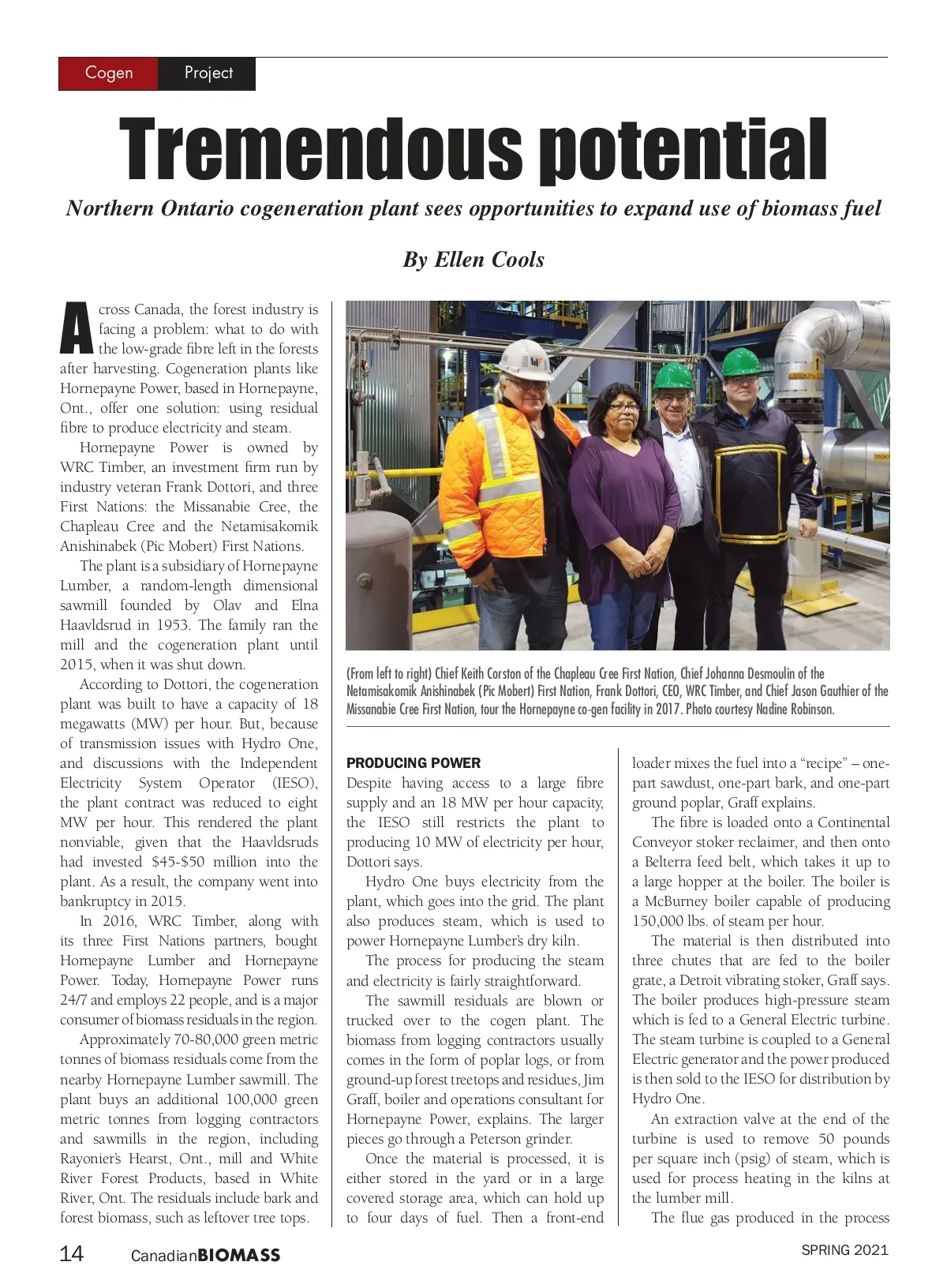
Cogen Project Northern Ontario cogeneration plant sees opportunities to expand use of biomass fuel By Ellen Cools 7UHPHQGRXVSRWHQWLDO A cross Canada, the forest industry is facing a problem: what to do with the low-grade fibre left in the forests after harvesting. Cogeneration plants like Hornepayne Power, based in Hornepayne, Ont., offer one solution: using residual fibre to produce electricity and steam. Hornepayne Power is owned by WRC Timber, an investment firm run by industry veteran Frank Dottori, and three First Nations: the Missanabie Cree, the Chapleau Cree and the Netamisakomik Anishinabek (Pic Mobert) First Nations. The plant is a subsidiary of Hornepayne Lumber, a random-length dimensional sawmill founded by Olav and Elna Haavldsrud in 1953. The family ran the mill and the cogeneration plant until 2015, when it was shut down. According to Dottori, the cogeneration plant was built to have a capacity of 18 megawatts (MW) per hour. But, because of transmission issues with Hydro One, and discussions with the Independent Electricity System Operator (IESO), the plant contract was reduced to eight MW per hour. This rendered the plant nonviable, given that the Haavldsruds had invested $45-$50 million into the plant. As a result, the company went into bankruptcy in 2015. In 2016, WRC Timber, along with its three First Nations partners, bought Hornepayne Lumber and Hornepayne Power. Today, Hornepayne Power runs 24/7 and employs 22 people, and is a major consumer of biomass residuals in the region. Approximately 70-80,000 green metric tonnes of biomass residuals come from the nearby Hornepayne Lumber sawmill. The plant buys an additional 100,000 green metric tonnes from logging contractors and sawmills in the region, including Rayonier’s Hearst, Ont., mill and White River Forest Products, based in White River, Ont. The residuals include bark and forest biomass, such as leftover tree tops. (From left to right) Chief Keith Corston of the Chapleau Cree First Nation, Chief Johanna Desmoulin of the Netamisakomik Anishinabek (Pic Mobert) First Nation, Frank Dottori, CEO, WRC Timber, and Chief Jason Gauthier of the Missanabie Cree First Nation, tour the Hornepayne co-gen facility in 2017. Photo courtesy Nadine Robinson. PRODUCING POWER Despite having access to a large fibre supply and an 18 MW per hour capacity, the IESO still restricts the plant to producing 10 MW of electricity per hour, Dottori says. Hydro One buys electricity from the plant, which goes into the grid. The plant also produces steam, which is used to power Hornepayne Lumber’s dry kiln. The process for producing the steam and electricity is fairly straightforward. The sawmill residuals are blown or trucked over to the cogen plant. The biomass from logging contractors usually comes in the form of poplar logs, or from ground-up forest treetops and residues, Jim Graff, boiler and operations consultant for Hornepayne Power, explains. The larger pieces go through a Peterson grinder. Once the material is processed, it is either stored in the yard or in a large covered storage area, which can hold up to four days of fuel. Then a front-end loader mixes the fuel into a “recipe” – one-part sawdust, one-part bark, and one-part ground poplar, Graff explains. The fibre is loaded onto a Continental Conveyor stoker reclaimer, and then onto a Belterra feed belt, which takes it up to a large hopper at the boiler. The boiler is a McBurney boiler capable of producing 150,000 lbs. of steam per hour. The material is then distributed into three chutes that are fed to the boiler grate, a Detroit vibrating stoker, Graff says. The boiler produces high-pressure steam which is fed to a General Electric turbine. The steam turbine is coupled to a General Electric generator and the power produced is then sold to the IESO for distribution by Hydro One. An extraction valve at the end of the turbine is used to remove 50 pounds per square inch (psig) of steam, which is used for process heating in the kilns at the lumber mill. The flue gas produced in the process SPRING 2021 14 Canadian BIOMASS
Canadian Biomass Spring 2021: Page 14