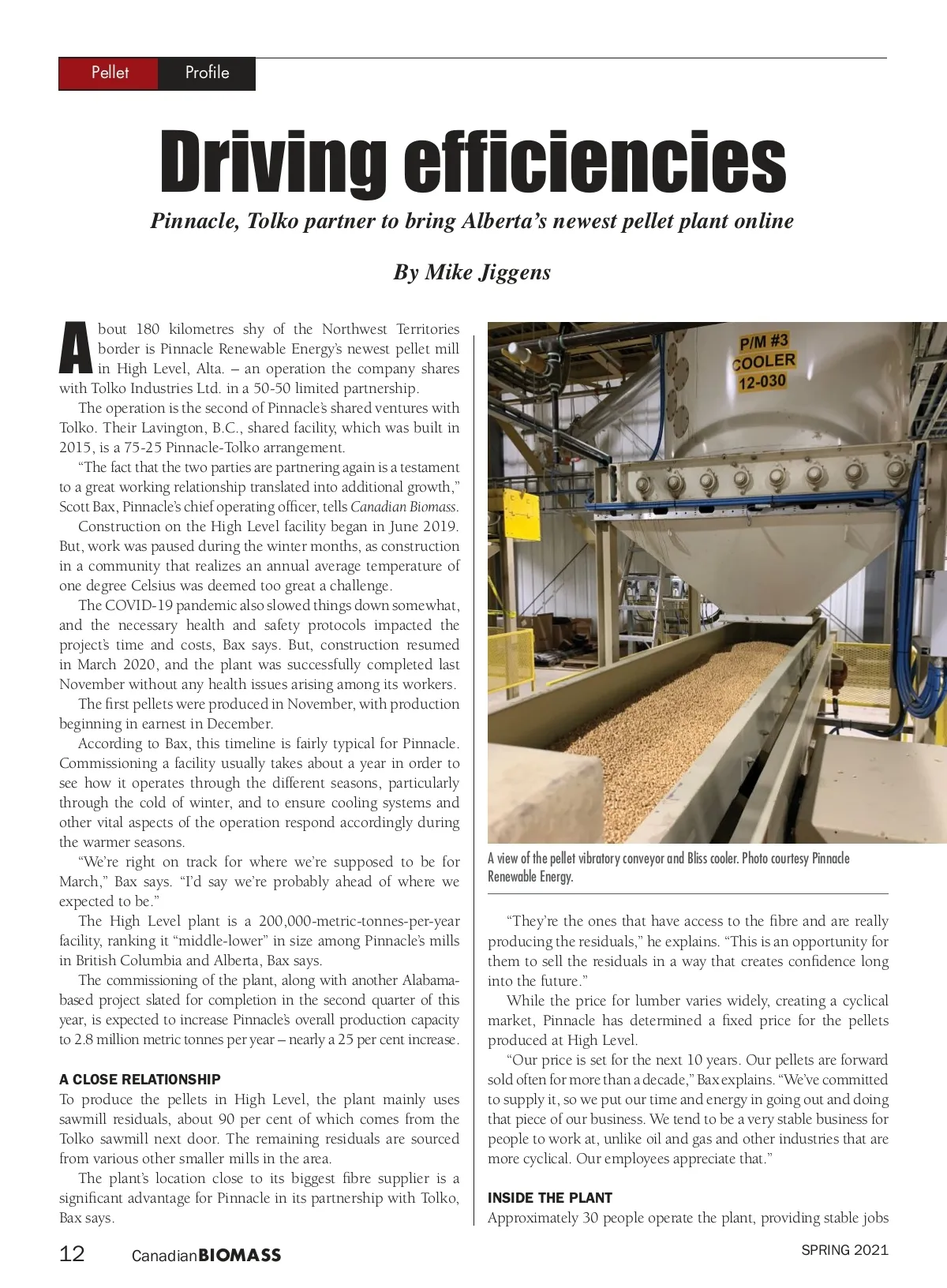
for Pinnacle’s workforce. The 24-hour operation has employees working four 12-hour shifts in a four-days-on, four-days-off cycle. However, the High Level plant is a largely automated operation. The first part of the plant houses the fibre breakdown BioSizer machine from Vancouver-based Brunette Machinery. Moving along conveyors from Continental Conveyors, fibre then goes to a bed dryer manufactured by Prodesa, a Spanish company. Akin to a mesh colander, the bed dryer measures six metres wide by 54 metres in length, or “about half a football field,” Bax says. About a 10-centimeter layer of fibre is placed on top, and warm air is pulled through the fibre, drawing out the moisture. The process also involves two hammer mills from CSE Bliss and six Andritz 26LM-II pellet mills. The plant’s Allied Blower air system from Surrey, B.C., blows out sawdust, shavings and chips. Once pellets are formed, they go to a cooler, where they are screened and then loaded into rail cars for shipment from FibreCo, located in Vancouver. Pellets produced at the plant are exported to European and Asian customers to be used mainly for industrial power and electricity generation. Pinnacle also installed a GreCon spark detection safety system to monitor the plant, along with fire and explosion suppression technology systems from CV Technologies. DRIVING EFFICIENCIES The High Level plant represents Pinnacle’s first project that incorporates more than just the residual stream from its partnering mill. It also takes heat energy from Tolko to generate steam from waste wood. “We really have an opportunity here to take this project where we’re co-located and link ourselves close to the residual stream. We’ve further driven more efficiencies and more sustainability in the business by utilizing the excess heat energy that Tolko’s already creating,” Bax says. This will help make the industry even more sustainable than it already is, given that the fibre for the pellets is sustainably sourced. The drying energy is a by-product of Tolko’s bark-fueled energy system. “Globally, society is becoming more attuned to not wanting to take sequestered carbon out of the ground in the forms of coal or natural gas and add it to the atmosphere,” Bax says. “Pellets are a step in our journey toward the way we create energy that’s more sustainable than anything we’ve done in the past.” And Pinnacle’s new owners, Drax Group, are also focused on pushing that sustainability message forward with a zero-carbon, lower-cost energy future. The company was acquired by Drax in February of this year, and the deal closed in April. “Drax is a world leader in creating meaningful change in the battle against carbon and the battle against climate change. They are already pushing beyond, aiming for a negative carbon future with the implementation of its bio energy carbon capture and storage initiative. It’s pretty exciting for us to be part of that. Any time a customer of yours purchases you as a business, that’s a compliment,” Bax says when asked about the news. • Continental Bulk Handling Storage and Reclaiming Mechanical Conveying Feeding and Sizing Fuel and Ash Handling Contact us to see how we can help you convey bulk materials. Thetford Mines, QC : 418-338-4682 Winnipeg, MB : 204-661-3321 Vancouver, BC : 604-233-2008 Napanee, ON : 613-354-3318 Edmonton, AB : 780-245-1664 New Orleans, LA : 504-284-7759 www.continentalconveyor.ca Canadian BIOMASS 13
Canadian Biomass Spring 2021: Page 13