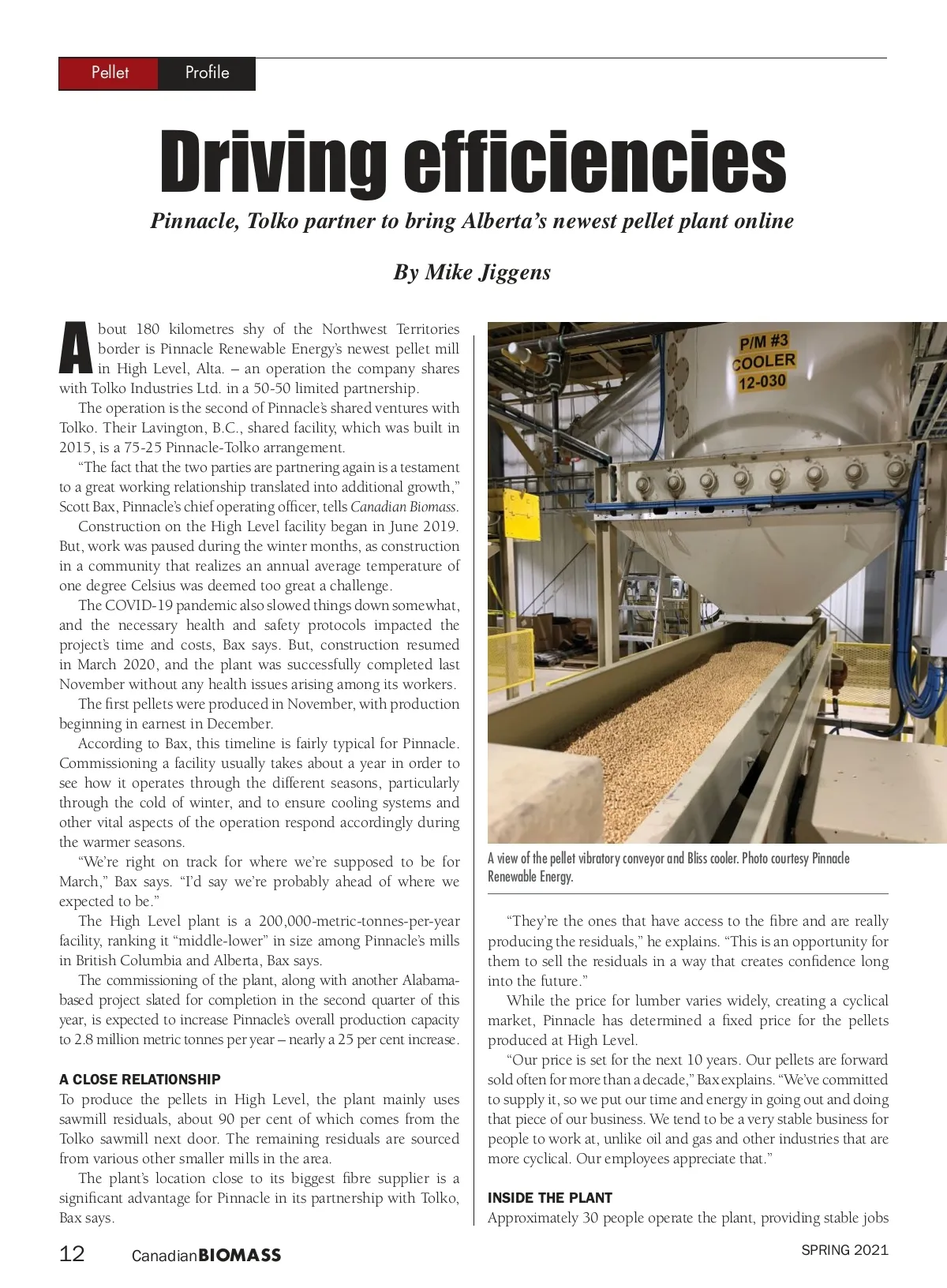
Pellet Profile Pinnacle, Tolko partner to bring Alberta’s newest pellet plant online By Mike Jiggens 'ULYLQJHIILFLHQFLHV A bout 180 kilometres shy of the Northwest Territories border is Pinnacle Renewable Energy’s newest pellet mill in High Level, Alta. – an operation the company shares with Tolko Industries Ltd. in a 50-50 limited partnership. The operation is the second of Pinnacle’s shared ventures with Tolko. Their Lavington, B.C., shared facility, which was built in 2015, is a 75-25 Pinnacle-Tolko arrangement. “The fact that the two parties are partnering again is a testament to a great working relationship translated into additional growth,” Scott Bax, Pinnacle’s chief operating officer, tells Canadian Biomass. Construction on the High Level facility began in June 2019. But, work was paused during the winter months, as construction in a community that realizes an annual average temperature of one degree Celsius was deemed too great a challenge. The COVID-19 pandemic also slowed things down somewhat, and the necessary health and safety protocols impacted the project’s time and costs, Bax says. But, construction resumed in March 2020, and the plant was successfully completed last November without any health issues arising among its workers. The first pellets were produced in November, with production beginning in earnest in December. According to Bax, this timeline is fairly typical for Pinnacle. Commissioning a facility usually takes about a year in order to see how it operates through the different seasons, particularly through the cold of winter, and to ensure cooling systems and other vital aspects of the operation respond accordingly during the warmer seasons. “We’re right on track for where we’re supposed to be for March,” Bax says. “I’d say we’re probably ahead of where we expected to be.” The High Level plant is a 200,000-metric-tonnes-per-year facility, ranking it “middle-lower” in size among Pinnacle’s mills in British Columbia and Alberta, Bax says. The commissioning of the plant, along with another Alabama-based project slated for completion in the second quarter of this year, is expected to increase Pinnacle’s overall production capacity to 2.8 million metric tonnes per year – nearly a 25 per cent increase. A view of the pellet vibratory conveyor and Bliss cooler. Photo courtesy Pinnacle Renewable Energy. A CLOSE RELATIONSHIP To produce the pellets in High Level, the plant mainly uses sawmill residuals, about 90 per cent of which comes from the Tolko sawmill next door. The remaining residuals are sourced from various other smaller mills in the area. The plant’s location close to its biggest fibre supplier is a significant advantage for Pinnacle in its partnership with Tolko, Bax says. “They’re the ones that have access to the fibre and are really producing the residuals,” he explains. “This is an opportunity for them to sell the residuals in a way that creates confidence long into the future.” While the price for lumber varies widely, creating a cyclical market, Pinnacle has determined a fixed price for the pellets produced at High Level. “Our price is set for the next 10 years. Our pellets are forward sold often for more than a decade,” Bax explains. “We’ve committed to supply it, so we put our time and energy in going out and doing that piece of our business. We tend to be a very stable business for people to work at, unlike oil and gas and other industries that are more cyclical. Our employees appreciate that.” INSIDE THE PLANT Approximately 30 people operate the plant, providing stable jobs SPRING 2021 12 Canadian BIOMASS
Canadian Biomass Spring 2021: Page 12