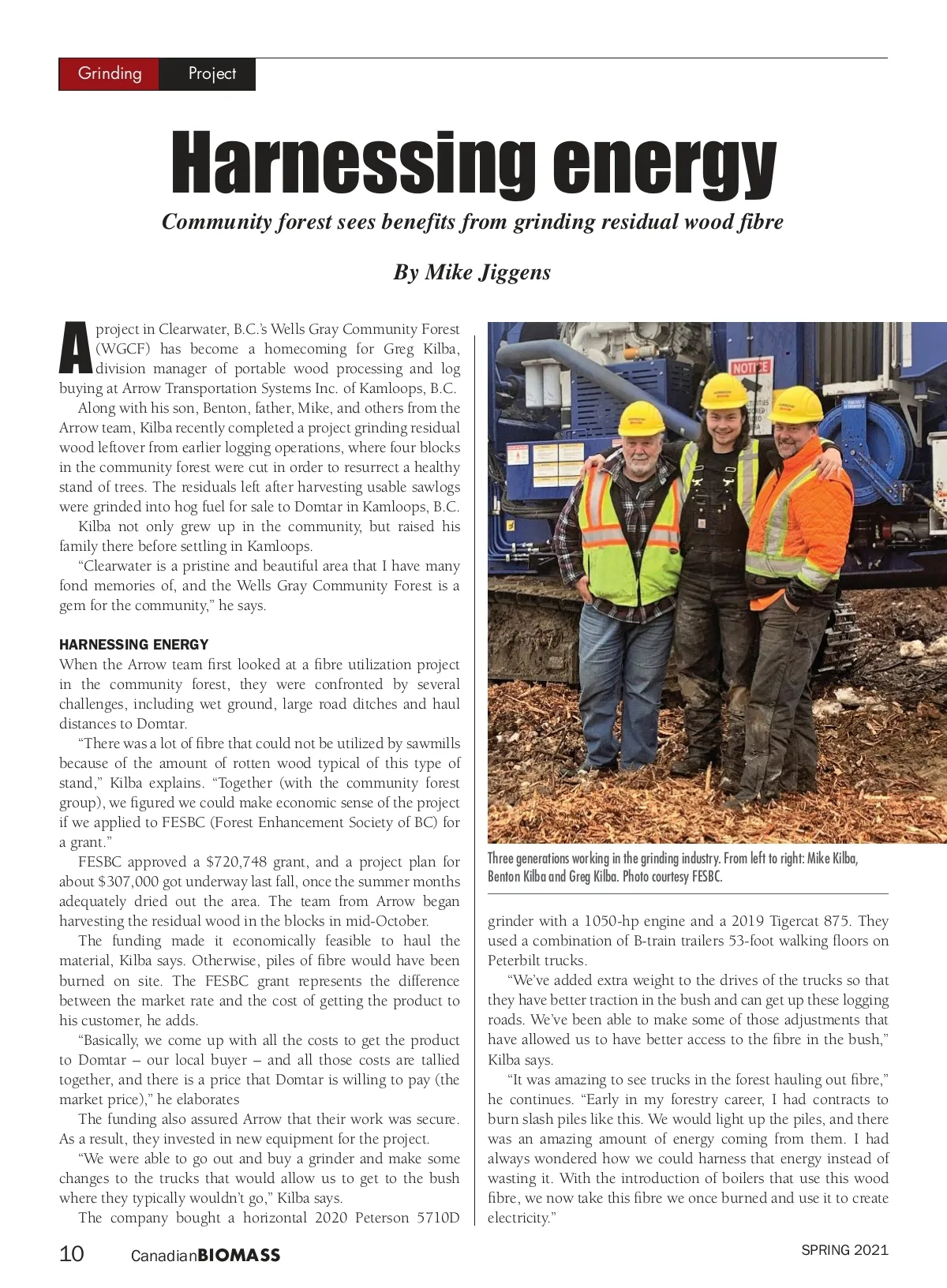
THE WAY OF THE FUTURE In total, Arrow ground 18,992 cubic metres of wood fibre, which roughly translates to 350 logging trucks worth of fibre. The ground-up fibre was transported to Domtar to generate electricity to run operations, with additional green energy being put back to the grid. The grinding project not only created an estimated 212 person-days of work, or close to 1,700 employable hours, but, by avoiding the burning of slash piles, the Clearwater airshed was spared smoke from fires – something George Brcko, WGCF general manager, and many Clearwater residents appreciate. “As a community forest, we can be nimble and innovative in finding ways to be collaborative and get the work done,” Brcko says. “The grinding and hauling of these residuals meant that we didn’t have smoke hanging in our valleys from burning slash. “Additionally, by removing the leftover wood fibre, this means we lessen the opportunity for a catastrophic wildfire in these areas. Without FESBC filling the gap financially, this project would not have happened. This kind of collaboration and support of community forests is the way of the future, and I believe just the tip of the iceberg in forest stewardship as we all work to do things better.” The Wells Gray Community Forest has been an asset to the citizens of Clearwater as revenues generated from operations flow directly back into the community. Since 2004, almost $3 million has gone back into community projects such as seniors housing, summer camps for children, and accessibility projects like multi-use pathways, which is a boon to the community, notes Jennifer Gunter, executive director of the B.C. Community Forest Association. “As we work to grow the bioeconomy and make our communities and forests more resilient, FESBC is providing the missing link by enabling community forests and local entrepreneurs to partner on innovative projects like this,” she says. “By supporting the utilization of residual fibre, multiple benefits are created for the communities, the forests and the province as a whole.” Helping to fund and oversee the project on behalf of FESBC is operations manager Dave Conly. “Arrow, in partnership with Domtar, has been able to develop great solutions with our local community forests, and by using fibre that would otherwise be wasted, they are creating well-paying jobs and assisting the province in achieving climate goals,” Conly says. “Overall, FESBC projects will have generated 5.3 million tonnes of net carbon benefits which is equivalent to removing 1.1 million cars off the road for a year.” Conly adds forestry is an ideal way to achieve British Columbia’s and Canada’s climate change targets while at the same time create more jobs in the bioeconomy. “I absolutely love that Arrow found a way, in partnership with FESBC and our community forest, to utilize residual wood fibre or slash,” Clearwater Mayor Merlin Blackwell says. “Our local Forestry Working Group – a group comprised of city councillors, local government representatives and industry stakeholders – has long advocated for this kind of work to be done because of the countless benefits.” • RecuDry® -Low-temperature belt dryer with heat recovery system Highest efficiency due to energy recovering Lowest emissions due to minished product warming Safe and proven indirect heated system Easy offhand operation and maintenance www.stela.de Canadian BIOMASS 11
Canadian Biomass Spring 2021: Page 11