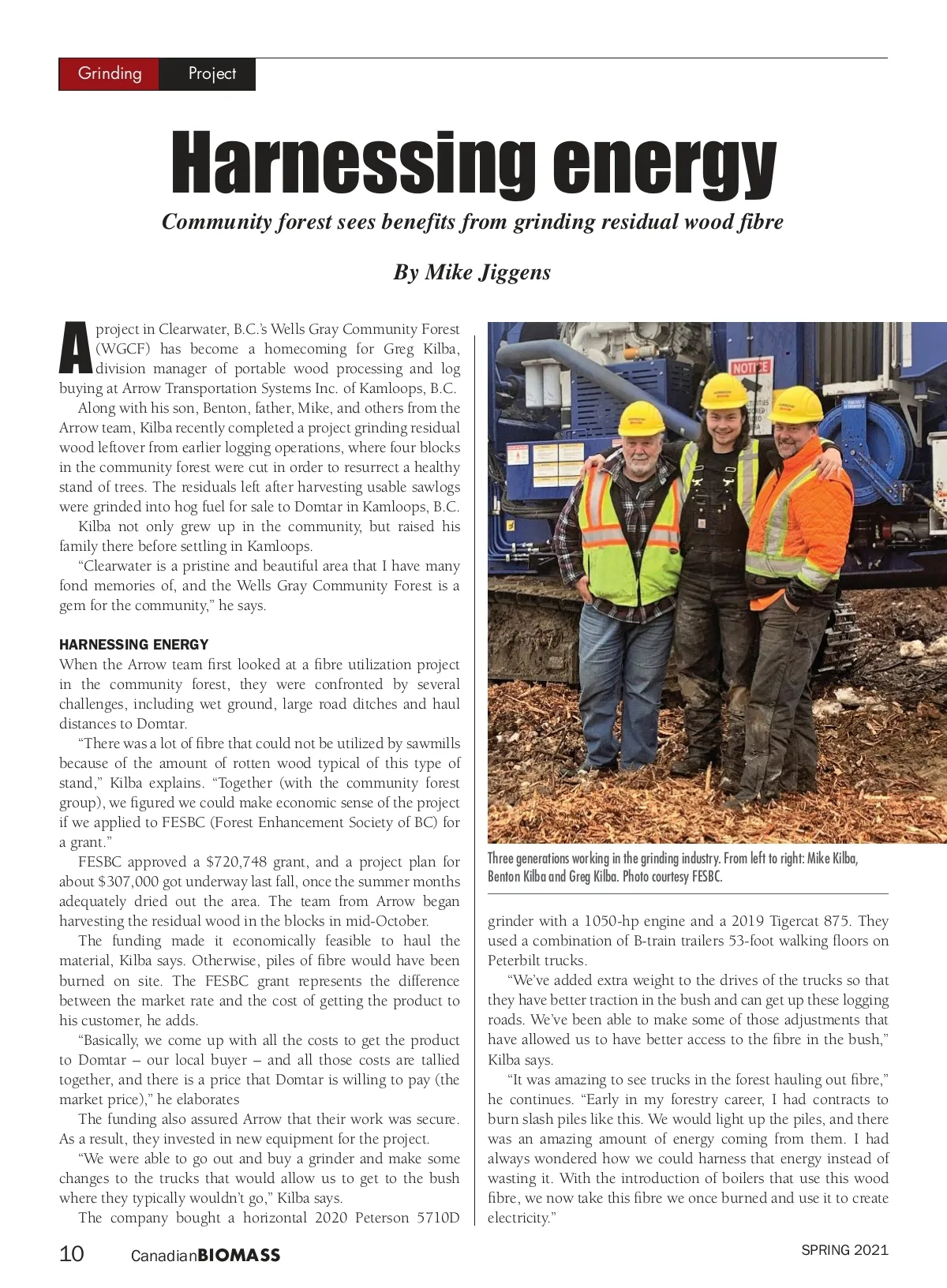
Grinding Project Community forest sees benefits from grinding residual wood fibre By Mike Jiggens +DUQHVVLQJHQHUJ\ A project in Clearwater, B.C.’s Wells Gray Community Forest (WGCF) has become a homecoming for Greg Kilba, division manager of portable wood processing and log buying at Arrow Transportation Systems Inc. of Kamloops, B.C. Along with his son, Benton, father, Mike, and others from the Arrow team, Kilba recently completed a project grinding residual wood leftover from earlier logging operations, where four blocks in the community forest were cut in order to resurrect a healthy stand of trees. The residuals left after harvesting usable sawlogs were grinded into hog fuel for sale to Domtar in Kamloops, B.C. Kilba not only grew up in the community, but raised his family there before settling in Kamloops. “Clearwater is a pristine and beautiful area that I have many fond memories of, and the Wells Gray Community Forest is a gem for the community,” he says. HARNESSING ENERGY When the Arrow team first looked at a fibre utilization project in the community forest, they were confronted by several challenges, including wet ground, large road ditches and haul distances to Domtar. “There was a lot of fibre that could not be utilized by sawmills because of the amount of rotten wood typical of this type of stand,” Kilba explains. “Together (with the community forest group), we figured we could make economic sense of the project if we applied to FESBC (Forest Enhancement Society of BC) for a grant.” FESBC approved a $720,748 grant, and a project plan for about $307,000 got underway last fall, once the summer months adequately dried out the area. The team from Arrow began harvesting the residual wood in the blocks in mid-October. The funding made it economically feasible to haul the material, Kilba says. Otherwise, piles of fibre would have been burned on site. The FESBC grant represents the difference between the market rate and the cost of getting the product to his customer, he adds. “Basically, we come up with all the costs to get the product to Domtar – our local buyer – and all those costs are tallied together, and there is a price that Domtar is willing to pay (the market price),” he elaborates The funding also assured Arrow that their work was secure. As a result, they invested in new equipment for the project. “We were able to go out and buy a grinder and make some changes to the trucks that would allow us to get to the bush where they typically wouldn’t go,” Kilba says. The company bought a horizontal 2020 Peterson 5710D Three generations working in the grinding industry. From left to right: Mike Kilba, Benton Kilba and Greg Kilba. Photo courtesy FESBC. grinder with a 1050-hp engine and a 2019 Tigercat 875. They used a combination of B-train trailers 53-foot walking floors on Peterbilt trucks. “We’ve added extra weight to the drives of the trucks so that they have better traction in the bush and can get up these logging roads. We’ve been able to make some of those adjustments that have allowed us to have better access to the fibre in the bush,” Kilba says. “It was amazing to see trucks in the forest hauling out fibre,” he continues. “Early in my forestry career, I had contracts to burn slash piles like this. We would light up the piles, and there was an amazing amount of energy coming from them. I had always wondered how we could harness that energy instead of wasting it. With the introduction of boilers that use this wood fibre, we now take this fibre we once burned and use it to create electricity.” SPRING 2021 10 Canadian BIOMASS
Canadian Biomass Spring 2021: Page 10