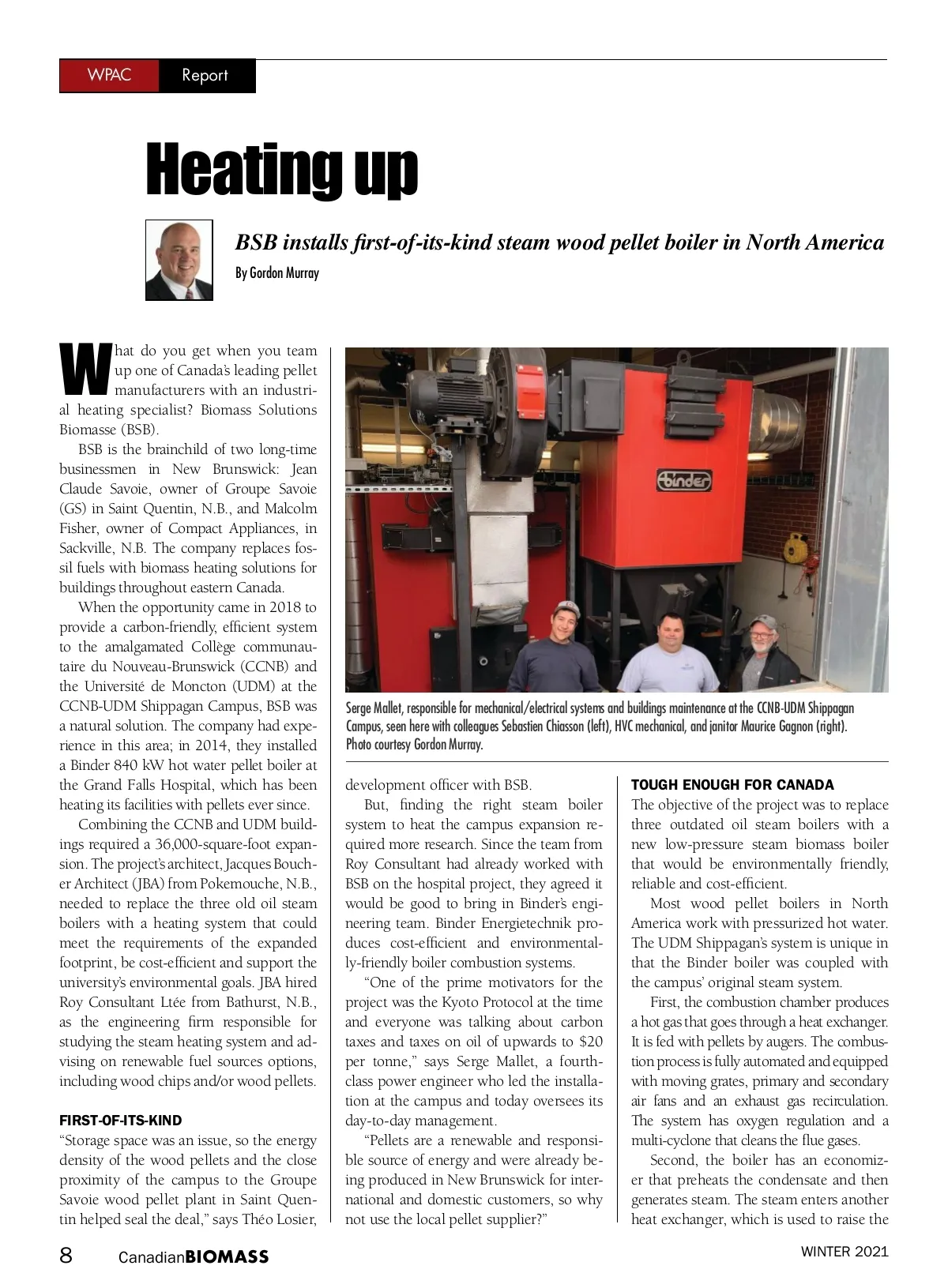
temperature of the hot water that circu-lates through the campus buildings, heat-ing radiators in each classroom. Both the steam and hot water cycles are closed. “Our system doesn’t use much fresh water – we recycle almost all of the con-densate and use steam instead of hot water so we can use a smaller-size boiler,” Mal-let says. “Using our steam boiler for heat and a heat exchanger for heating the water makes the system more efficient.” The Binder system has also proven it-self tough enough to face winters in Ship-pagan, where temperatures can dip down to -20 to -30 Celsius. While two new back-up oil boilers were installed to replace the old ones, they aren’t getting a lot of use. The entire system can be controlled re-motely through the main control system. All the controls and alarms are linked to Mallet’s and his assistant’s cell phones. “When I want to reduce the capacity of the boiler, I can do it from my computer at home. Every night before going to bed, I check the boiler on my cell phone and I check the weather. And if the weather will get warmer that night I reduce the boiler capacity before I go to bed,” Mallet explains. “In the morning, I increase the boiler capacity early before all the normal daily systems come on – they are sched-uled to start 15 minutes apart so there’s not too much demand on the system at once.” COMING FULL CIRCLE – comprised almost entirely from the re-siduals from harvesting or sawmilling. A local trucking company delivers 30 tonnes of pellets at a time to the campus – a 300 kilometre trip one-way from the pellet plant. When the campus is down to about 25-30 per cent, usually within 20 days, it calls the dispatcher for more pellets. The pellets are also benefitting the local greenhouse. After combustion, the ash left from burning the pellets is collected in a massive bin that fills up approximately every 20 days. The product is transported to the greenhouse to be used as fertilizer for gar-dens, coming full circle to start a new cycle. PROVING THE BUSINESS CASE Groupe Savoie’s pellet plant produces 90,000 metric tonnes of pellets every year Like with most innovative projects, there was hesitancy about investing nearly $1 million in new technology that was un-tried in the Canadian marketplace. “Not everyone was convinced is was the right thing to do, having a wood pel-let steam boiler instead of oil, because it’s never been done in North America. So, we had to go through lots of convincing with the engineer, architect and stakeholders,” says Losier. “We focused on saving and reducing emissions, and I believe, at the end of the day, the two goals have been achieved – more than expected, actually.” Placing the combustion chamber next to the heat exchanger was a first not only in North America but for Binder, who managed that part of the design. “Normally, we have a boiler that is just one big block, with a heat exchanger above the fire. Binder managed that part of the design, but it was a bit tricky to fit it in the room because the building was already designed with that boiler room,” says Fran-cis Lamarche, BSB’s mechanical engineer. “This was ground-breaking stuff and first-of-its-kind in North America,” says Losier. “Not only did we have to win peo-ple over about the technology but also on the idea of a farm-style silo on the campus next to the modern look of the expansion building. But, in the end, everyone agrees that it blends in well.” Local residents were also concerned about the potential for emissions from the burning of the pellets, especially since it’s located in the heart of the campus. “I believe it’s cleaner than burning fuel – we’ve reduced emissions by nearly 85 per cent,” says Mallet. “There is no partic-ulate and once the boiler is hot, you don’t see any smoke.” And it’s not just the air that’s clear, but also the future for more buildings to adopt this technology. Losier says other New Brunswick public buildings, including schools and hospitals, are considering us-ing pellets for energy. “Here, we have a carbon-friendly prod-uct coming from New Brunswick wood waste, and [we are] turning it into a clean source of energy that is supporting local businesses and jobs while reducing emis-sions and costs – it is the future of energy. We just have to look to Europe and Asia to see how it’s taken off there. We’ve got a good thing going here.” • Fink Machine Inc. , is very excited to announce that we have added Schmid Energy Solutions boilers to our current product portfolio. Fink’s success is based on Service and we are looking to continue that by adding Schmid boilers to its line of high quality products. Canada’s leading supplier of commercial and small industrial heating systems ASME and CSA certified 100 kW – 12 MW (0.3 MMBTU – 36 MMBTU) Over 130 energy efficient systems installed Fink District Heating System Box 308, 124 Old Vernon St. Enderby, B.C. V0E 1V0 Ph. 250.838.0077 | Fax. 250.838.0068 | www.FinkMachine.com CB_Fink_June20_EJS.indd 1 Canadian BIOMASS 2020-06-26 8:08 AM 9
Canadian Biomass Winter 2021: Page 9