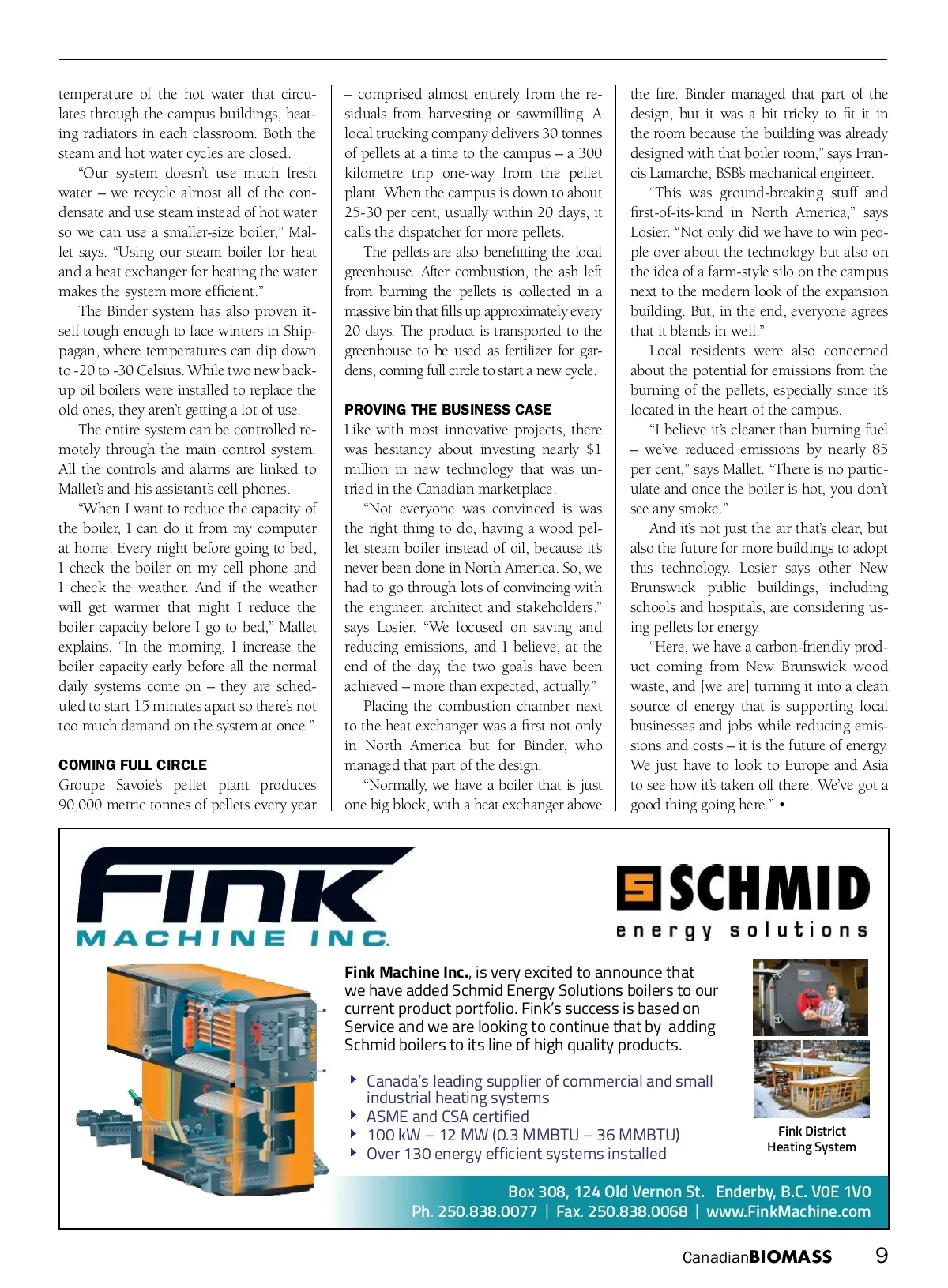
WPAC Report Heating up BSB installs first-of-its-kind steam wood pellet boiler in North America By Gordon Murray W hat do you get when you team up one of Canada’s leading pellet manufacturers with an industri-al heating specialist? Biomass Solutions Biomasse (BSB). BSB is the brainchild of two long-time businessmen in New Brunswick: Jean Claude Savoie, owner of Groupe Savoie (GS) in Saint Quentin, N.B., and Malcolm Fisher, owner of Compact Appliances, in Sackville, N.B. The company replaces fos-sil fuels with biomass heating solutions for buildings throughout eastern Canada. When the opportunity came in 2018 to provide a carbon-friendly, efficient system to the amalgamated Collège communau-taire du Nouveau-Brunswick (CCNB) and the Université de Moncton (UDM) at the CCNB-UDM Shippagan Campus, BSB was a natural solution. The company had expe-rience in this area; in 2014, they installed a Binder 840 kW hot water pellet boiler at the Grand Falls Hospital, which has been heating its facilities with pellets ever since. Combining the CCNB and UDM build-ings required a 36,000-square-foot expan-sion. The project’s architect, Jacques Bouch-er Architect (JBA) from Pokemouche, N.B., needed to replace the three old oil steam boilers with a heating system that could meet the requirements of the expanded footprint, be cost-efficient and support the university’s environmental goals. JBA hired Roy Consultant Ltée from Bathurst, N.B., as the engineering firm responsible for studying the steam heating system and ad-vising on renewable fuel sources options, including wood chips and/or wood pellets. Serge Mallet, responsible for mechanical/electrical systems and buildings maintenance at the CCNB-UDM Shippagan Campus, seen here with colleagues Sebastien Chiasson (left), HVC mechanical, and janitor Maurice Gagnon (right). Photo courtesy Gordon Murray. FIRST-OF-ITS-KIND “Storage space was an issue, so the energy density of the wood pellets and the close proximity of the campus to the Groupe Savoie wood pellet plant in Saint Quen-tin helped seal the deal,” says Théo Losier, development officer with BSB. But, finding the right steam boiler system to heat the campus expansion re-quired more research. Since the team from Roy Consultant had already worked with BSB on the hospital project, they agreed it would be good to bring in Binder’s engi-neering team. Binder Energietechnik pro-duces cost-efficient and environmental-ly-friendly boiler combustion systems. “One of the prime motivators for the project was the Kyoto Protocol at the time and everyone was talking about carbon taxes and taxes on oil of upwards to $20 per tonne,” says Serge Mallet, a fourth-class power engineer who led the installa-tion at the campus and today oversees its day-to-day management. “Pellets are a renewable and responsi-ble source of energy and were already be-ing produced in New Brunswick for inter-national and domestic customers, so why not use the local pellet supplier?” TOUGH ENOUGH FOR CANADA The objective of the project was to replace three outdated oil steam boilers with a new low-pressure steam biomass boiler that would be environmentally friendly, reliable and cost-efficient. Most wood pellet boilers in North America work with pressurized hot water. The UDM Shippagan’s system is unique in that the Binder boiler was coupled with the campus’ original steam system. First, the combustion chamber produces a hot gas that goes through a heat exchanger. It is fed with pellets by augers. The combus-tion process is fully automated and equipped with moving grates, primary and secondary air fans and an exhaust gas recirculation. The system has oxygen regulation and a multi-cyclone that cleans the flue gases. Second, the boiler has an economiz-er that preheats the condensate and then generates steam. The steam enters another heat exchanger, which is used to raise the WINTER 2021 8 Canadian BIOMASS
Canadian Biomass Winter 2021: Page 8