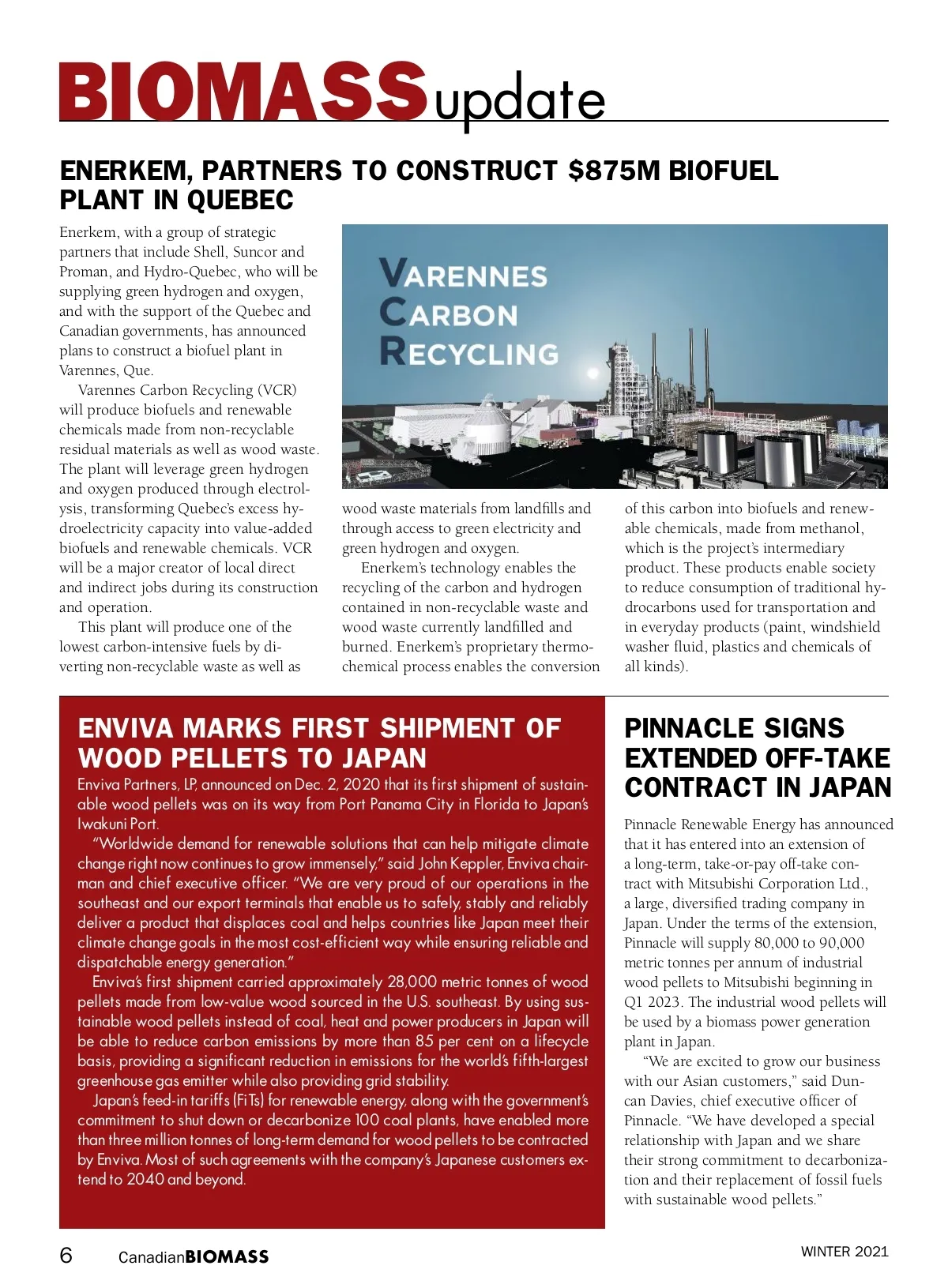
NEW MICROSITE PROMOTES EQUITY AND DIVERSITY IN FORESTRY The Canadian Institute of Forestry/ Institute forestier du Canada (CIF-IFC) and the Centre for Social Intelligence (CSI) have launched Free to Grow in Forestry (www.freetogrowinforestry.ca), a microsite that communicates to all stake-holders in the forest sector the resources developed through the Gender Equity in Canada’s Forest Sector National Action Plan. The National Action Plan is a three-year initiative spearheaded by the CIF-IFC and the CSI, with strategic guidance from a National Steering Committee of forest sector leaders from government, industry, academia, Indigenous and non-profit organizations to achieve gender equality and meaningful inclusion of women, Indigenous peoples and new Canadians at all levels, from technical to executive level positions, in the forest sector. The Free to Grow in Forestry microsite is a culmination of this effort and will share the actions undertaken in this initiative including, but not limited to, com-munication “shareables” that individuals and organizations are encouraged to utilize in their spheres of influence. “With labour market demands mounting and an ever increasing globally compet-itive market, the forest sector must look for ways to remain competitive and thrive,” said Luc M. Rainville, past president, CIF-IFC. “Working together across the sector is a transformational approach to affecting change on diversity and inclusion. Not only will the workplace culture see benefits, organizations can expect to see an improvement in the bottom line,” said Kelly Cooper, CEO and founder, CSI. GREENLANE RENEWABLES SIGNS $10M CONTRACT FOR NEW U.S. RNG PROJECT Greenlane Renewables Inc.’s whol-ly-owned subsidiary, Greenlane Bio-gas North America Ltd., has signed a $10 million ($7.7 million U.S.) con-tract for a new renewable natural gas (RNG) project in the United States owned by an international energy company. This project will utilize Greenlane’s membrane separation biogas upgrading system. “Greenlane continues to gain traction with global energy companies as they seek to diversify their energy portfolios and introduce low-carbon intensity fuel options to their custom-er base.” said Brad Douville, presi-dent and CEO of Greenlane. “To be selected for this exciting new project showcases again our unique ability to provide the best solution from our portfolio of multiple upgrading technologies. This is becoming in-creasingly important as our customers originate, develop and finance a wide range of projects within their respec-tive portfolios, each with unique requirements. This ability, combined with our decades of experience and proven track record, makes Greenlane the ideal partner to help all of our customers scale up rapidly.” While uncertainty remains with respect to the COVID-19 pandemic and its ongoing impact on global economies, the company believes that the energy transition is here to stay. Furthermore, the company believes that RNG will play a meaningful and growing part in countries’ efforts to stimulate their economies while tack-ling climate change and moving to-ward a decarbonized future, in which Greenlane will play an important role. Correction: In Canadian Biomass’ 2020 Pellet Gear Directory, S. Huot should have appeared under Handling Equipment and in the list of company names. Canadian Biomass regrets the error. QUEBEC GOVERNMENT INVESTS $5.9M IN WOOD-WASTE-TO-BIOFUEL PROJECT The Quebec government has awarded funding totalling $5.943 million to a non-profit organization, Bioénergie La Tuque (BELT), under a program called Technoclimat from Transition Énergétique Québec (TEQ), for a project to develop and demonstrate the potential of produc-ing advanced biofuels from locally-sourced forestry waste in La Tuque, Que. The funding will be used to continue project development and plant design, which are key enablers for making further decisions regarding the potential of building a renewable fuels plant in the area. BELT, the Council of the Atikamekw Nation (CNA) and Neste have been col-laborating on the project since 2017. The partners have been jointly assessing the feasibility of utilizing sustainably-sourced forest-based biomass, particularly har-vesting residues – such as branches and tops that are not suitable for sale – in the production of advanced sustainable biofuels. Once in place, this biorefinery could produce advanced renewable biofuels based on logging residues from the Haute-Mauricie region in Quebec. The advanced biofuel will be fully com-patible with existing infrastructure and therefore an excellent candidate for sup-porting the energy transition into the next decade. Thus, the project has the potential to significantly reduce the greenhouse gas emissions from Quebec’s transportation sector, allowing the province to reach sig-nificantly larger emission reductions than what is currently projected. “The region developed around logging, yet, at the moment, residues from this industry are rotting in the woods. In a co-herent energy transition towards a greener economy, projects that make it possible to recover what is currently considered to be waste is aligned with Atikamekw’s values of improving the use of the territory’s resources. These are not perfect industries but, by acting wisely, we can combine economic, social and environmental development,” said Constant Awashish, Grand Chief of the Atikamekw Nation. Canadian BIOMASS 7
Canadian Biomass Winter 2021: Page 7