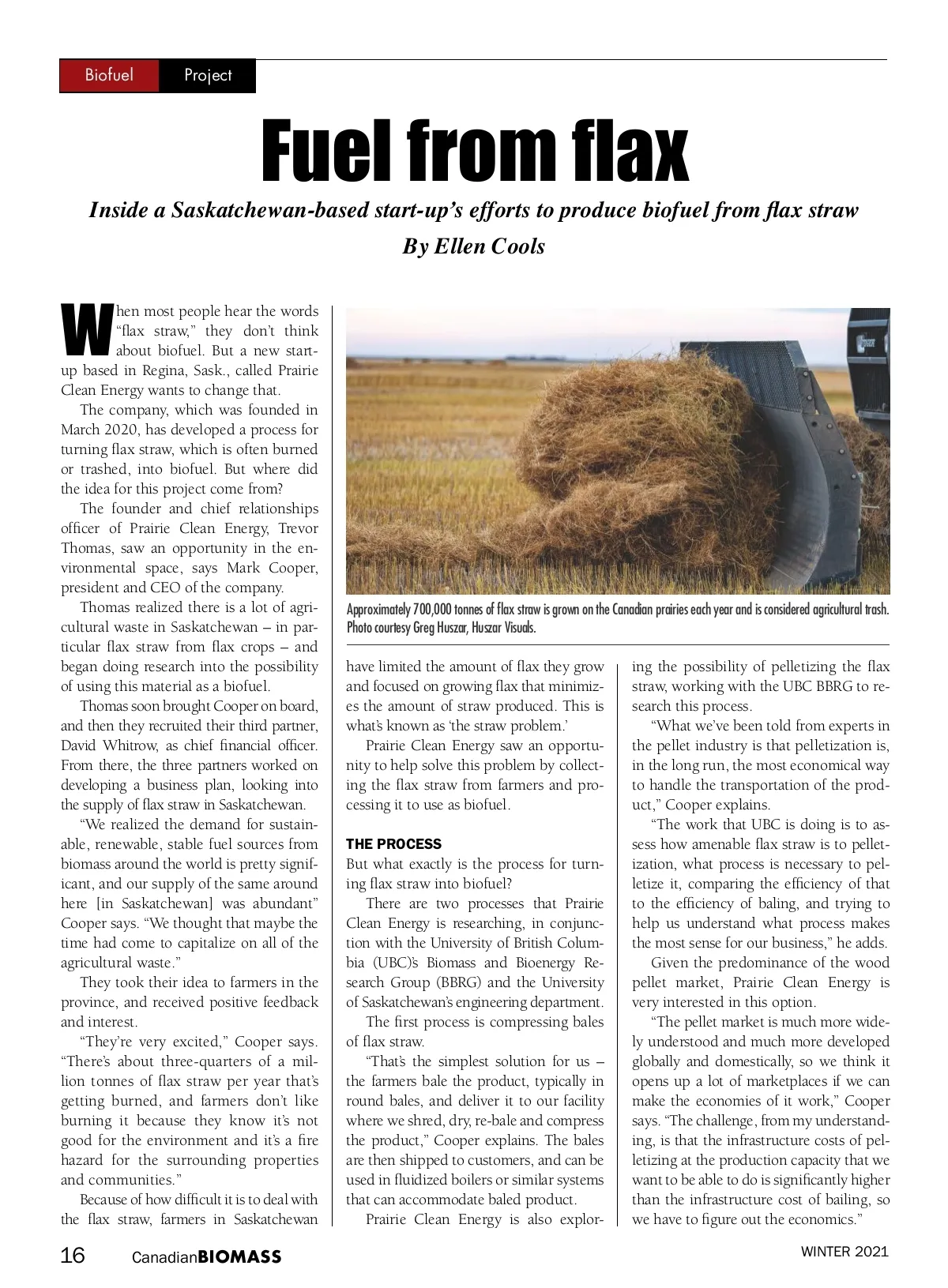
Biofuel Project Inside a Saskatchewan-based start-up’s efforts to produce biofuel from flax straw By Ellen Cools Fuel from flax W hen most people hear the words “flax straw,” they don’t think about biofuel. But a new start-up based in Regina, Sask., called Prairie Clean Energy wants to change that. The company, which was founded in March 2020, has developed a process for turning flax straw, which is often burned or trashed, into biofuel. But where did the idea for this project come from? The founder and chief relationships officer of Prairie Clean Energy, Trevor Thomas, saw an opportunity in the en-vironmental space, says Mark Cooper, president and CEO of the company. Thomas realized there is a lot of agri-cultural waste in Saskatchewan – in par-ticular flax straw from flax crops – and began doing research into the possibility of using this material as a biofuel. Thomas soon brought Cooper on board, and then they recruited their third partner, David Whitrow, as chief financial officer. From there, the three partners worked on developing a business plan, looking into the supply of flax straw in Saskatchewan. “We realized the demand for sustain-able, renewable, stable fuel sources from biomass around the world is pretty signif-icant, and our supply of the same around here [in Saskatchewan] was abundant” Cooper says. “We thought that maybe the time had come to capitalize on all of the agricultural waste.” They took their idea to farmers in the province, and received positive feedback and interest. “They’re very excited,” Cooper says. “There’s about three-quarters of a mil-lion tonnes of flax straw per year that’s getting burned, and farmers don’t like burning it because they know it’s not good for the environment and it’s a fire hazard for the surrounding properties and communities.” Because of how difficult it is to deal with the flax straw, farmers in Saskatchewan Approximately 700,000 tonnes of flax straw is grown on the Canadian prairies each year and is considered agricultural trash. Photo courtesy Greg Huszar, Huszar Visuals. have limited the amount of flax they grow and focused on growing flax that minimiz-es the amount of straw produced. This is what’s known as ‘the straw problem.’ Prairie Clean Energy saw an opportu-nity to help solve this problem by collect-ing the flax straw from farmers and pro-cessing it to use as biofuel. THE PROCESS But what exactly is the process for turn-ing flax straw into biofuel? There are two processes that Prairie Clean Energy is researching, in conjunc-tion with the University of British Colum-bia (UBC)’s Biomass and Bioenergy Re-search Group (BBRG) and the University of Saskatchewan’s engineering department. The first process is compressing bales of flax straw. “That’s the simplest solution for us – the farmers bale the product, typically in round bales, and deliver it to our facility where we shred, dry, re-bale and compress the product,” Cooper explains. The bales are then shipped to customers, and can be used in fluidized boilers or similar systems that can accommodate baled product. Prairie Clean Energy is also explor-ing the possibility of pelletizing the flax straw, working with the UBC BBRG to re-search this process. “What we’ve been told from experts in the pellet industry is that pelletization is, in the long run, the most economical way to handle the transportation of the prod-uct,” Cooper explains. “The work that UBC is doing is to as-sess how amenable flax straw is to pellet-ization, what process is necessary to pel-letize it, comparing the efficiency of that to the efficiency of baling, and trying to help us understand what process makes the most sense for our business,” he adds. Given the predominance of the wood pellet market, Prairie Clean Energy is very interested in this option. “The pellet market is much more wide-ly understood and much more developed globally and domestically, so we think it opens up a lot of marketplaces if we can make the economies of it work,” Cooper says. “The challenge, from my understand-ing, is that the infrastructure costs of pel-letizing at the production capacity that we want to be able to do is significantly higher than the infrastructure cost of bailing, so we have to figure out the economics.” WINTER 2021 16 Canadian BIOMASS
Canadian Biomass Winter 2021: Page 16