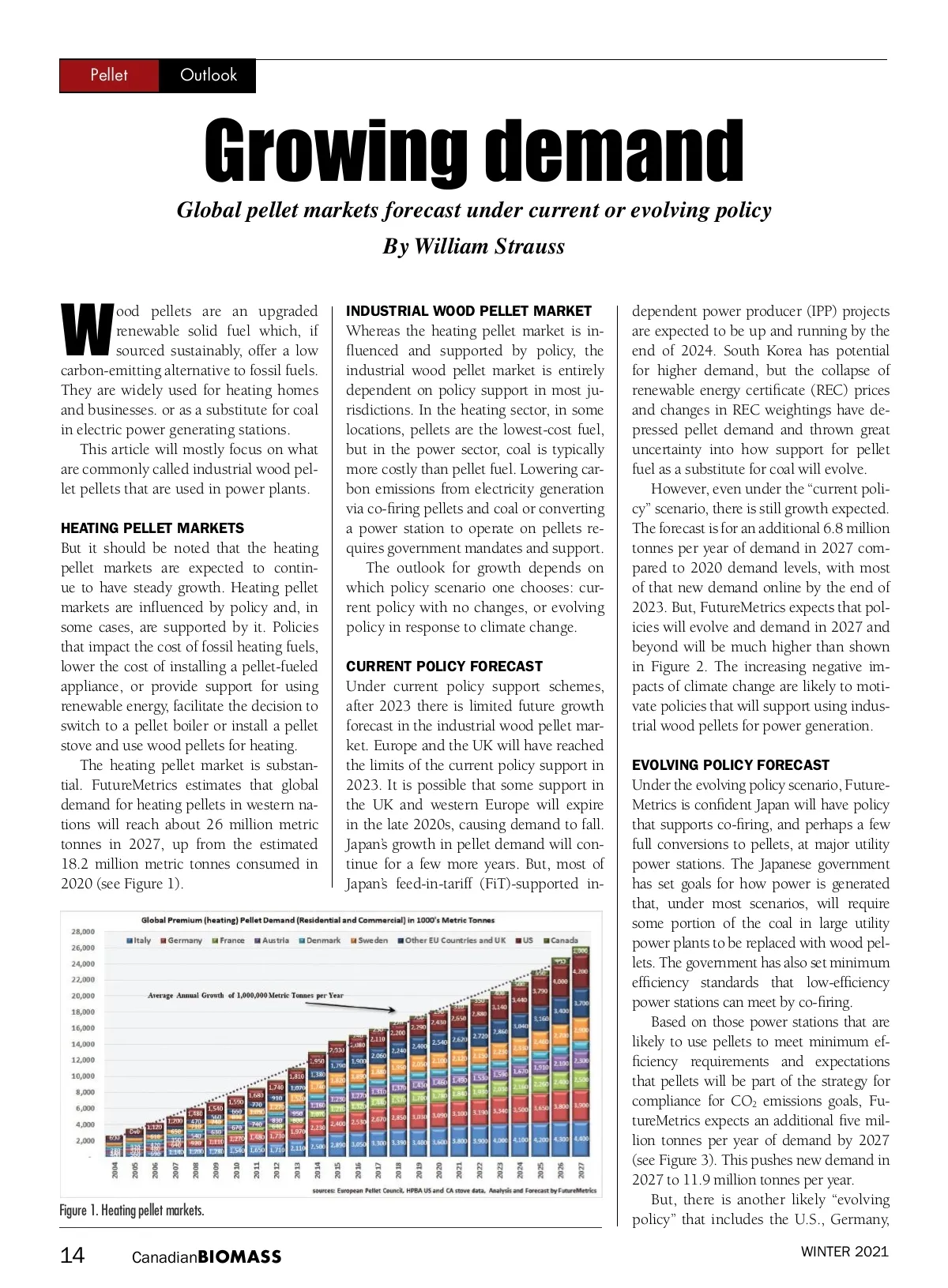
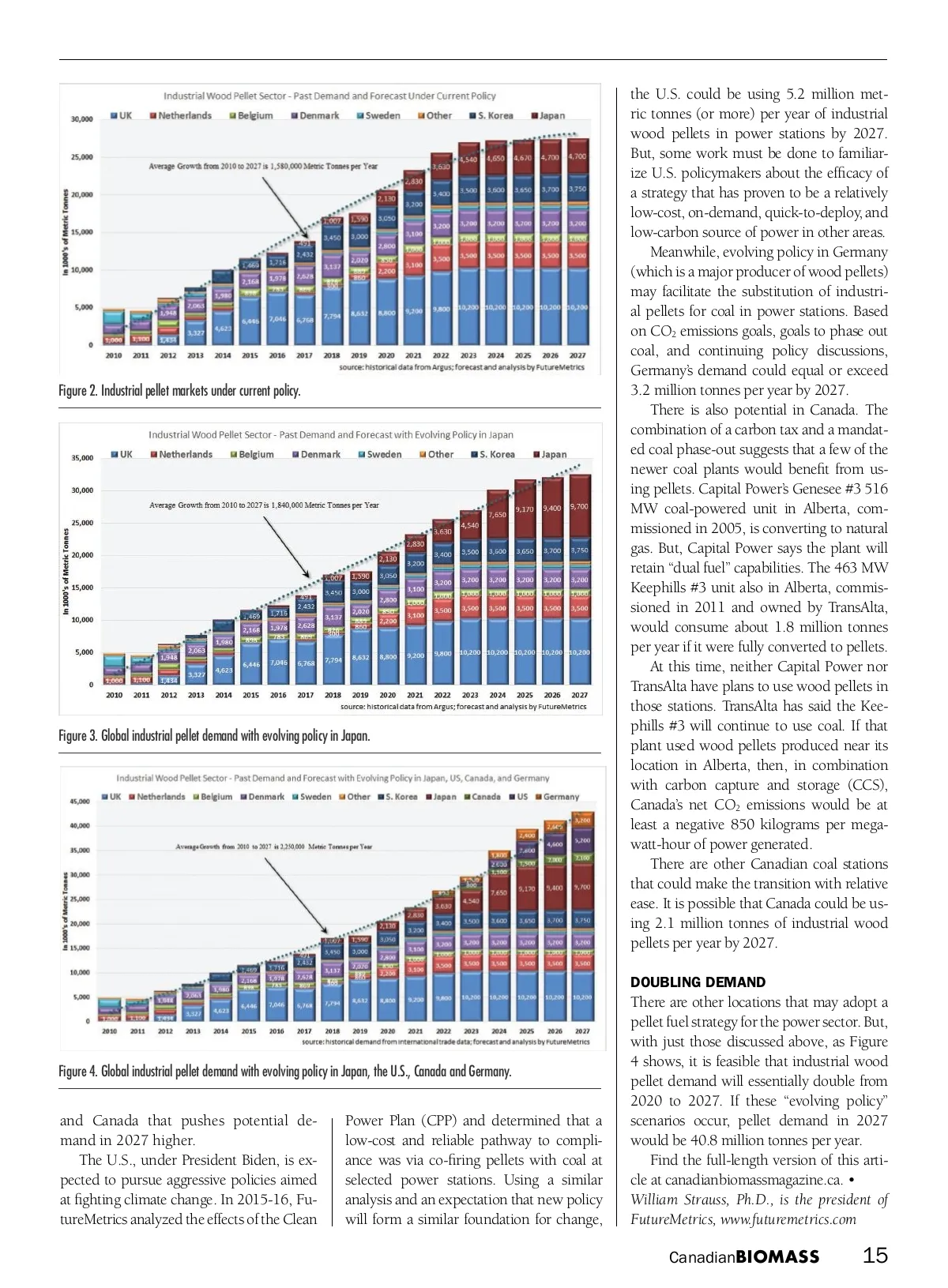
Figure 2. Industrial pellet markets under current policy. Figure 3. Global industrial pellet demand with evolving policy in Japan. the U.S. could be using 5.2 million met-ric tonnes (or more) per year of industrial wood pellets in power stations by 2027. But, some work must be done to familiar-ize U.S. policymakers about the efficacy of a strategy that has proven to be a relatively low-cost, on-demand, quick-to-deploy, and low-carbon source of power in other areas. Meanwhile, evolving policy in Germany (which is a major producer of wood pellets) may facilitate the substitution of industri-al pellets for coal in power stations. Based on CO 2 emissions goals, goals to phase out coal, and continuing policy discussions, Germany’s demand could equal or exceed 3.2 million tonnes per year by 2027. There is also potential in Canada. The combination of a carbon tax and a mandat-ed coal phase-out suggests that a few of the newer coal plants would benefit from us-ing pellets. Capital Power’s Genesee #3 516 MW coal-powered unit in Alberta, com-missioned in 2005, is converting to natural gas. But, Capital Power says the plant will retain “dual fuel” capabilities. The 463 MW Keephills #3 unit also in Alberta, commis-sioned in 2011 and owned by TransAlta, would consume about 1.8 million tonnes per year if it were fully converted to pellets. At this time, neither Capital Power nor TransAlta have plans to use wood pellets in those stations. TransAlta has said the Kee-phills #3 will continue to use coal. If that plant used wood pellets produced near its location in Alberta, then, in combination with carbon capture and storage (CCS), Canada’s net CO 2 emissions would be at least a negative 850 kilograms per mega-watt-hour of power generated. There are other Canadian coal stations that could make the transition with relative ease. It is possible that Canada could be us-ing 2.1 million tonnes of industrial wood pellets per year by 2027. DOUBLING DEMAND Figure 4. Global industrial pellet demand with evolving policy in Japan, the U.S., Canada and Germany. and Canada that pushes potential de-mand in 2027 higher. The U.S., under President Biden, is ex-pected to pursue aggressive policies aimed at fighting climate change. In 2015-16, Fu-tureMetrics analyzed the effects of the Clean Power Plan (CPP) and determined that a low-cost and reliable pathway to compli-ance was via co-firing pellets with coal at selected power stations. Using a similar analysis and an expectation that new policy will form a similar foundation for change, There are other locations that may adopt a pellet fuel strategy for the power sector. But, with just those discussed above, as Figure 4 shows, it is feasible that industrial wood pellet demand will essentially double from 2020 to 2027. If these “evolving policy” scenarios occur, pellet demand in 2027 would be 40.8 million tonnes per year. Find the full-length version of this arti-cle at canadianbiomassmagazine.ca. • William Strauss, Ph.D., is the president of FutureMetrics, www.futuremetrics.com Canadian BIOMASS 15
Canadian Biomass Winter 2021: Page 15