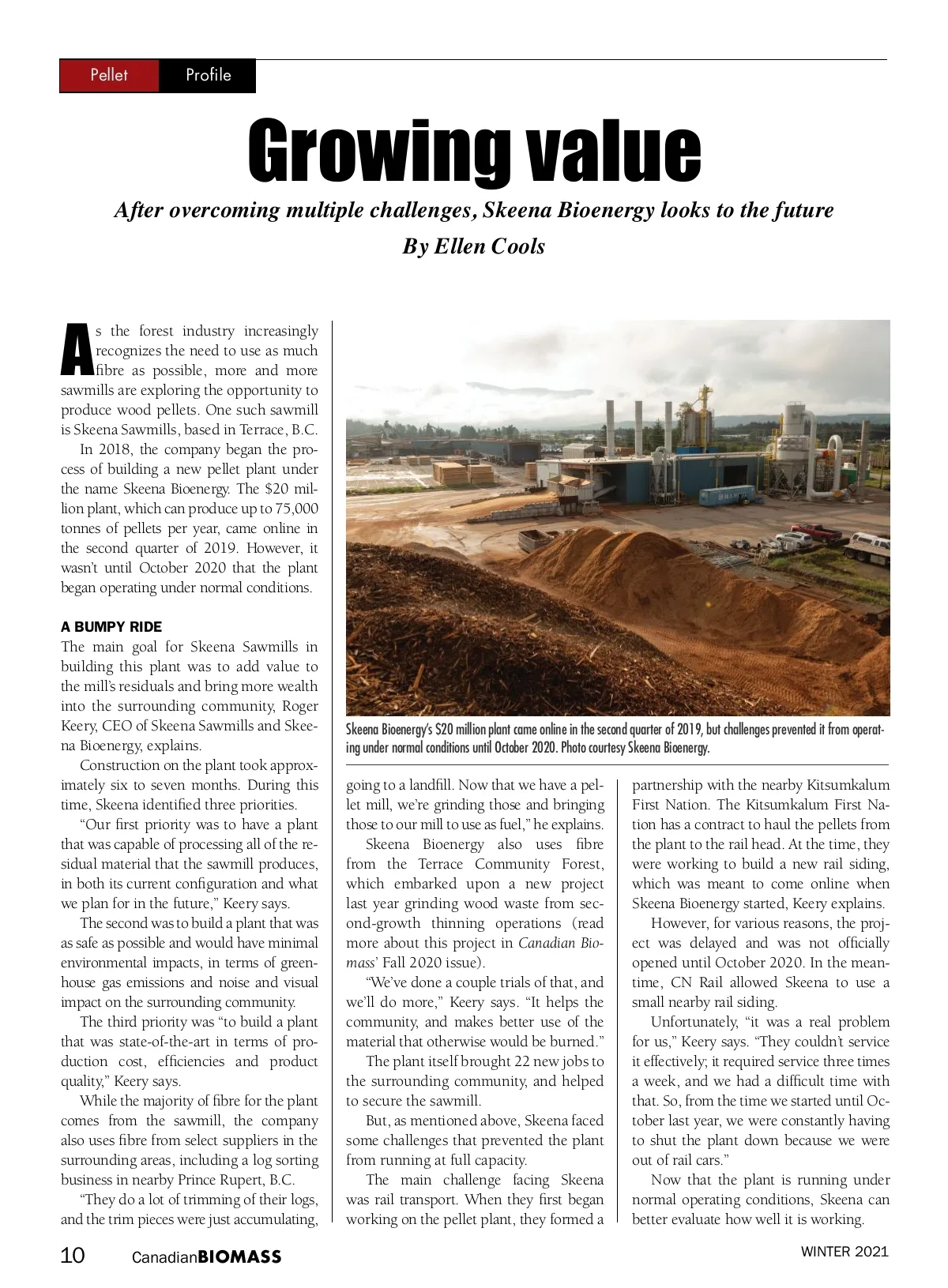
Pellet Profile After overcoming multiple challenges, Skeena Bioenergy looks to the future By Ellen Cools Growing value s the forest industry increasingly recognizes the need to use as much fibre as possible, more and more sawmills are exploring the opportunity to produce wood pellets. One such sawmill is Skeena Sawmills, based in Terrace, B.C. In 2018, the company began the pro-cess of building a new pellet plant under the name Skeena Bioenergy. The $20 mil-lion plant, which can produce up to 75,000 tonnes of pellets per year, came online in the second quarter of 2019. However, it wasn’t until October 2020 that the plant began operating under normal conditions. A BUMPY RIDE A The main goal for Skeena Sawmills in building this plant was to add value to the mill’s residuals and bring more wealth into the surrounding community, Roger Keery, CEO of Skeena Sawmills and Skee-na Bioenergy, explains. Construction on the plant took approx-imately six to seven months. During this time, Skeena identified three priorities. “Our first priority was to have a plant that was capable of processing all of the re-sidual material that the sawmill produces, in both its current configuration and what we plan for in the future,” Keery says. The second was to build a plant that was as safe as possible and would have minimal environmental impacts, in terms of green-house gas emissions and noise and visual impact on the surrounding community. The third priority was “to build a plant that was state-of-the-art in terms of pro-duction cost, efficiencies and product quality,” Keery says. While the majority of fibre for the plant comes from the sawmill, the company also uses fibre from select suppliers in the surrounding areas, including a log sorting business in nearby Prince Rupert, B.C. “They do a lot of trimming of their logs, and the trim pieces were just accumulating, Skeena Bioenergy’s $20 million plant came online in the second quarter of 2019, but challenges prevented it from operat-ing under normal conditions until October 2020. Photo courtesy Skeena Bioenergy. going to a landfill. Now that we have a pel-let mill, we’re grinding those and bringing those to our mill to use as fuel,” he explains. Skeena Bioenergy also uses fibre from the Terrace Community Forest, which embarked upon a new project last year grinding wood waste from sec-ond-growth thinning operations (read more about this project in Canadian Bio-mass ’ Fall 2020 issue). “We’ve done a couple trials of that, and we’ll do more,” Keery says. “It helps the community, and makes better use of the material that otherwise would be burned.” The plant itself brought 22 new jobs to the surrounding community, and helped to secure the sawmill. But, as mentioned above, Skeena faced some challenges that prevented the plant from running at full capacity. The main challenge facing Skeena was rail transport. When they first began working on the pellet plant, they formed a partnership with the nearby Kitsumkalum First Nation. The Kitsumkalum First Na-tion has a contract to haul the pellets from the plant to the rail head. At the time, they were working to build a new rail siding, which was meant to come online when Skeena Bioenergy started, Keery explains. However, for various reasons, the proj-ect was delayed and was not officially opened until October 2020. In the mean-time, CN Rail allowed Skeena to use a small nearby rail siding. Unfortunately, “it was a real problem for us,” Keery says. “They couldn’t service it effectively; it required service three times a week, and we had a difficult time with that. So, from the time we started until Oc-tober last year, we were constantly having to shut the plant down because we were out of rail cars.” Now that the plant is running under normal operating conditions, Skeena can better evaluate how well it is working. WINTER 2021 10 Canadian BIOMASS
Canadian Biomass Winter 2021: Page 10