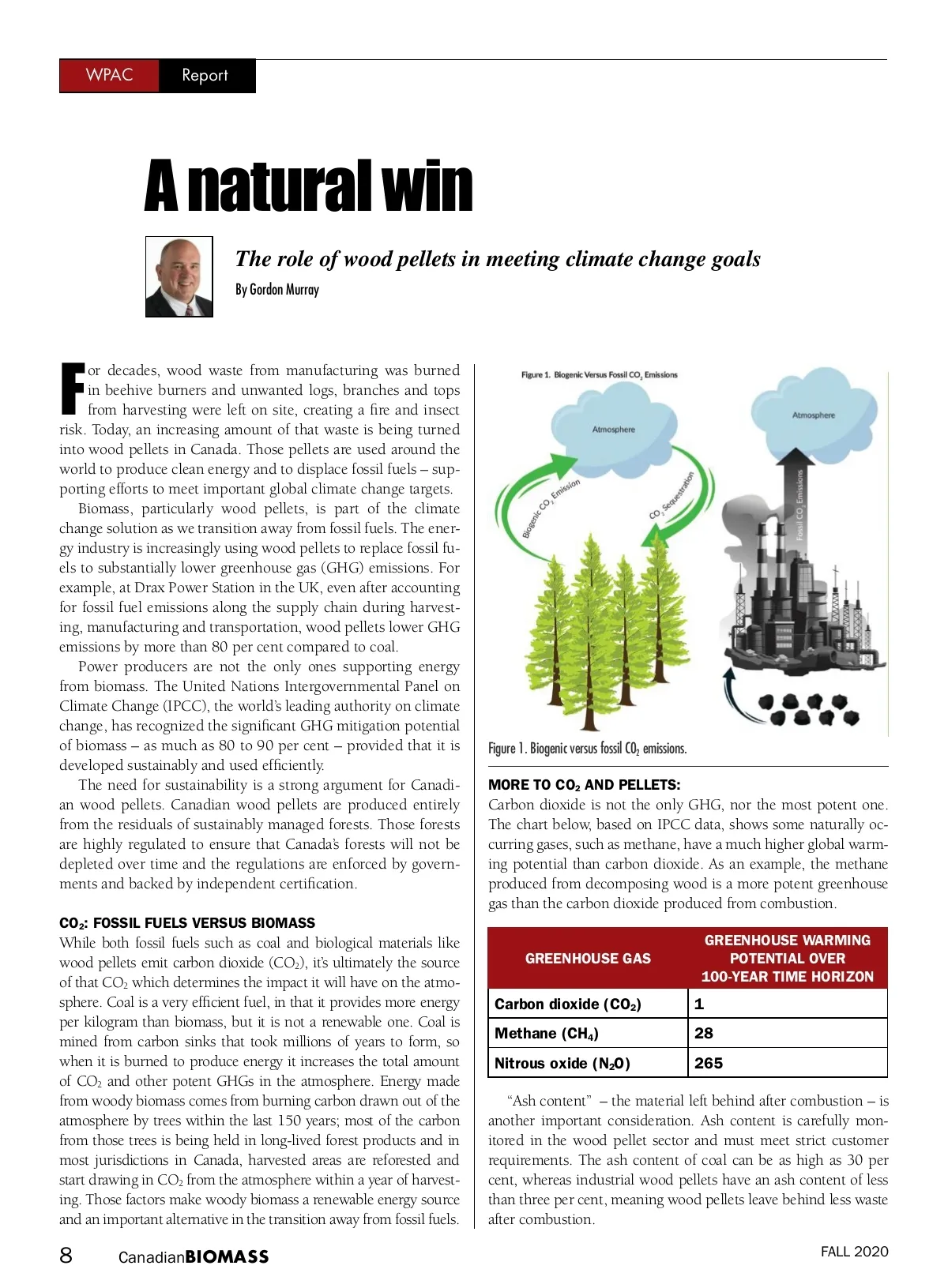
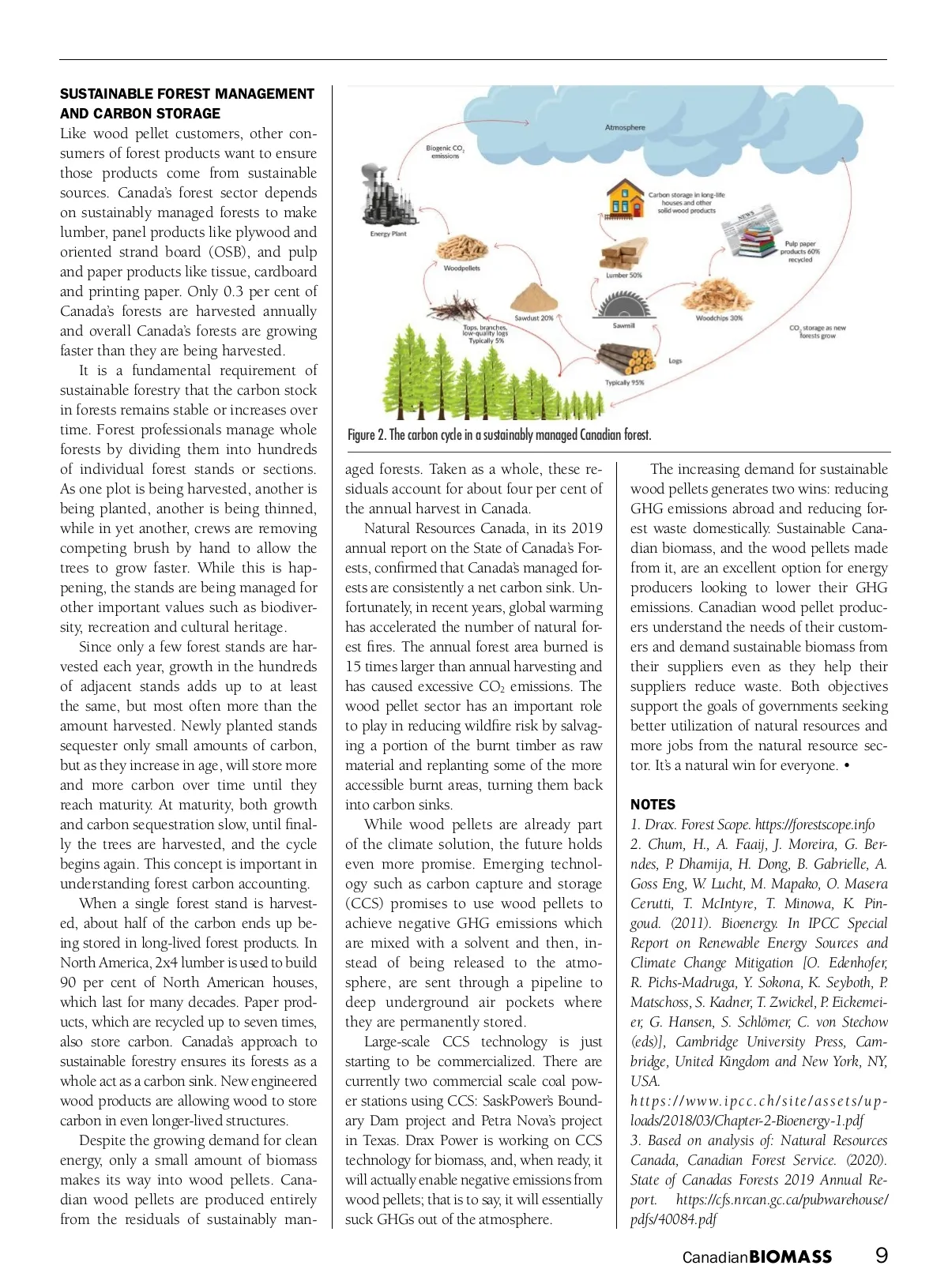
SUSTAINABLE FOREST MANAGEMENT AND CARBON STORAGE Like wood pellet customers, other con-sumers of forest products want to ensure those products come from sustainable sources. Canada’s forest sector depends on sustainably managed forests to make lumber, panel products like plywood and oriented strand board (OSB), and pulp and paper products like tissue, cardboard and printing paper. Only 0.3 per cent of Canada’s forests are harvested annually and overall Canada’s forests are growing faster than they are being harvested. It is a fundamental requirement of sustainable forestry that the carbon stock in forests remains stable or increases over time. Forest professionals manage whole forests by dividing them into hundreds of individual forest stands or sections. As one plot is being harvested, another is being planted, another is being thinned, while in yet another, crews are removing competing brush by hand to allow the trees to grow faster. While this is hap-pening, the stands are being managed for other important values such as biodiver-sity, recreation and cultural heritage. Since only a few forest stands are har-vested each year, growth in the hundreds of adjacent stands adds up to at least the same, but most often more than the amount harvested. Newly planted stands sequester only small amounts of carbon, but as they increase in age, will store more and more carbon over time until they reach maturity. At maturity, both growth and carbon sequestration slow, until final-ly the trees are harvested, and the cycle begins again. This concept is important in understanding forest carbon accounting. When a single forest stand is harvest-ed, about half of the carbon ends up be-ing stored in long-lived forest products. In North America, 2x4 lumber is used to build 90 per cent of North American houses, which last for many decades. Paper prod-ucts, which are recycled up to seven times, also store carbon. Canada’s approach to sustainable forestry ensures its forests as a whole act as a carbon sink. New engineered wood products are allowing wood to store carbon in even longer-lived structures. Despite the growing demand for clean energy, only a small amount of biomass makes its way into wood pellets. Cana-dian wood pellets are produced entirely from the residuals of sustainably man-Figure 2. The carbon cycle in a sustainably managed Canadian forest. aged forests. Taken as a whole, these re-siduals account for about four per cent of the annual harvest in Canada. Natural Resources Canada, in its 2019 annual report on the State of Canada’s For-ests, confirmed that Canada’s managed for-ests are consistently a net carbon sink. Un-fortunately, in recent years, global warming has accelerated the number of natural for-est fires. The annual forest area burned is 15 times larger than annual harvesting and has caused excessive CO 2 emissions. The wood pellet sector has an important role to play in reducing wildfire risk by salvag-ing a portion of the burnt timber as raw material and replanting some of the more accessible burnt areas, turning them back into carbon sinks. While wood pellets are already part of the climate solution, the future holds even more promise. Emerging technol-ogy such as carbon capture and storage (CCS) promises to use wood pellets to achieve negative GHG emissions which are mixed with a solvent and then, in-stead of being released to the atmo-sphere, are sent through a pipeline to deep underground air pockets where they are permanently stored. Large-scale CCS technology is just starting to be commercialized. There are currently two commercial scale coal pow-er stations using CCS: SaskPower’s Bound-ary Dam project and Petra Nova’s project in Texas. Drax Power is working on CCS technology for biomass, and, when ready, it will actually enable negative emissions from wood pellets; that is to say, it will essentially suck GHGs out of the atmosphere. The increasing demand for sustainable wood pellets generates two wins: reducing GHG emissions abroad and reducing for-est waste domestically. Sustainable Cana-dian biomass, and the wood pellets made from it, are an excellent option for energy producers looking to lower their GHG emissions. Canadian wood pellet produc-ers understand the needs of their custom-ers and demand sustainable biomass from their suppliers even as they help their suppliers reduce waste. Both objectives support the goals of governments seeking better utilization of natural resources and more jobs from the natural resource sec-tor. It’s a natural win for everyone. • NOTES 1. Drax. Forest Scope. https://forestscope.info 2. Chum, H., A. Faaij, J. Moreira, G. Ber-ndes, P. Dhamija, H. Dong, B. Gabrielle, A. Goss Eng, W. Lucht, M. Mapako, O. Masera Cerutti, T. McIntyre, T. Minowa, K. Pin-goud. (2011). Bioenergy. In IPCC Special Report on Renewable Energy Sources and Climate Change Mitigation [O. Edenhofer, R. Pichs-Madruga, Y. Sokona, K. Seyboth, P. Matschoss, S. Kadner, T. Zwickel, P. Eickemei-er, G. Hansen, S. Schlömer, C. von Stechow (eds)], Cambridge University Press, Cam-bridge, United Kingdom and New York, NY, USA. https://www.ipcc.ch/site/assets/up -loads/2018/03/Chapter-2-Bioenergy-1.pdf 3. Based on analysis of: Natural Resources Canada, Canadian Forest Service. (2020). State of Canadas Forests 2019 Annual Re-port. https://cfs.nrcan.gc.ca/pubwarehouse/ pdfs/40084.pdf Canadian BIOMASS 9
Canadian Biomass Fall 2020: Page 9