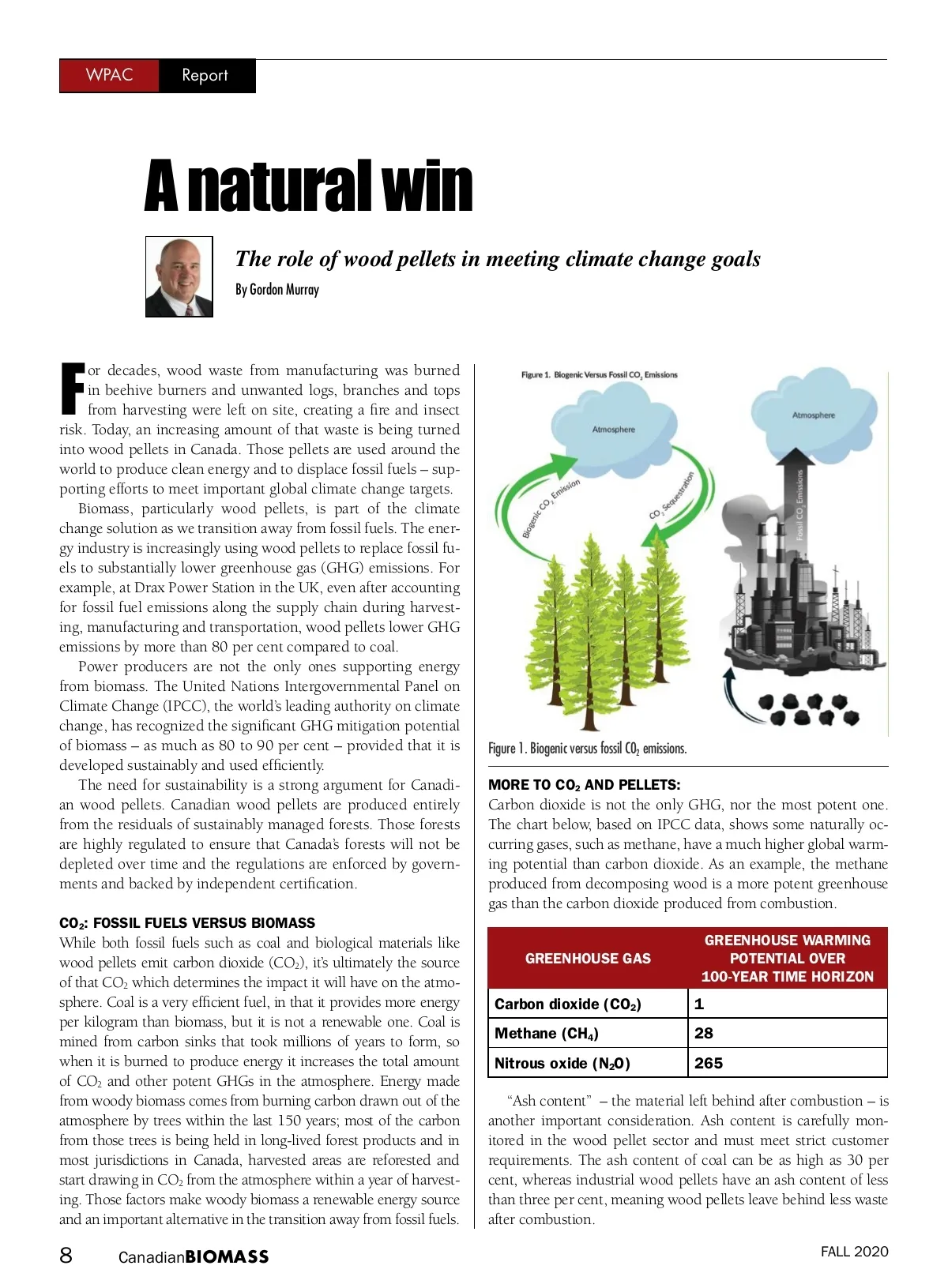
WPAC Report A natural win The role of wood pellets in meeting climate change goals By Gordon Murray or decades, wood waste from manufacturing was burned in beehive burners and unwanted logs, branches and tops from harvesting were left on site, creating a fire and insect risk. Today, an increasing amount of that waste is being turned into wood pellets in Canada. Those pellets are used around the world to produce clean energy and to displace fossil fuels – sup-porting efforts to meet important global climate change targets. Biomass, particularly wood pellets, is part of the climate change solution as we transition away from fossil fuels. The ener-gy industry is increasingly using wood pellets to replace fossil fu-els to substantially lower greenhouse gas (GHG) emissions. For example, at Drax Power Station in the UK, even after accounting for fossil fuel emissions along the supply chain during harvest-ing, manufacturing and transportation, wood pellets lower GHG emissions by more than 80 per cent compared to coal. Power producers are not the only ones supporting energy from biomass. The United Nations Intergovernmental Panel on Climate Change (IPCC), the world’s leading authority on climate change, has recognized the significant GHG mitigation potential of biomass – as much as 80 to 90 per cent – provided that it is developed sustainably and used efficiently. The need for sustainability is a strong argument for Canadi-an wood pellets. Canadian wood pellets are produced entirely from the residuals of sustainably managed forests. Those forests are highly regulated to ensure that Canada’s forests will not be depleted over time and the regulations are enforced by govern-ments and backed by independent certification. CO 2 : FOSSIL FUELS VERSUS BIOMASS F Figure 1. Biogenic versus fossil C0 2 emissions. MORE TO CO 2 AND PELLETS: Carbon dioxide is not the only GHG, nor the most potent one. The chart below, based on IPCC data, shows some naturally oc-curring gases, such as methane, have a much higher global warm-ing potential than carbon dioxide. As an example, the methane produced from decomposing wood is a more potent greenhouse gas than the carbon dioxide produced from combustion. GREENHOUSE GAS GREENHOUSE WARMING POTENTIAL OVER 100-YEAR TIME HORIZON While both fossil fuels such as coal and biological materials like wood pellets emit carbon dioxide (CO 2 ), it’s ultimately the source of that CO 2 which determines the impact it will have on the atmo-sphere. Coal is a very efficient fuel, in that it provides more energy per kilogram than biomass, but it is not a renewable one. Coal is mined from carbon sinks that took millions of years to form, so when it is burned to produce energy it increases the total amount of CO 2 and other potent GHGs in the atmosphere. Energy made from woody biomass comes from burning carbon drawn out of the atmosphere by trees within the last 150 years; most of the carbon from those trees is being held in long-lived forest products and in most jurisdictions in Canada, harvested areas are reforested and start drawing in CO 2 from the atmosphere within a year of harvest-ing. Those factors make woody biomass a renewable energy source and an important alternative in the transition away from fossil fuels. Carbon dioxide (CO 2 ) Methane (CH 4 ) Nitrous oxide (N 2 O) 1 28 265 “Ash content” – the material left behind after combustion – is another important consideration. Ash content is carefully mon-itored in the wood pellet sector and must meet strict customer requirements. The ash content of coal can be as high as 30 per cent, whereas industrial wood pellets have an ash content of less than three per cent, meaning wood pellets leave behind less waste after combustion. FALL 2020 8 Canadian BIOMASS
Canadian Biomass Fall 2020: Page 8