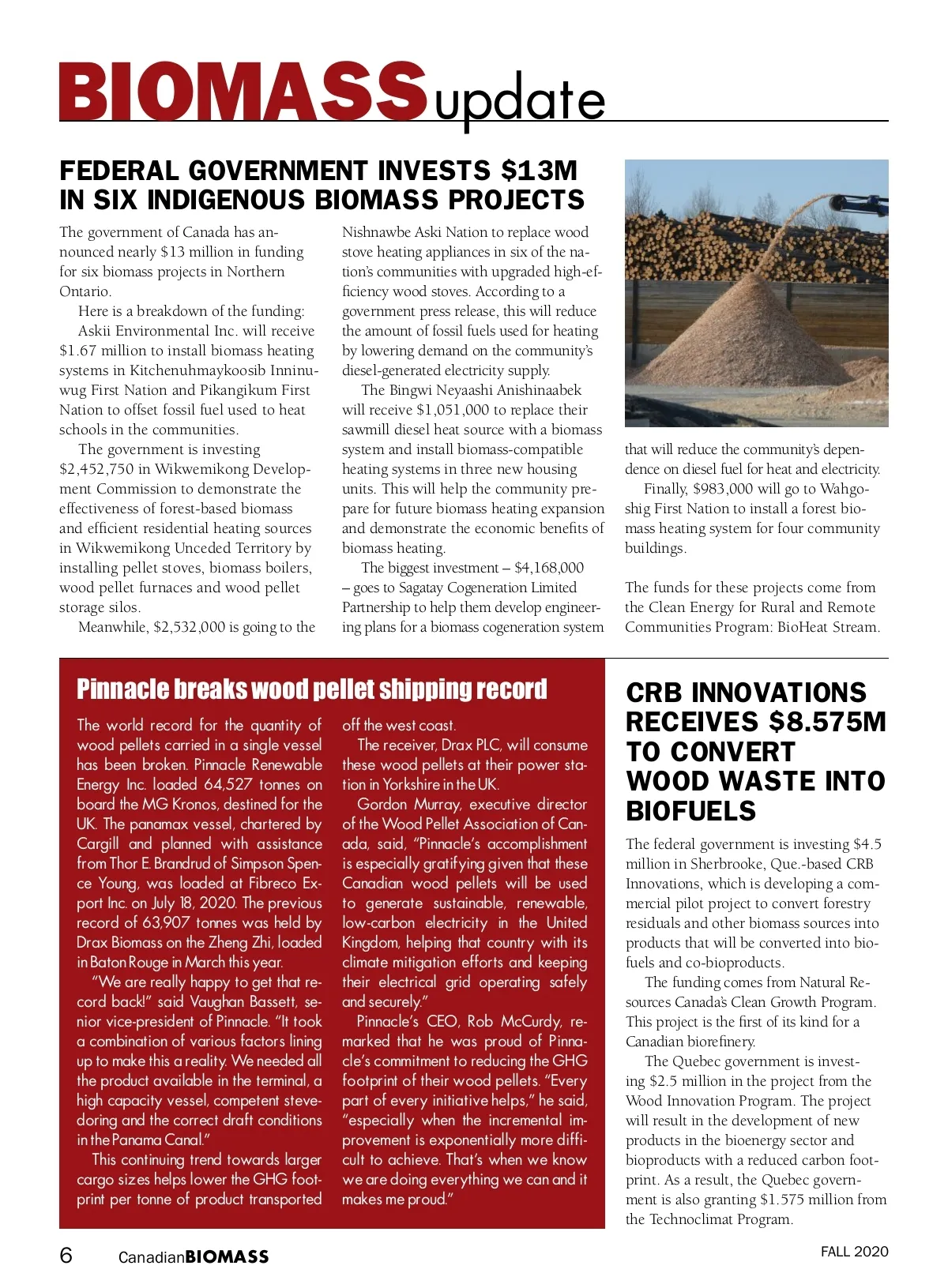
ELKEM TO BUILD BIOCARBON PLANT IN QUEBEC Elkem has decided to invest in a new biocarbon pilot plant in Canada. The project aims to secure industrial ver-ification of Elkem’s technology for renewable biocarbon, with a long-term goal of contributing to climate-neutral metal production. The technology also has potential for application in other industry sectors, contributing to reduced CO 2 emissions. The total investment for the pilot plant amounts to 180 million Norwegian Krone (NOK). The project has received financial support from the Canadian government, the Québec government and the city of Saguenay, reducing Elkem’s net investment to 60 million NOK. The plant will be constructed near Elkem’s production site in Chicoutimi, Que., with the start of construction planned for the second half of 2020. Based on conclusions from the pilot, Elkem will evaluate the basis for a full-scale plant. “With this new biocarbon pilot plant in Canada, we aim to secure long-term access to low-cost, high-quality renewable biocarbon to replace fossil coal, and further improve our competitive position for a sustainable future. In addition, we see a potential for scaling up this technol-ogy to other industries – helping reduce emissions,” said Michael Koenig, CEO of Elkem. With the new plant, Elkem will pilot an industrial biocarbon process tailor-made for silicon and ferrosilicon production. Using climate-neutral renewable biocarbon instead of fossil coal as a reduction agent is a key part of Elkem’s sustainable production strategy. Elkem already uses close to 20 per cent biocarbon in its production in Norway and the company is working towards increasing this to 40 per cent by 2030. The pilot plant will source raw materials from local sawmills in Canada, including recycled bark, wood chips, sawdust and wood shaves. This will create new business opportunities within the circular economy and create new green jobs. More than two million Green tons (Gt) of potential raw material is already produced within 100 kilometres of the Chicoutimi area in Quebec. NOVA SCOTIA GOVERNMENT AWARDS CONTRACTS TO BUILD WOOD CHIP HEATING SYSTEMS The province of Nova Scotia has selected four companies to con-vert fossil fuel heating systems at six sites to wood chip heating systems. According to a government press release, the companies will design, build and operate new boilers. The contracts include long-term agreements to source wood chips from private wood-lots and sawmills. The contracts have been awarded as follows: • Mira Forestry Development Ltd., based in Albert Bridge, N.S., will convert the fossil fuel heating systems at Memori-al High School in Sydney Mines, N.S., and Riverview High School in Sydney, N.S. • Wood4heating Canada Inc. in Charlottetown, N.S., will convert the systems at Perennia Park Atlantic Centre for Agri-Innovation in Bible Hill, N.S., and Hants East Rural High School in Milford, N.S. • Spec Resources Inc. in Church Point, N.S., will convert the system at Nova Scotia Community College Centre of Geo-graphic Sciences in Lawrencetown, N.S. • Finally, ACFOR Energy Inc., based in Cocagne, N.B., will convert the fossil fuel system at the Bridgewater Provincial Court. The province has also announced a district heating network will be created at Perennia Park and three buildings will be heated by the new boiler. Bridgewater Provincial Court and Nova Scotia Community College’s Lunenberg campus will form a two-build-ing district heating network. “These projects help us progress towards a greener economy and reduce the carbon footprint of government buildings by replacing fossil fuels with a renewable resource,” said Nova Scotia lands and forestry minister Iain Rankin in a statement. “Using lower grade wood for heat will create new and stable markets for Nova Scotia’s wood chips and opportunities for private woodlot owners and sawmills to sell lower grade wood locally.” LETHBRIDGE BIOGAS UNDERGOING $7M EXPANSION Lethbridge Biogas has announced a $7 million expansion of the company’s existing site that will provide new op-portunities for the region. The company, based in Lethbridge, Alta., has been operating since 2013. The plant produces renewable electrici-ty through the use of organic resources such as agricultural manures and food processing by-products. The expansion will introduce Lethbridge Biogas into the natural gas market by allowing for the plant’s bio-gas to be purified into pipeline-grade biomethane (renewable natural gas (RNG)), which will be injected into ATCO’s natural gas grid. The RNG will also be supplied to FortisBC under a long-term supply agreement by mid-2021. Once the expansion is complete, Lethbridge Biogas will have the first full-scale, commercial renewable natu-ral gas application in Alberta. “This expansion at our Lethbridge Biogas facility is another significant milestone in the history of our project,” said Lethbridge Biogas director of oper-ations Stefan Michalski, who also works on the national level as co-chair of the Canadian Biogas Association. “It is the result of dedication and very hard work from our team over many, many years to get our business established, not only in the Lethbridge area but beyond in the Canadian and North American context. A lot of players in the RNG market were interested to become part of this expansion, as RNG has become a highly sought-after commodity to reduce the carbon footprint in the natural gas supply chain.” Canadian BIOMASS 7
Canadian Biomass Fall 2020: Page 7