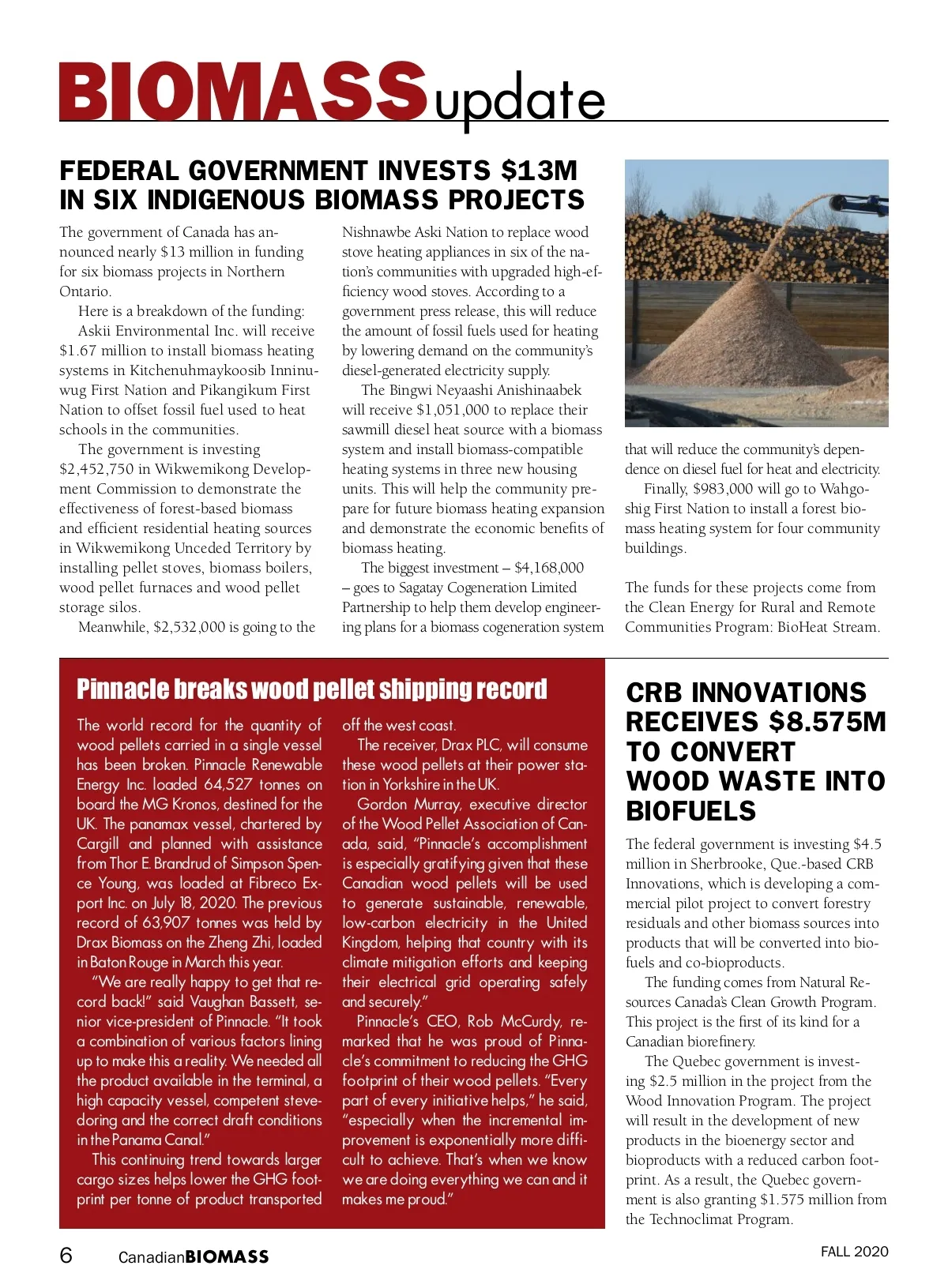
BIOMASS update FEDERAL GOVERNMENT INVESTS $13M IN SIX INDIGENOUS BIOMASS PROJECTS The government of Canada has an-nounced nearly $13 million in funding for six biomass projects in Northern Ontario. Here is a breakdown of the funding: Askii Environmental Inc. will receive $1.67 million to install biomass heating systems in Kitchenuhmaykoosib Inninu-wug First Nation and Pikangikum First Nation to offset fossil fuel used to heat schools in the communities. The government is investing $2,452,750 in Wikwemikong Develop-ment Commission to demonstrate the effectiveness of forest-based biomass and efficient residential heating sources in Wikwemikong Unceded Territory by installing pellet stoves, biomass boilers, wood pellet furnaces and wood pellet storage silos. Meanwhile, $2,532,000 is going to the Nishnawbe Aski Nation to replace wood stove heating appliances in six of the na-tion’s communities with upgraded high-ef-ficiency wood stoves. According to a government press release, this will reduce the amount of fossil fuels used for heating by lowering demand on the community’s diesel-generated electricity supply. The Bingwi Neyaashi Anishinaabek will receive $1,051,000 to replace their sawmill diesel heat source with a biomass system and install biomass-compatible heating systems in three new housing units. This will help the community pre-pare for future biomass heating expansion and demonstrate the economic benefits of biomass heating. The biggest investment – $4,168,000 – goes to Sagatay Cogeneration Limited Partnership to help them develop engineer-ing plans for a biomass cogeneration system that will reduce the community’s depen-dence on diesel fuel for heat and electricity. Finally, $983,000 will go to Wahgo-shig First Nation to install a forest bio-mass heating system for four community buildings. The funds for these projects come from the Clean Energy for Rural and Remote Communities Program: BioHeat Stream. Pinnacle breaks wood pellet shipping record The world record for the quantity of wood pellets carried in a single vessel has been broken. Pinnacle Renewable Energy Inc. loaded 64,527 tonnes on board the MG Kronos, destined for the UK. The panamax vessel, chartered by Cargill and planned with assistance from Thor E. Brandrud of Simpson Spen-ce Young, was loaded at Fibreco Ex-port Inc. on July 18, 2020. The previous record of 63,907 tonnes was held by Drax Biomass on the Zheng Zhi, loaded in Baton Rouge in March this year. “We are really happy to get that re-cord back!” said Vaughan Bassett, se-nior vice-president of Pinnacle. “It took a combination of various factors lining up to make this a reality. We needed all the product available in the terminal, a high capacity vessel, competent steve-doring and the correct draft conditions in the Panama Canal.” This continuing trend towards larger cargo sizes helps lower the GHG foot-print per tonne of product transported off the west coast. The receiver, Drax PLC, will consume these wood pellets at their power sta-tion in Yorkshire in the UK. Gordon Murray, executive director of the Wood Pellet Association of Can-ada, said, “Pinnacle’s accomplishment is especially gratifying given that these Canadian wood pellets will be used to generate sustainable, renewable, low-carbon electricity in the United Kingdom, helping that country with its climate mitigation efforts and keeping their electrical grid operating safely and securely.” Pinnacle’s CEO, Rob McCurdy, re-marked that he was proud of Pinna-cle’s commitment to reducing the GHG footprint of their wood pellets. “Every part of every initiative helps,” he said, “especially when the incremental im-provement is exponentially more diffi-cult to achieve. That’s when we know we are doing everything we can and it makes me proud.” CRB INNOVATIONS RECEIVES $8.575M TO CONVERT WOOD WASTE INTO BIOFUELS The federal government is investing $4.5 million in Sherbrooke, Que.-based CRB Innovations, which is developing a com-mercial pilot project to convert forestry residuals and other biomass sources into products that will be converted into bio-fuels and co-bioproducts. The funding comes from Natural Re-sources Canada’s Clean Growth Program. This project is the first of its kind for a Canadian biorefinery. The Quebec government is invest-ing $2.5 million in the project from the Wood Innovation Program. The project will result in the development of new products in the bioenergy sector and bioproducts with a reduced carbon foot-print. As a result, the Quebec govern-ment is also granting $1.575 million from the Technoclimat Program. FALL 2020 6 Canadian BIOMASS
Canadian Biomass Fall 2020: Page 6