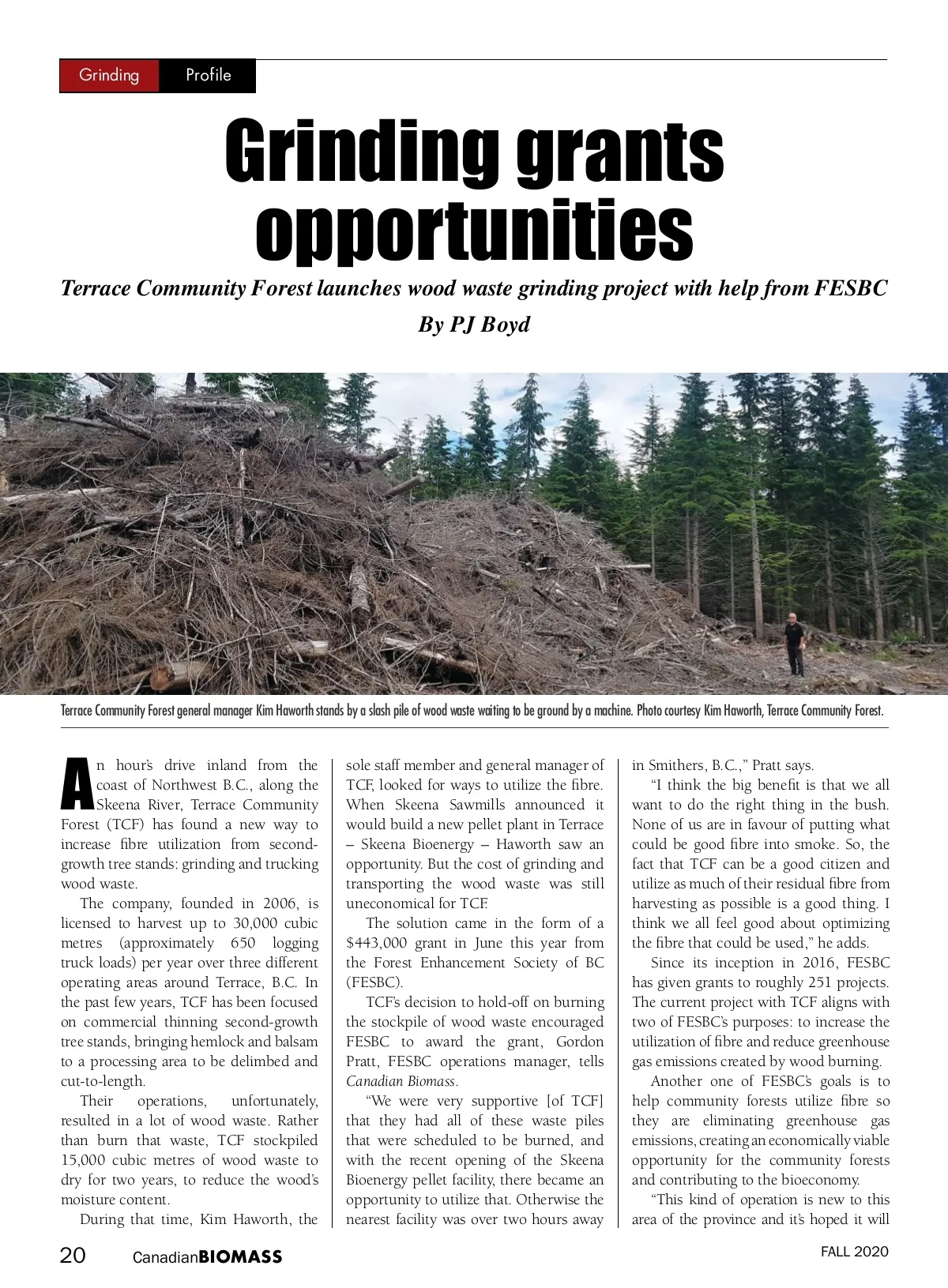
help the community forests get operators to invest in the proper equipment and figure out how to do this economically. Then, over time, it becomes sustainable and funding isn’t required,” Pratt says. GETTING THE JOB DONE GRINDING ACCOMPLISHMENTS TCF began grinding immediately after the grant was approved. Having previously burnt roughly 60,000 cubic metres of tops, limbs and non-merchantable logging material, Haworth was excited to begin the project. For him, it offered a chance to fully utilize the TCF’s timber profile, create four new jobs and minimize the amount of CO 2 equivalent that TCF would have otherwise released into the atmosphere through burning. “I think the main thing with this particular project is that the second-growth management is particularly new in the Northwest. We’re struggling with the small-diameter log in terms of markets,” Haworth says. TCF’s logs are typically exported overseas to China, but this market has become limited because of the amount of beetle-damaged spruce wood being exported to the country at low prices, he explains. But this grinding project opens up a new market for TCF: the wood pellet industry. “It gives us the opportunity to fully utilize the timber profile without distributing that material into the atmosphere,” Haworth says. “I think that’s a really good thing. It creates the jobs necessary to do it and a revenue stream not just for TCF and the local community, but for the provincial government as a whole through the stumpage process. “This money all goes back into the community,” he continues. “Everything that TCF generates in terms of a revenue stream goes back into the community directly, through grants or by allocating funds to the city as a whole. We try to hire as many local people as we can. So, anyone involved in this specific project is a local individual.” As of September, TCF had ground approximately two-thirds of the stockpiled material, which was being shipped to Skeena Bioenergy. “I received enough funding this year to complete the grinding, so by the time the weather rolls around and changes to the point where we can’t grind anymore, I’ll be finished,” Haworth says. He hopes to deliver any remaining material to the plant by early 2021. TCF hires contractors to carry out most of its work, such as layout and supervision, management, tree planting, silviculture and harvesting. For the commercial thinning and grinding operations, TCF contracts Timber Baron Contracting. Logs are harvested using a LX830 Tigercat feller buncher, a 240 Hitachi excavator with a HTH623C Waratah harvesting head, 2954D John Deere swing machines, Tigercat 880 loggers and an 848H John Deere skidder. A Morbark 3200 track horizontal grinder, fed by a Tigercat 880 log loader, is used for the grinding. Timber Baron hauls the logs with a fleet of Kenworth T800 trucks, as well as freightliner haulers for bush grind. TCF also contracts Stardust Contracting Ltd. to haul wood waste using two 53-foot chip trailers with a live floor and tri-axle tractor. Although TCF doesn’t know the exact amount of fibre that has been grinded up until this point, Haworth hopes to have processed 30,000 cubic meters of fibre by the time the project is completed. Operations have not been as efficient as they could have been, Haworth admits, because TCF’s burn piles were not set up with the intention of transferring them to a pellet plant. But, in the future, the amount of fibre that is utilized will increase as they proceed with the knowledge and experience gained from this project. “When we do this moving forward, it’s not going to be in a way that we’re doing it right now. The information that comes out of this is going to change because we will be changing our format when we’re processing this material. Hopefully the information I get from this will allow us to go forward with our own operational funds to do this project,” Haworth says. Moving forward, TCF plans to organize their wood residual piles in a way that meets Skeena Bioenergy’s demands. For this, they will be more proactive in separating tops and limbs for grinding and trucking. TCF also plans to focus on moisture reduction as they work more closely with the pellet plant – especially for their harvested hemlock, which has a high moisture content and consequently requires more time and energy invested in drying. Haworth believes these changes will result in more positive numbers that will grow as the project becomes financially sustainable and begins to generate opportunities for continued grinding operations and more job creation. • ans years Authorized Distributor of Contact Cardinal for all your equipment, parts and service needs! www.cardinalsaw.com [email protected] Follow us Canadian BIOMASS CB_Cardinal_Fall20_CSA.indd 1 21 2020-07-27 10:13 AM
Canadian Biomass Fall 2020: Page 21